Data vs Prediction
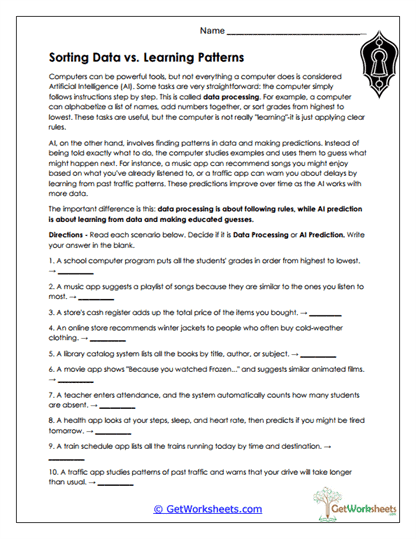
This worksheet is designed for students in Grades 4-6 to build reading comprehension, comparison skills, and critical thinking while exploring how artificial intelligence differs from simple data processing. Through short, clear scenarios, students analyze whether a system is following fixed rules or making predictions based on patterns, helping them understand how AI systems “learn” rather than merely compute.
Learning Goals
- AI Learning vs. Programming (Grades 4-6) – Distinguish between rule-based data processing and AI prediction.
- Reading for Purpose & Comparison – Analyze scenario descriptions to determine key differences in function.
- Classification & Reasoning – Sort examples accurately using logical thinking and evidence from the text.
- Foundational Computer Science Concepts – Recognize how data analysis and prediction are used in AI systems.
Instructional Benefits
- Teacher-Created Resource – Designed by educators to support upper-elementary technology and ELA standards.
- Scenario-Based Learning – Realistic examples make abstract concepts clear and accessible.
- Supports Critical Thinking – Encourages students to justify decisions and explain reasoning.
- Flexible Use – Ideal for STEM integration, literacy instruction, independent practice, or discussion-based lessons.
This printable worksheet helps students develop a clear understanding of how artificial intelligence differs from traditional computing. By comparing data processing and AI prediction, learners strengthen comprehension, reasoning, and decision-making skills while building essential digital literacy. Suitable for classroom or homeschool use, this no-prep activity introduces foundational AI concepts in an engaging, age-appropriate way that supports thoughtful analysis and meaningful discussion.
This worksheet is part of our History of AI collection.
Bookmark Us Now!
New, high-quality worksheets are added every week! Do not miss out!