Shape Connection Path
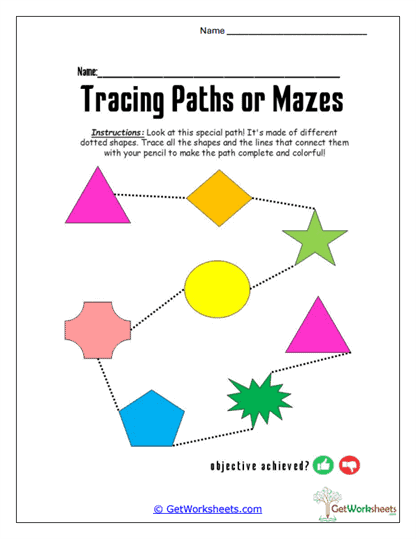
This worksheet helps early learners strengthen fine motor control, visual discrimination, and foundational geometry skills through a structured tracing activity. Students trace dotted outlines of geometric shapes-such as stars, circles, triangles, and polygons-and follow the connecting lines between them, practicing steady pencil movement across multiple angles and line types.
Learning Goals
- Shape Recognition & Geometry Foundations (Early Math)
Students identify and trace a variety of geometric shapes, building familiarity with basic forms. - Fine Motor Tracing Accuracy (Early Childhood)
Learners develop hand steadiness and control by navigating straight lines, curves, and angled paths. - Visual Discrimination & Tracking
Following connected shapes strengthens the ability to distinguish outlines and stay on a continuous path. - Pre-Writing Motor Skills
Consistent pencil pressure and controlled movement prepare students for letter and number formation.
Instructional Benefits
- Teacher-Created Resource
Designed to align with preschool and kindergarten fine motor and early math standards. - Multi-Angle Tracing Practice
Exposes students to varied stroke directions beyond simple lines. - Integrated Math & Motor Learning
Combines geometry awareness with hands-on tracing skill development. - Flexible Classroom Use
Ideal for math centers, morning work, occupational therapy support, independent practice, or homeschool activities.
This printable worksheet turns tracing practice into a meaningful early math experience. By connecting and tracing multiple shapes, students strengthen coordination, visual accuracy, and confidence while building a strong foundation for geometry understanding and handwriting readiness.
This worksheet is part of our Tracing Paths Worksheets collection.
Bookmark Us Now!
New, high-quality worksheets are added every week! Do not miss out!