Emotion in Shadows
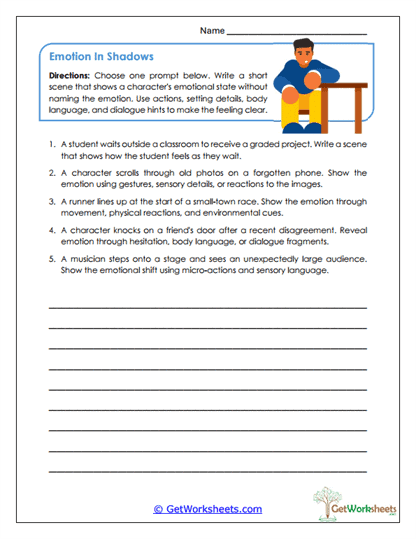
This worksheet is designed for students in Grades 5, 6, and 7 to practice crafting short narrative scenes that communicate emotion through inference rather than explicit labeling. Using structured prompts, learners apply sensory detail, body language, setting cues, dialogue fragments, and purposeful pacing to convey a character’s internal state in a more mature and intentional way.
Instructional Objectives
- Scene-Based Narrative Writing (Grades 5-7)
Construct complete scenes that rely on showing techniques instead of direct emotional statements. - Implicit Emotional Development
Reveal feelings through character behavior, reactions, and environmental interaction. - Sensory and Setting Detail
Use sights, sounds, textures, and atmosphere to support emotional meaning. - Character Depth and Inference
Strengthen characterization by embedding subtle emotional clues for the reader to interpret.
Instructional Support
- Teacher-Friendly Prompts
Clear scenarios make modeling and guided instruction easy and effective. - Assessment-Ready Writing Task
Provides a strong measure of how well students apply show-don’t-tell strategies across an entire scene. - Encourages Higher-Level Thinking
Reinforces inference, intentional word choice, and reader awareness. - Flexible Implementation
Works well for whole-class lessons, writing workshops, or extended practice.
This activity helps students move beyond sentence-level description and into full-scene storytelling that depends on subtle clues and reader interpretation. By focusing on sensory detail, pacing, and character reaction, learners develop stronger narrative control and a deeper understanding of how writers communicate emotion indirectly. It fits naturally into classroom writing units and homeschool language arts programs focused on advanced descriptive writing and inference.
This worksheet is part of our Show, Don’t Tell Techniques Worksheets collection.
Bookmark Us Now!
New, high-quality worksheets are added every week! Do not miss out!