Trial Fairness
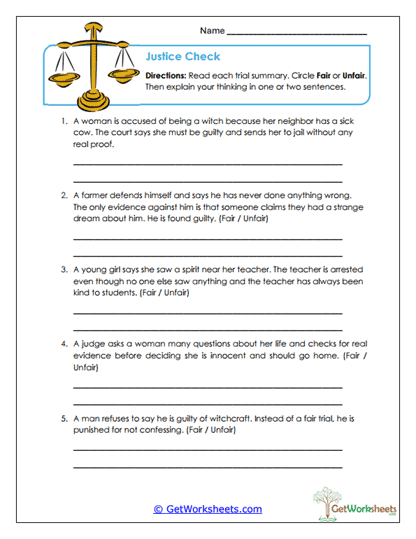
This worksheet helps students in Grades 4 and 5 strengthen critical thinking, moral reasoning, reading comprehension, and written explanation skills by examining trial scenarios inspired by the Salem Witch Trials. Students read brief descriptions of courtroom situations and decide whether each trial was fair or unfair, then explain their reasoning in one or two clear sentences.
Learning Goals
- Understanding Justice & Due Process (Grades 4-5) – Students identify key elements of fair trials, including evidence, rights, and impartial judgment.
- Evaluating Historical Events – Learners analyze how justice was applied-or ignored-during the Salem Witch Trials.
- Opinion Writing with Reasoning – Students clearly state an opinion and support it with logical explanation.
- Analyzing Fairness & Evidence – The activity highlights bias, weak evidence, and flawed legal practices.
Instructional Benefits
- Teacher-Created Resource – Designed by educators to align with elementary social studies and ELA standards.
- Scenario-Based Analysis – Short trial descriptions make abstract legal ideas concrete and accessible.
- Connects Past to Present – Encourages students to compare historical trials with modern ideas of fairness.
- Flexible Classroom Use – Works well for independent work, partner discussion, assessments, or enrichment.
- Low-Prep Printable – Ready for classroom or homeschool use with minimal preparation.
This Trial Fairness worksheet helps students think critically about justice by evaluating historical trial practices and explaining their reasoning. By deciding whether trials were fair or unfair and defending their answers, learners strengthen written expression, ethical reasoning, and understanding of due process-skills that connect historical study to modern civic principles.
This worksheet is part of our Salem Witch Trials Worksheets collection.
Bookmark Us Now!
New, high-quality worksheets are added every week! Do not miss out!