Accusation Sorting
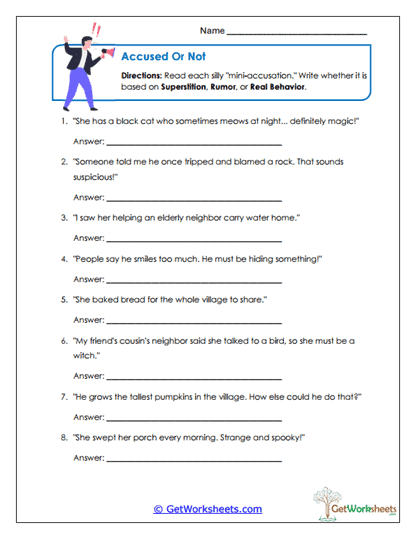
This worksheet helps students in Grades 4 and 5 strengthen critical thinking, reading comprehension, and historical reasoning by examining short “mini-accusations” inspired by the Salem Witch Trials. Students classify each statement as superstition, rumor, or real behavior, learning to distinguish between irrational claims and observable actions while reflecting on the consequences of misinformation.
Learning Goals
- Classifying Claims and Evidence (Grades 4-5) – Students analyze statements to determine validity and type of evidence.
- Understanding Causes of Mass Hysteria – Learners explore how fear, rumor, and superstition contributed to the Salem Witch Trials.
- Interpreting Short Statements – The activity strengthens close reading and attention to detail.
- Recognizing Superstition vs. Reality – Students connect historical events to modern examples of misinformation and false accusations.
Instructional Benefits
- Teacher-Created Resource – Designed by educators to align with elementary social studies and ELA standards.
- Engaging & Accessible Format – Short, humorous statements make abstract ideas concrete and relatable.
- Promotes Discussion – Encourages reflection on evidence, fairness, and the impact of false claims.
- Flexible Classroom Use – Works well for independent practice, partner work, review lessons, or enrichment.
- Low-Prep Printable – Ready for classroom or homeschool use with minimal preparation.
This Accusation Sorting worksheet helps students think critically about the spread of misinformation and its consequences. By classifying claims as superstition, rumor, or reality, learners strengthen comprehension, reasoning, and historical understanding while drawing connections between past hysteria and modern examples of misleading information.
This worksheet is part of our Salem Witch Trials Worksheets collection.
Bookmark Us Now!
New, high-quality worksheets are added every week! Do not miss out!