Spotting Bias in Outputs
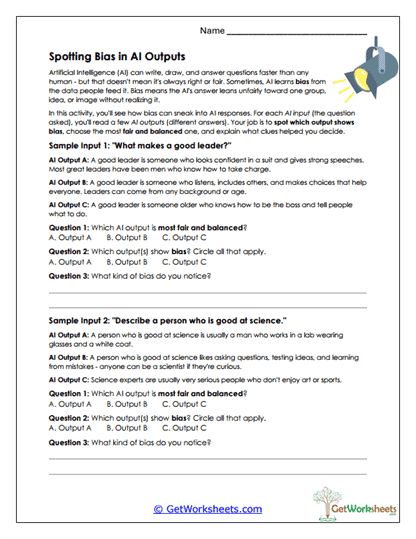
This worksheet helps students in Grades 6, 7, and 8 strengthen critical reading, ethical reasoning, and digital literacy skills by examining AI-generated responses for hidden bias. Students compare multiple outputs created from the same prompt, decide which response is most fair and balanced, and identify which responses include biased language, stereotypes, or unfair assumptions.
Learning Goals
- Evaluating Text for Bias (Grades 6-8) – Students analyze wording and tone to detect biased or unfair language.
- Analyzing Assumptions and Stereotypes – Learners identify hidden assumptions and generalizations in AI-generated responses.
- Comparing Multiple Texts – Students evaluate differences between responses to determine which best meets fairness and accuracy standards.
- Media and Digital Literacy – Students understand how bias can appear in AI-generated information.
Instructional Benefits
- Teacher-Created Resource – Designed by educators with realistic AI output examples and guided questions.
- Low-Prep and Discussion-Ready – Suitable for independent work, partner analysis, or whole-class discussion.
- Builds Ethical Awareness – Encourages thoughtful evaluation of fairness and representation.
- Supports Diverse Learners – Structured comparisons help students focus on specific indicators of bias.
- Cross-Curricular Alignment – Reinforces English Language Arts analysis skills while supporting social studies media literacy and technology literacy.
This printable worksheet helps students become more discerning readers by teaching them how to spot bias in AI-generated content. Through comparison, analysis, and reflection, learners strengthen critical thinking, fairness awareness, and digital-literacy skills. Ideal for classroom or homeschool use, this activity supports responsible evaluation of AI outputs and informed engagement with modern media.
This worksheet is part of our Role of Bias in AI collection.
Bookmark Us Now!
New, high-quality worksheets are added every week! Do not miss out!