Comparing Large Objects
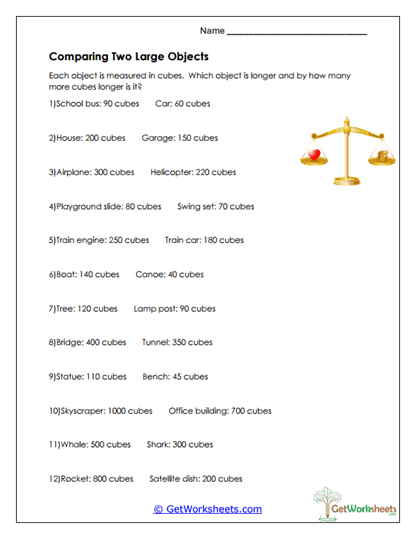
This worksheet is designed for students in Grades 2 and 3 to strengthen measurement understanding by comparing the lengths of large, familiar objects using non-standard units. Through visual comparison, subtraction, numerical reasoning, and spatial awareness, learners determine which object is longer and calculate how many cubes longer it is, connecting arithmetic skills to real-world size relationships.
Learning Goals
- Comparing Lengths & Sizes (Gr. 2-3): Determine which of two large objects is longer using cube units.
- Subtraction as Difference: Calculate how many cubes longer one object is than another.
- Non-Standard Measurement: Build understanding of measurement using consistent, informal units.
- Quantitative Relationships: Develop early algebraic thinking by analyzing and comparing numerical differences.
Instructional Benefits
- Teacher-Created Resource: Designed by educators to align with elementary math measurement standards.
- Real-World Contexts: Familiar objects like buses, cars, houses, and garages make comparisons meaningful.
- Visual & Concrete Reasoning: Cube units help students see and understand length differences clearly.
- Flexible Use: Ideal for math centers, independent practice, small groups, intervention, homework, or homeschool instruction.
This comparing large objects worksheet helps students connect subtraction to measurement in a concrete, visual way. By analyzing size differences using non-standard units, learners strengthen number sense, spatial reasoning, and confidence with comparison tasks. Whether used in the classroom or a homeschool setting, this printable provides engaging, no-prep practice that supports foundational measurement and arithmetic skills.
This worksheet is part of our Non-Standard Units collection.

Bookmark Us Now!
New, high-quality worksheets are added every week! Do not miss out!