Estimating with Non-Standard Units
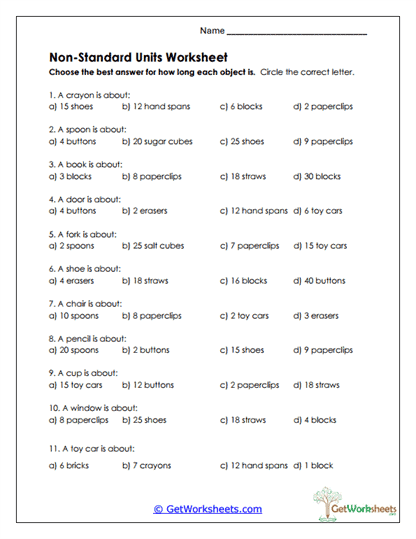
This worksheet is designed for students in Grades 2 and 3 to strengthen estimation and reasoning skills using non-standard units of measurement. By choosing the most reasonable length for everyday objects measured in paperclips, hand spans, toy cars, or blocks, learners practice comparing sizes, thinking about scale, and making logical decisions based on real-world context.
Learning Goals
- Estimation & Reasonableness (Gr. 2-3): Select the most sensible estimate for an object’s length using informal units.
- Understanding Non-Standard Measurement: Build conceptual understanding of how familiar objects can represent measurement units.
- Comparing Object Lengths: Analyze relative size and proportion to eliminate unreasonable choices.
- Measurement Vocabulary & Number Sense: Use terms related to length and size accurately while developing intuition about scale.
Instructional Benefits
- Teacher-Created Resource: Designed by educators to align with elementary measurement standards.
- Multiple-Choice Format: Encourages careful thinking, comparison, and justification of answers.
- Real-World Connections: Familiar objects help students visualize and estimate more effectively.
- Critical Thinking Focus: Emphasizes reasoning and decision-making over exact calculation.
- Flexible Use: Ideal for math centers, independent practice, small groups, assessment review, homework, or homeschool instruction.
This Estimating with Non-Standard Units worksheet helps students develop a strong sense of scale and reasonableness in measurement. By estimating lengths with everyday units, learners strengthen number sense, comparison skills, and confidence making measurement judgments-essential foundations for later work with standard units and precise measurement tools.
This worksheet is part of our Non-Standard Units collection.
Bookmark Us Now!
New, high-quality worksheets are added every week! Do not miss out!