Measurement Riddles – What Am I?
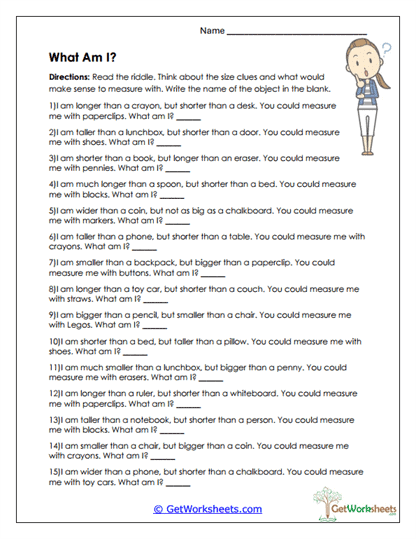
This worksheet is designed for students in Grades 2 and 3 to build strong measurement reasoning skills through engaging, riddle-based problem solving. By reading descriptive clues and thinking about relative size, appropriate non-standard units, estimation, and comparison, learners infer which everyday object best matches each riddle while strengthening logical and spatial thinking.
Learning Goals
- Estimation & Comparison in Measurement (Gr. 2-3): Analyze clues to compare object sizes and determine what makes sense.
- Choosing Appropriate Units: Decide whether objects would reasonably be measured with paperclips, shoes, toy cars, or other non-standard units.
- Deductive & Inferential Reasoning: Use logic and evidence from text to identify the correct object.
- Measurement Vocabulary & Context: Apply language related to size, length, and measurement meaningfully.
Instructional Benefits
- Teacher-Created Resource: Designed by educators to align with elementary math and literacy standards.
- Language-Rich Format: Integrates reading comprehension with mathematical reasoning.
- Engaging Riddle Structure: Motivates students to think deeply and justify their answers.
- Flexible Use: Ideal for math centers, literacy centers, small groups, independent practice, enrichment, homework, or homeschool instruction.
This Measurement Riddles worksheet helps students connect measurement concepts with logical reasoning and language skills. By interpreting clues and considering realistic unit choices, learners strengthen estimation, comparison, and critical thinking in a fun, low-pressure format. Whether used in the classroom or a homeschool setting, this printable provides meaningful, no-prep practice that supports conceptual understanding of measurement and real-world problem solving.
This worksheet is part of our Non-Standard Units of Measurement collection.
Bookmark Us Now!
New, high-quality worksheets are added every week! Do not miss out!