Choosing Measuring Tools
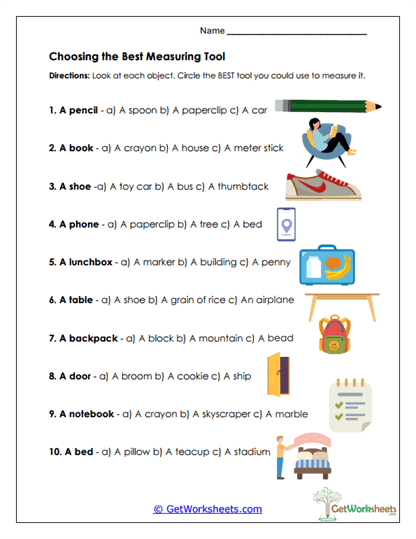
This worksheet is designed for students in Grades 2 and 3 to build practical measurement understanding by selecting the most appropriate tool for measuring everyday objects. Through observation, scale awareness, proportional reasoning, and real-world context, learners decide which tool-such as a ruler, meter stick, or small reference item-makes the most sense for each measurement task.
Learning Goals
- Selecting Appropriate Measurement Tools (Gr. 2-3): Choose tools that match the size and purpose of the object being measured.
- Scale & Proportion Awareness: Understand how object size influences tool selection.
- Observation & Reasoning Skills: Use visual and contextual clues to make logical measurement decisions.
- Real-World Measurement Application: Connect classroom tools to everyday measuring situations.
Instructional Benefits
- Teacher-Created Resource: Designed by educators to align with elementary math and science measurement standards.
- Concept-Focused Practice: Emphasizes why a tool is appropriate rather than performing calculations.
- Student-Friendly Scenarios: Familiar objects like tables, lunchboxes, and classroom items support understanding.
- Flexible Use: Ideal for math centers, independent practice, small groups, intervention, homework, or homeschool instruction.
This Choosing Measuring Tools worksheet helps students develop confidence and judgment when working with measurement tasks. By evaluating scale and practicality, learners strengthen reasoning skills and build a strong foundation for using standard measurement instruments accurately. Whether used in the classroom or a homeschool setting, this printable provides meaningful, no-prep practice that supports real-world measurement literacy.
This worksheet is part of our Non-Standard Units of Measurement collection.
Bookmark Us Now!
New, high-quality worksheets are added every week! Do not miss out!