Guess the Moon
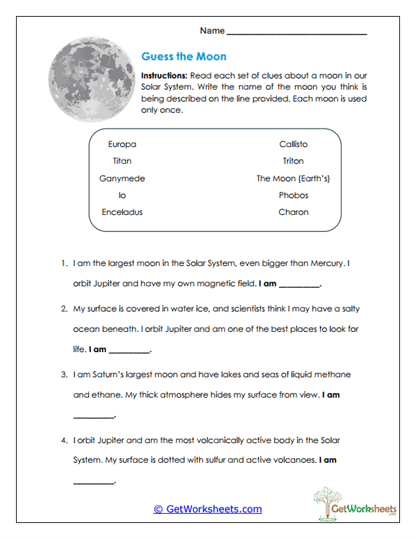
This deductive reasoning worksheet helps students in Grades 4, 5, and 6 apply planetary science knowledge to identify famous moons using descriptive clues and contextual information. Learners analyze statements about geological activity, surface features, atmospheres, and exploration discoveries to match each clue to the correct moon, strengthening scientific reasoning, reading comprehension, and astronomy vocabulary.
Skills Reinforced
- Comparative Moon Science (Grades 4-6) – Distinguish between moons such as Europa, Titan, and Io based on unique physical and geological traits
- Deductive Reasoning – Use evidence from clues to make accurate identifications
- Context Clue Analysis – Interpret informational descriptions to determine correct answers
- Science Literacy Development – Understand how specific moon characteristics contribute to scientific study
Instructional Support
- Teacher-Created Resource – Designed by educators to align with upper elementary space science standards
- Engaging Problem-Solving Format – Encourages thoughtful analysis rather than simple recall
- Clear, Structured Clues – Supports independent work and reduces student frustration
- Flexible Classroom Use – Suitable for science centers, review lessons, formative assessments, or enrichment
- Low-Prep Printable – Ready to use in classroom or homeschool settings
This guess-the-moon worksheet helps students deepen understanding of lunar diversity by connecting scientific features to specific celestial bodies through logical reasoning. By combining reading comprehension, factual recall, and deductive thinking, it strengthens science literacy and critical thinking skills. Whether used in a classroom astronomy unit or a homeschool lesson, this activity provides an engaging way for students to explore how each moon’s unique traits shape our understanding of the Solar System.
This worksheet is part of our Moons and Their Features collection.
Bookmark Us Now!
New, high-quality worksheets are added every week! Do not miss out!