Space Distance Conversions
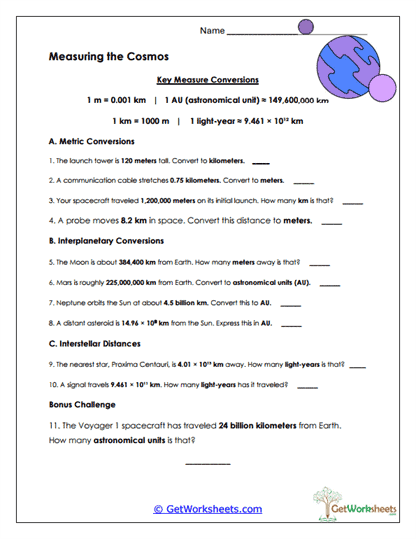
This worksheet supports students in Grades 5 and 6 as they explore distance measurement, metric conversion, scientific notation, and proportional reasoning through the context of space science. By calculating and comparing distances between celestial objects using meters, kilometers, astronomical units (AU), and light-years, learners develop a deeper mathematical understanding of scale while connecting math skills to real astronomical concepts.
Academic Focus
- Metric and Astronomical Conversions (Grades 5-6)
Convert distances between meters, kilometers, astronomical units, and light-years. - Scientific Notation Skills
Use scientific notation to represent and work with extremely large distances. - Proportional and Quantitative Reasoning
Apply ratios and scaling strategies to compare vast spatial measurements. - Space Science Connections
Interpret distances between the Moon, Sun, planets, and nearby stars.
Instructional Benefits
- Teacher-Created Resource
Designed to align with upper-elementary math standards and space science curriculum. - Progressive Skill Structure
Problems move from familiar metric units to abstract astronomical measurements. - Cross-Curricular Learning
Integrates mathematics and science to reinforce understanding in both subjects. - Flexible Classroom Use
Suitable for independent work, enrichment, small groups, STEM lessons, or homework.
This printable worksheet helps students build confidence with metric conversion, scientific notation, and large-scale reasoning through engaging space-based examples. It strengthens mathematical fluency, spatial reasoning, and conceptual understanding of astronomical distances. Whether used in a classroom or homeschool setting, this no-prep resource offers a meaningful way to connect mathematics with the wonders of space.
This worksheet is part of our Measurement Unit Conversion collection.
Bookmark Us Now!
New, high-quality worksheets are added every week! Do not miss out!