Archaeologic Past
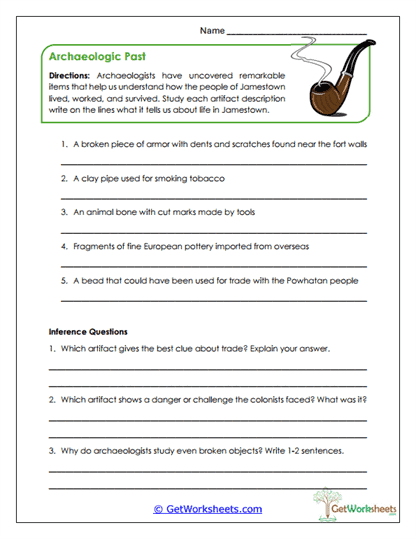
This inquiry-based worksheet supports students in Grades 4, 5, and 6 as they practice making inferences, analyzing evidence, historical reasoning, and close reading. By examining descriptions of real artifacts discovered at Jamestown, students think like archaeologists and use physical evidence to draw conclusions about trade, danger, daily life, and survival in early colonial America.
Learning Goals
- Archaeological Evidence (Grades 4-6) – Analyze artifacts such as armor, beads, and animal bones to understand early colonial life.
- Historical Inference – Draw conclusions about daily survival, conflict, and trade using evidence-based reasoning.
- Making Inferences – Use descriptive clues to infer meaning beyond what is directly stated.
- Historical Thinking Skills – Understand how physical objects support and shape our knowledge of the past.
Instructional Benefits
- Teacher-Created Resource – Designed by educators to align with upper elementary social studies and ELA standards.
- Hands-On Inquiry Format – Encourages active thinking and engagement through artifact analysis.
- Supports Critical Reasoning – Promotes observation, interpretation, and justification of ideas.
- Flexible Use – Ideal for social studies units, small-group work, enrichment activities, or assessments.
This printable worksheet helps students strengthen inference skills, historical interpretation, and analytical thinking by exploring how archaeologists learn from physical evidence. By connecting artifacts to real-life conditions at Jamestown, learners gain a deeper understanding of how history is constructed from clues left behind. It’s a meaningful, no-prep resource that works well in both classroom instruction and homeschool learning.
This worksheet is part of our Jamestown Settlement collection.
Bookmark Us Now!
New, high-quality worksheets are added every week! Do not miss out!