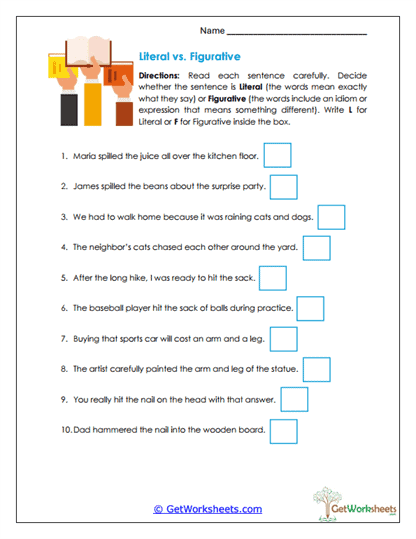
Literal vs. Figurative Sort
This worksheet helps students in Grades 3, 4, and 5 build strong awareness of how language can be used literally or figuratively within sentences. Through careful reading, meaning analysis, figurative language recognition, and comprehension practice, learners decide whether each sentence describes a real action or conveys a nonliteral idea, strengthening overall language interpretation skills.
Academic Focus
- Literal vs. Nonliteral Meaning (Grades 3-5) – Students identify whether sentences are meant to be taken at face value or interpreted figuratively.
- Figurative Language Recognition – Learners practice spotting idioms and expressions that go beyond direct definitions.
- Reading Comprehension and Analysis – The task encourages close reading and thoughtful evaluation of sentence meaning.
- Author’s Intent Awareness – Students consider why an author might choose figurative language to express ideas.
Instructional Benefits
- Teacher-Created Resource – Designed to align with ELA standards and common classroom needs.
- Simple Sorting Format – Clear directions make the activity accessible while still requiring critical thinking.
- Flexible Use – Ideal for independent practice, small groups, homework, or formative assessment.
- Supports Vocabulary Growth – Reinforces understanding of nuanced word meanings and expressions.
This literal versus figurative sorting worksheet helps students improve figurative language awareness, reading comprehension, vocabulary development, and semantic reasoning. By distinguishing between direct statements and expressive language, learners gain confidence interpreting meaning and tone in texts. Whether used in a classroom or homeschool setting, this printable provides focused, no-prep practice with language interpretation and analysis.
This worksheet is part of our idioms and expressions worksheets collection.
Bookmark Us Now!
New, high-quality worksheets are added every week! Do not miss out!