Then vs. Now
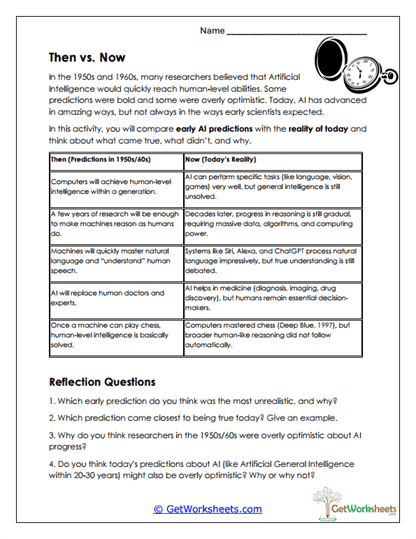
This worksheet is designed for students in Grades 6-8 to build analytical reading, historical reasoning, and critical thinking by comparing early artificial intelligence predictions with modern realities. Students examine optimistic forecasts from the 1950s-60s, analyze which ideas became reality and which did not, and reflect on how scientific limits, data, and technology shaped actual outcomes over time.
Academic Focus
- Interpreting Historical Perspectives (Grades 6-8) – Understand how early scientists viewed the future of artificial intelligence.
- Evaluating Predictions & Outcomes – Compare historical forecasts with real-world AI developments.
- Analytical Reading & Reflection – Use evidence to explain why some predictions succeeded while others failed.
- Evidence-Based Reasoning – Support conclusions with examples from history and modern technology.
Instructional Benefits
- Teacher-Created Resource – Designed by educators to align with middle school ELA, science, and social studies standards.
- Balanced Historical Analysis – Encourages students to consider both optimism and technological limitations.
- Discussion-Ready Format – Reflection questions support debate and classroom conversation.
- Flexible Use – Ideal for history of technology units, STEM integration, or critical thinking lessons.
This printable worksheet helps students understand that technological progress is shaped by expectations, constraints, and real-world challenges. By comparing early AI predictions to today’s capabilities, learners strengthen reasoning, comprehension, and historical awareness. Suitable for classroom or homeschool use, this no-prep activity encourages thoughtful discussion about how humans imagine the future-and how innovation actually unfolds over time.
This worksheet is part of our History of AI collection.
Bookmark Us Now!
New, high-quality worksheets are added every week! Do not miss out!