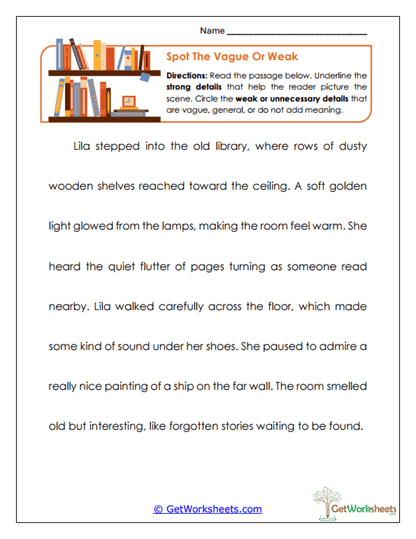
Spot the Vague or Weak
This worksheet helps students in Grades 4, 5, and 6 sharpen descriptive reading and editing skills by closely analyzing a descriptive passage about a library. Students underline effective details and circle weak or vague ones, practicing precision, imagery evaluation, word effectiveness, and clarity while learning how strong description supports setting and meaning.
Learning Goals
- Identifying Strong vs. Weak Details (Grades 4-6) – Distinguish between vivid, meaningful description and vague or filler language.
- Editing for Precision and Clarity – Recognize which details improve understanding and which should be revised or removed.
- Close Reading of Descriptive Text – Analyze author choices at the sentence and word level.
- Improving Word Effectiveness – Understand how specific details strengthen imagery and reader engagement.
Instructional Benefits
- Teacher-Created Resource – Designed by educators to support descriptive writing and revision standards.
- Active Annotation Practice – Underlining and circling keeps students engaged and focused on purpose.
- Flexible Classroom Use – Works well for whole-class modeling, small groups, independent practice, or intervention.
- Prepares Students for Revision – Builds awareness students can apply directly to their own writing.
This printable worksheet helps students learn that not all details contribute equally to a piece of writing. By identifying strong imagery and spotting vague or weak wording, learners build confidence in close reading, editing, and descriptive clarity. It is a simple, no-prep resource for classroom and homeschool settings that strengthens precision, imagery awareness, and effective word choice.
This worksheet is part of our Editing and Revising Descriptive Passages Worksheets collection.

Bookmark Us Now!
New, high-quality worksheets are added every week! Do not miss out!