Curtis’s Stand
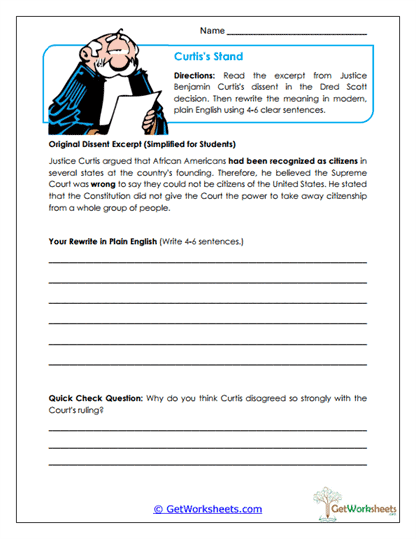
This civics and writing worksheet supports students in Grades 5 and 6 as they practice paraphrasing, constitutional reasoning, critical reading, and analysis of differing viewpoints. By examining Justice Benjamin Curtis’s dissent in the Dred Scott case, students rewrite complex legal arguments in plain language and explain why Curtis disagreed with the majority decision, helping them understand the importance of dissent in a democratic system.
Learning Goals
- Judicial Dissent (Grades 5-6) – Understand the role of dissenting opinions in Supreme Court decisions.
- Constitutional Interpretation – Analyze how different justices can interpret the Constitution in contrasting ways.
- Paraphrasing Complex Texts – Rewrite legal arguments using clear, student-friendly language while preserving meaning.
- Evaluating Arguments – Compare majority and minority viewpoints to understand disagreement and debate in lawmaking.
Instructional Benefits
- Teacher-Created Resource – Designed by educators to align with upper elementary civics, social studies, and ELA standards.
- Plain-Language Focus – Makes challenging legal ideas accessible to developing readers and writers.
- Emphasis on Democratic Principles – Highlights dissent as a vital part of fairness, balance, and justice.
- Flexible Use – Ideal for Supreme Court units, critical thinking lessons, writing practice, or discussion starters.
This printable worksheet helps students strengthen civic understanding, paraphrasing skills, and analytical reasoning by exploring Justice Curtis’s dissent in the Dred Scott case. By examining why disagreement matters in democracy, learners gain insight into constitutional debate and the value of minority viewpoints. It’s a thoughtful, no-prep resource that works well in both classroom instruction and homeschool learning.
This worksheet is part of our Dred Scott Decision collection.
Bookmark Us Now!
New, high-quality worksheets are added every week! Do not miss out!