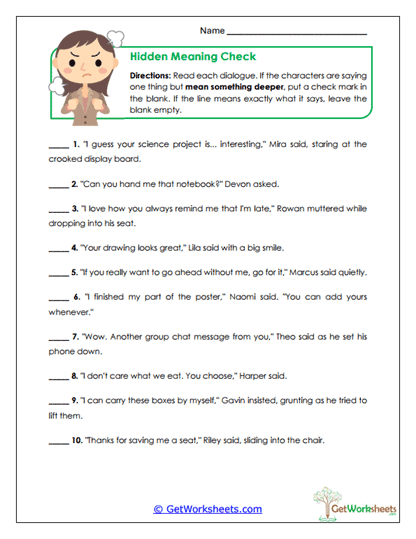
Hidden Meaning Check
This worksheet helps students in Grades 5, 6, and 7 strengthen reading comprehension and narrative analysis by examining dialogue for hidden meaning. Students read individual lines of dialogue and decide whether the speaker is implying something deeper than what is said outright, sharpening skills in inference, tone analysis, context awareness, and interpretation of implied communication.
Learning Goals
- Identifying Subtext (Grades 5-7) – Determine when dialogue contains implied meaning rather than literal intent.
- Making Inferences from Dialogue – Use context clues, tone, and word choice to interpret what characters truly mean.
- Understanding Understatement and Sarcasm – Recognize common forms of indirect communication in dialogue.
- Literal vs. Implied Meaning – Distinguish between surface-level speech and deeper messages.
Instructional Benefits
- Teacher-Created Resource – Designed by educators to support reading comprehension and narrative craft standards.
- Focused Close-Reading Practice – Short dialogue lines encourage careful attention to nuance and intent.
- Supports Both Reading and Writing – Builds skills students can apply when analyzing texts and crafting authentic dialogue.
- Flexible Classroom Use – Works well for warm-ups, small groups, independent practice, or assessment.
This printable worksheet helps students understand that dialogue often communicates more than it says directly. By identifying lines with subtext, learners build confidence in inference, critical thinking, and interpretation of implied meaning. It is a simple, no-prep resource for classroom and homeschool settings that strengthens comprehension, dialogue analysis, and understanding of how characters convey hidden messages.
This worksheet is part of our Dialogue Writing Worksheets collection.
Bookmark Us Now!
New, high-quality worksheets are added every week! Do not miss out!