Say It or Think It
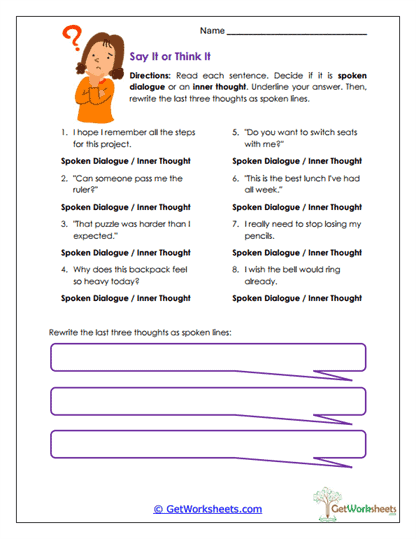
This worksheet helps students in Grades 4, 5, and 6 strengthen narrative comprehension and writing skills by distinguishing between spoken dialogue and internal monologue. By closely reading individual sentences and identifying whether each represents speech or thought, students practice interpreting context clues, wording, and structure before revising inner thoughts into realistic spoken dialogue.
Learning Goals
- Dialogue vs. Internal Monologue (Grades 4-6) – Accurately identify whether a sentence represents spoken words or private thoughts.
- Interpreting Character Expression – Use context and phrasing to determine how a character communicates ideas or emotions.
- Converting Thoughts into Dialogue – Rewrite inner thoughts as spoken lines while maintaining meaning and realism.
- Narrative Communication Choices – Understand when characters should speak aloud versus think silently in storytelling.
Instructional Benefits
- Teacher-Created Resource – Designed by educators to support narrative writing and reading standards.
- Clear, Scaffolded Practice – Identification tasks lead naturally into short revision writing.
- Flexible Classroom Use – Works well for mini-lessons, writing centers, small groups, or independent practice.
- Supports Writing Clarity – Helps students make intentional choices about dialogue use in narratives.
This printable worksheet helps students recognize how writers balance inner thoughts and spoken dialogue to reveal character and advance a story. By identifying and revising internal monologue into dialogue, learners build confidence in narrative clarity, character expression, and effective communication choices. It is a simple, no-prep resource for both classroom and homeschool settings that strengthens dialogue awareness and storytelling skills.
This worksheet is part of our Dialogue Writing Worksheets collection.
Bookmark Us Now!
New, high-quality worksheets are added every week! Do not miss out!