Law in the Colonies
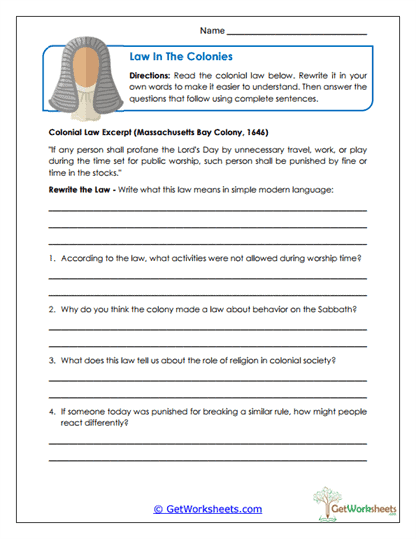
This primary source analysis worksheet supports students in Grades 4, 5, and 6 as they practice historical literacy, paraphrasing, reading comprehension, and civic reflection. By examining an excerpt from a 1646 Massachusetts Bay Colony law about Sabbath observance, students analyze how religion, authority, and community order shaped colonial lawmaking while translating historical language into modern meaning and connecting past governance to present-day views on freedom.
Learning Goals
- Colonial Government & Law (Grades 4-6) – Understand how laws were created and enforced in early colonial communities.
- Primary Source Paraphrasing – Rewrite historical legal language in clear, modern terms while preserving meaning.
- Reading for Meaning – Analyze a primary source excerpt to identify purpose, rules, and underlying values.
- Civic Reflection – Compare colonial legal expectations with modern perspectives on religious freedom and public authority.
Instructional Benefits
- Teacher-Created Resource – Designed by educators to align with upper elementary social studies, civics, and ELA standards.
- Authentic Historical Document – Introduces students to real colonial law in an age-appropriate format.
- Guided Comprehension Questions – Supports thoughtful analysis and evidence-based responses.
- Flexible Use – Ideal for colonial history units, primary source lessons, writing practice, or discussion starters.
This printable worksheet helps students strengthen historical reasoning, paraphrasing skills, and civic understanding by exploring how law, religion, and authority intersected in colonial America. By translating and reflecting on a real 17th-century law, learners gain insight into changing social norms and the evolution of freedom over time. It’s a meaningful, no-prep resource that works well in both classroom instruction and homeschool learning.
This worksheet is part of our Colonial America collection.
Bookmark Us Now!
New, high-quality worksheets are added every week! Do not miss out!