Opposite Continuum
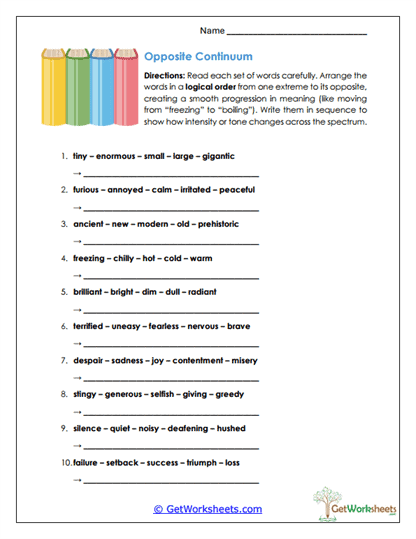
This worksheet is designed for students in Grades 4, 5, and 6 to strengthen vocabulary precision, semantic awareness, and analytical reasoning by exploring words along a continuum of meaning. Instead of treating opposites as simple binaries, learners arrange related words in gradual order-such as tiny → small → large → gigantic-to examine intensity, tone, and subtle shifts in connotation through logical sequencing and inference.
Learning Goals
- Gradient Vocabulary Understanding (Grades 4-6) – Recognize that word meanings exist along a spectrum rather than as fixed opposites.
- Logical Sequencing & Categorization – Arrange words in meaningful order from one extreme to another.
- Precision in Word Meaning & Tone – Analyze how slight changes in wording affect strength, emphasis, and nuance.
- Semantic & Analytical Reasoning – Use inference and comparison to justify placement within a continuum.
Instructional Benefits
- Teacher-Created Resource – Designed by educators to align with upper-elementary ELA vocabulary and reasoning standards.
- Moves Beyond Binary Thinking – Encourages deeper understanding of nuance and degree in language.
- Visual & Cognitive Mapping – Helps students conceptualize relationships between words clearly.
- Flexible Use – Ideal for independent practice, small groups, enrichment, or discussion-based lessons.
- Low-Prep Design – Easy to print and use in classroom or homeschool settings.
This printable worksheet helps students refine vocabulary knowledge by examining how meaning shifts gradually across related words. Through sequencing and analysis, learners improve word choice precision, reading comprehension, and critical thinking about tone and intensity. Whether used in a classroom or homeschool environment, this activity builds sophisticated language awareness and supports confident, nuanced communication.
Bookmark Us Now!
New, high-quality worksheets are added every week! Do not miss out!