Writing a Good AI Prompt Worksheets
About This Worksheet Collection
This collection teaches students how to write strong, clear, and effective AI prompts-one of the most important digital-literacy skills of the modern classroom. Through structured readings, comparison activities, revisions, dissection exercises, and creative prompt-building tasks, learners discover how the quality of a prompt directly shapes the quality of an AI response.
Students explore concepts such as task clarity, context, tone, audience, structure, and constraints. They practice identifying vague or flawed prompts, revising them for specificity, and designing prompts tailored for different purposes. Across the set, students build essential communication and critical-thinking abilities that help them collaborate with AI responsibly and effectively.
Detailed Descriptions Of These Worksheets
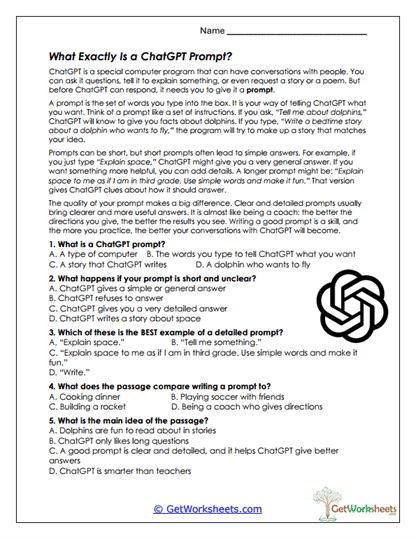
What Exactly Is a ChatGPT Prompt?
Students learn what a prompt is and why clarity matters. After reading an informational passage, they answer multiple-choice questions to reinforce definitions, purpose, and the link between prompt quality and output quality.
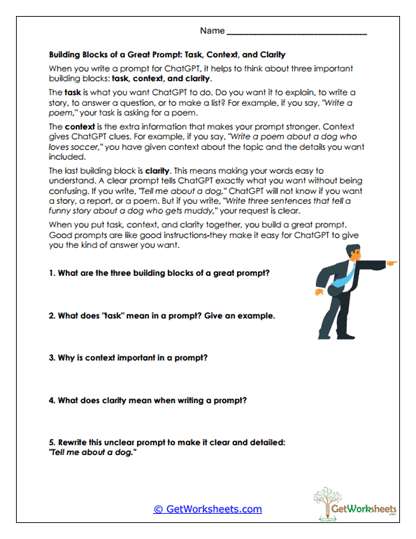
Building Blocks of a Great Prompt: Task, Context, and Clarity
Learners explore three core components of strong prompts and practice rewriting a weak prompt. This builds foundational skills in identifying essential information and structuring instructions.
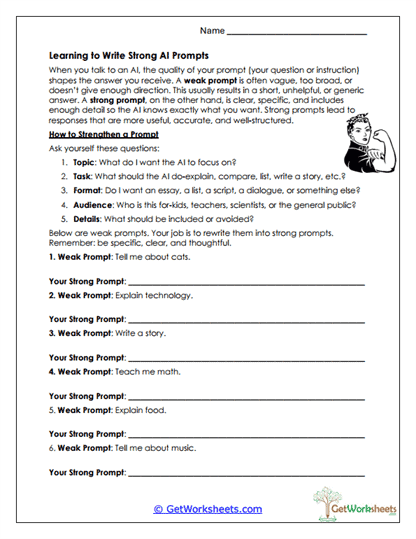
Learning to Write Strong AI Prompts
Students transform vague prompts into strong ones by adding topic, task, format, audience, and details. The activity reinforces instructional clarity and purposeful revision.
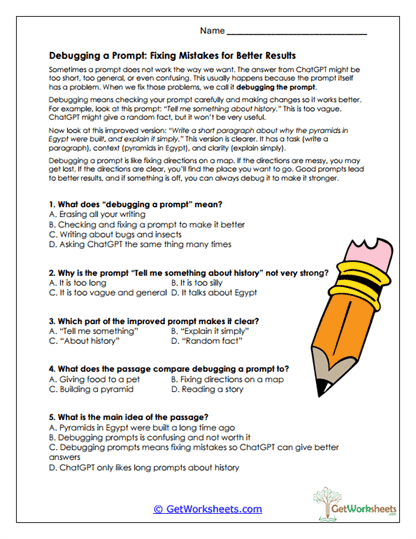
Debugging a Prompt: Fixing Mistakes for Better Results
Through reading and multiple-choice questions, students learn how to "debug" prompts by spotting vague, confusing, or incomplete instructions. This strengthens editing and troubleshooting skills.
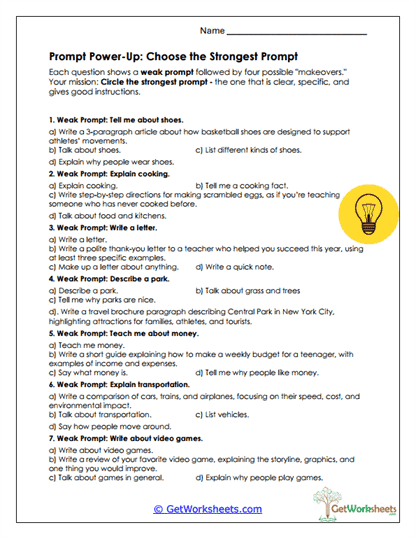
Prompt Power-Up: Choose the Strongest Prompt
Learners compare multiple versions of a prompt and select the strongest one. This helps them recognize what clear, detailed instructions look like and builds decision-making skills.
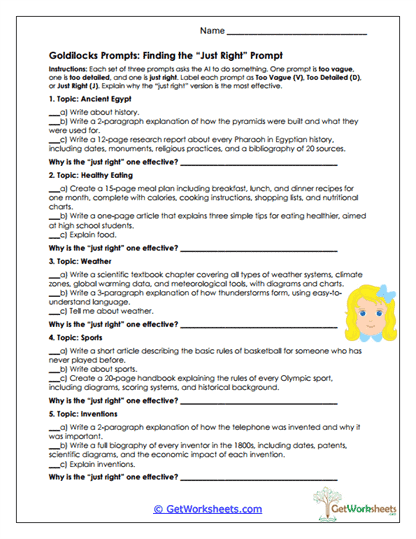
Goldilocks Prompts: Finding the "Just Right" Prompt
Students label prompts as too vague, too detailed, or "just right," and explain their reasoning. This teaches balance-enough detail to guide the AI without overwhelming it.
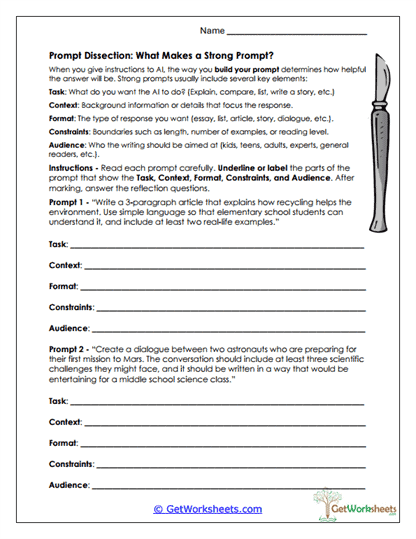
Prompt Dissection: What Makes a Strong Prompt?
Learners break down sample prompts into Task, Context, Format, Constraints, and Audience. Annotation and reflection strengthen structural understanding of effective prompts.
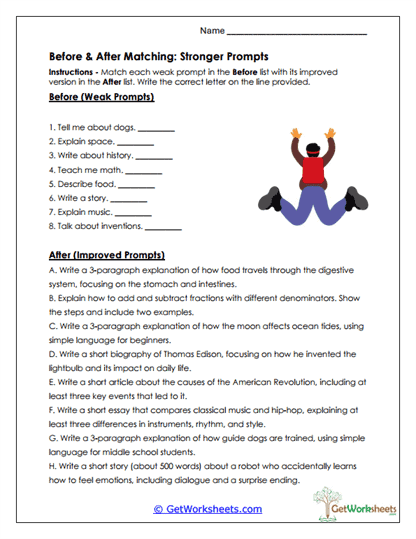
Before & After Matching: Stronger Prompts
Students match weak prompts to their improved versions. This helps them recognize how clarity, focus, and detail transform instructions.
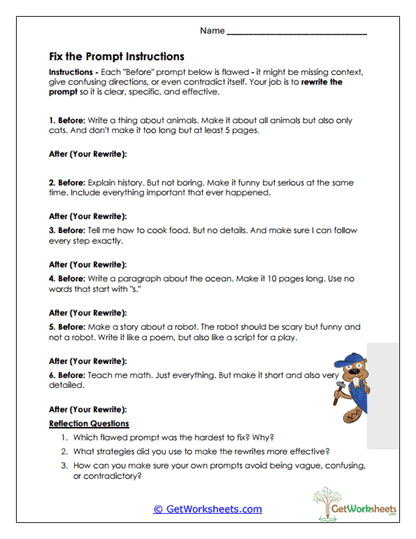
Fix the Prompt Instructions
Learners revise flawed prompts-contradictory, vague, or missing context-into effective versions. Reflection questions deepen metacognitive thinking about revision strategy.
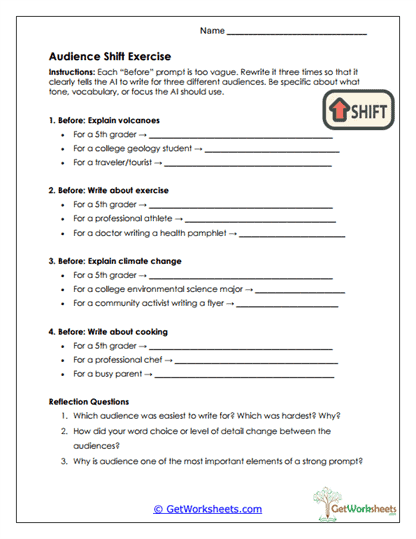
Audience Shift Exercise
Students rewrite prompts for three different audiences, adjusting tone, vocabulary, complexity, and purpose. This builds audience awareness and communication flexibility.
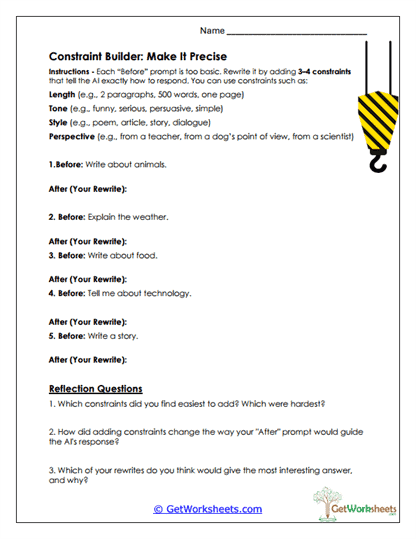
Constraint Builder: Make It Precise
Learners strengthen vague prompts by adding constraints such as tone, word count, style, or perspective. This teaches how constraints guide AI output and improve usefulness.
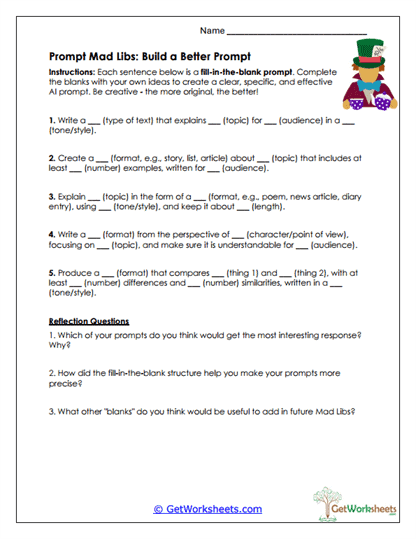
Prompt Mad Libs: Build a Better Prompt
Students complete structured prompt templates by filling in blanks for topic, tone, format, examples, and more. This creative activity reinforces how structured prompts improve clarity and encourages imaginative experimentation.
Bookmark Us Now!
New, high-quality worksheets are added every week! Do not miss out!