Volume Worksheets
About This Worksheet Collection
The Volume worksheet collection gives students a strong foundation in understanding how three-dimensional objects occupy space and how their measurements relate to one another. Each worksheet introduces a different solid-ranging from cubes and prisms to cylinders, cones, pyramids, and spheres-and gradually advances to composite and real-world examples. Students learn to identify key dimensions, apply the appropriate formulas in words, and interpret what volume means in everyday contexts such as packaging, construction, and design. The sequence moves from guided practice to independent reasoning, helping learners visualize, compute, and explain geometric relationships with confidence.
By completing these activities, students build essential geometry and measurement skills while strengthening accuracy, proportional reasoning, and spatial awareness. They connect math to science and daily life, learning how different shapes are measured and compared. Whether calculating the space inside a box, the capacity of a cylinder, or the combined volume of complex objects, students develop a clear, practical understanding of how mathematics describes the physical world.
Detailed Descriptions Of These Worksheets
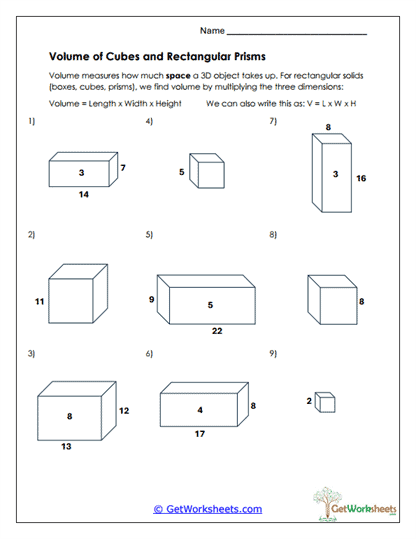
Cubes and Rectangular Prisms
Students practice finding how much space is inside cubes and rectangular boxes by multiplying the object's length, width, and height. The diagrams help learners see how the three dimensions work together to determine volume. This activity builds multiplication fluency and real-world connections to familiar objects like storage boxes and containers.
Triangular Prisms
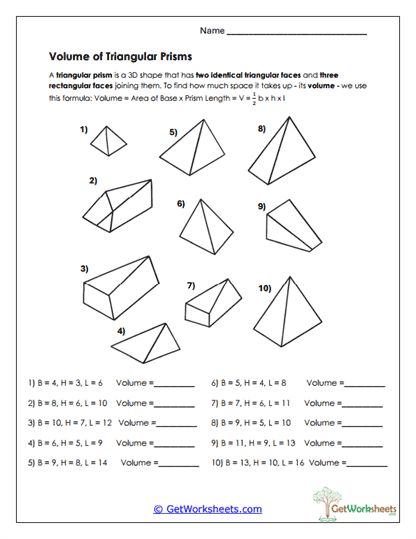
Learners calculate the space inside triangular prisms by finding the area of the triangle at the base and then multiplying it by how long the prism extends. Visual models guide students in identifying each dimension. The worksheet develops understanding of how flat shapes extend into solids and how to use fractional reasoning in measurement.
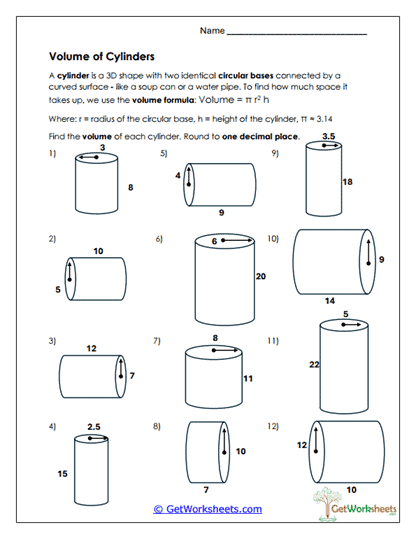
Cylinders
Students determine how much space a cylinder holds by finding the area of its circular base and multiplying by its height. The activity emphasizes accuracy with circular measurements and rounding, helping learners connect two-dimensional circles to three-dimensional forms like cans, tubes, or pipes.
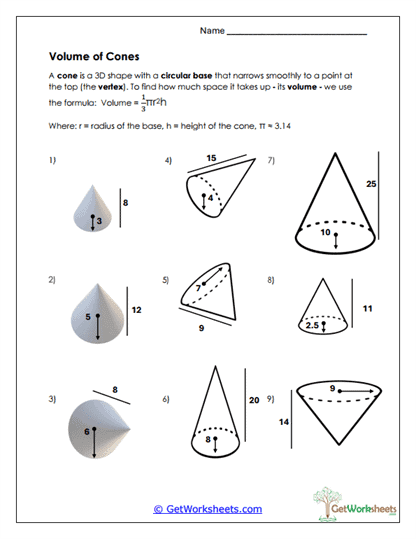
Cones
In this exercise, students find the amount of space inside cones by comparing them to cylinders of the same base and height, understanding that a cone holds one-third as much. They strengthen their skills in reasoning with fractions, precision in computation, and visualization of curved surfaces.
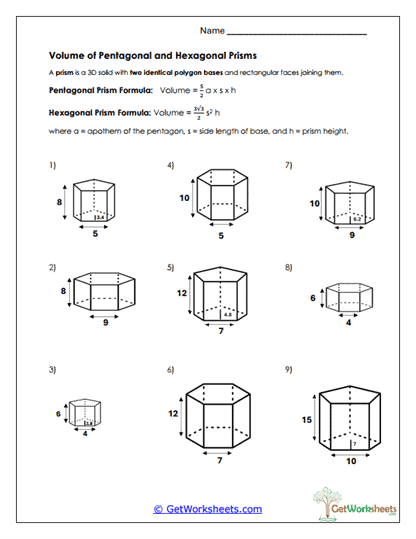
Pentagonal and Hexagonal Prisms
This worksheet challenges students to work with prisms that have polygon-shaped bases such as pentagons and hexagons. Learners calculate the area of each base and multiply by the prism's height to find its volume. They extend their understanding of how complex flat shapes form solid figures when extended through space.
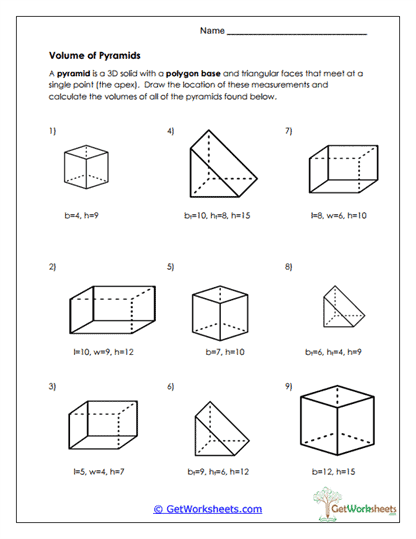
Pyramids
Students find the volume of pyramids by multiplying the area of the base by the height and then dividing by three. The worksheet illustrates how tapering affects the amount of space inside a shape. Learners improve proportional reasoning and spatial visualization while interpreting how the pyramid's structure reduces total volume.
Spheres
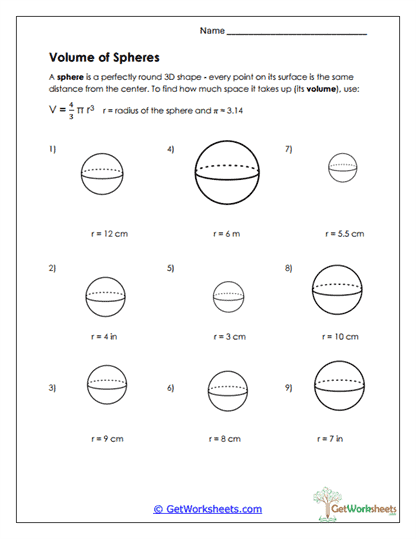
Learners explore the relationship between the radius of a sphere and how much space it encloses. They calculate volume by using repeated multiplication of the radius and applying a constant factor that connects the sphere's surface to its interior. The activity reinforces exponential thinking and accurate rounding.
Triangular Pyramids
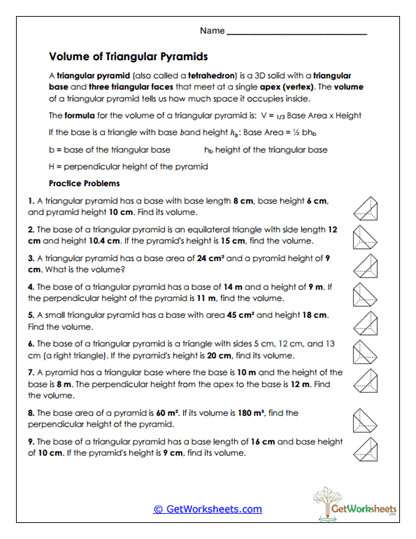
Students calculate the space inside triangular pyramids by finding the area of the base triangle, multiplying by the height, and dividing by three. The activity builds comprehension of fractional relationships in solids and promotes visualization of how smaller shapes combine to form complete figures.
Rectangular Pyramids
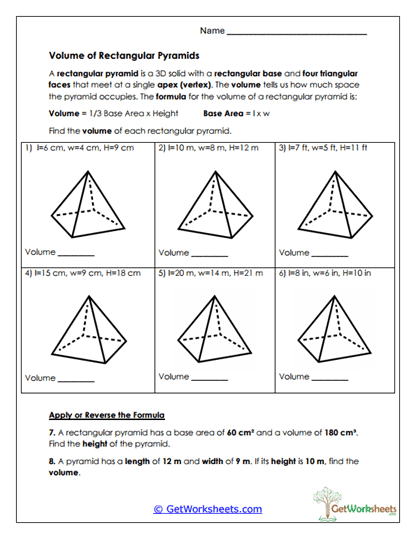
This worksheet guides students through finding the volume of rectangular pyramids by multiplying the base's length and width with its height, then taking one-third of that result. Learners apply reasoning about dimensions, scaling, and proportionality while reinforcing multiplication and division accuracy.
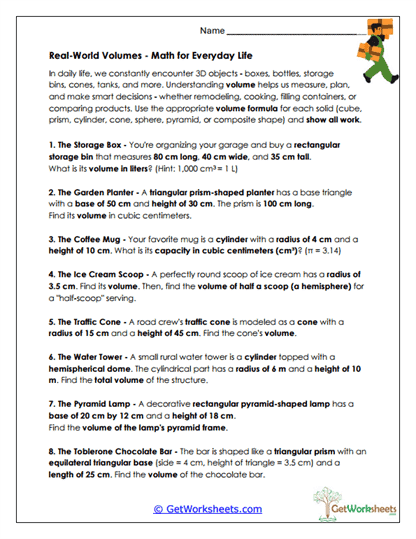
Real-World Volume Applications
Students solve everyday problems that involve calculating how much space objects hold-such as boxes, tanks, or containers. They learn to identify which formula applies, substitute given values, and interpret results with correct units. The worksheet connects abstract formulas to realistic problem-solving and practical reasoning.
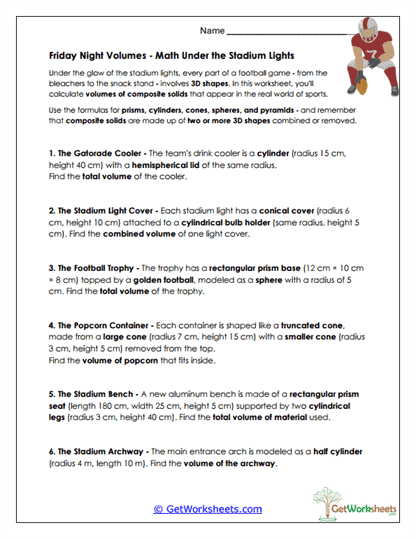
Friday Night Volumes
Using sports and stadium examples, students apply their knowledge of volume by finding the combined space of various objects like coolers, benches, and trophies. They add and subtract volumes of different solids to find total capacity, reinforcing both geometric reasoning and real-world applications.
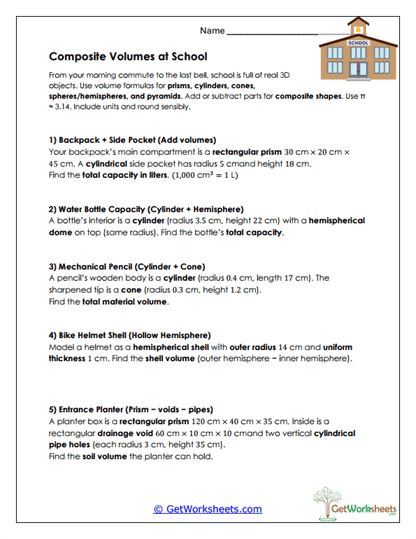
Composite Volumes at School
Learners calculate how much space is inside composite objects modeled after everyday school items such as bottles, helmets, and planters. They practice breaking complex figures into simpler shapes, finding each part's volume, and combining the results. This activity promotes higher-level spatial reasoning and strengthens problem-solving with multiple solids.
Bookmark Us Now!
New, high-quality worksheets are added every week! Do not miss out!