Time Zones Worksheets
About This Worksheet Collection
The Time Zones and Their Basis collection helps students understand how Earth's rotation, longitude, and global cooperation shape the measurement of time. Through activities that combine geography, science, math, and social studies, learners explore why time zones exist, how they are calculated, and how they affect travel, communication, and daily life around the world.
These worksheets develop both conceptual and practical understanding, from converting times between major cities to reflecting on how humans coordinate activities globally. Students practice reading data, sequencing events, and applying reasoning to real-world situations like international meetings or airline scheduling. The collection blends factual knowledge with critical thinking to show how science and society work together to organize the rhythms of modern life.
Detailed Descriptions Of These Worksheets
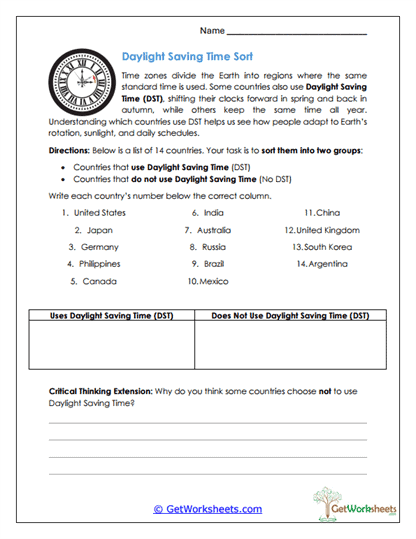
Daylight Saving Time Sort
Students sort countries into two groups-those that use Daylight Saving Time and those that do not-while learning how geography and sunlight distribution influence policy. A reflection task asks why some nations avoid DST. The activity promotes global comparison and awareness of cultural differences in timekeeping. It builds reasoning about how environment and society shape time systems.
Event Ordering
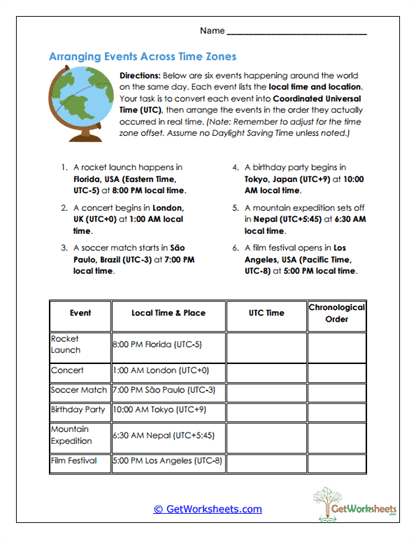
Learners convert event times from multiple world cities into Coordinated Universal Time (UTC) and then arrange them in chronological order. The exercise reinforces math skills, sequencing, and understanding of Earth's rotation. Students practice interpreting offsets and see how time zones synchronize global communication. It builds analytical and applied reasoning for real-world coordination.
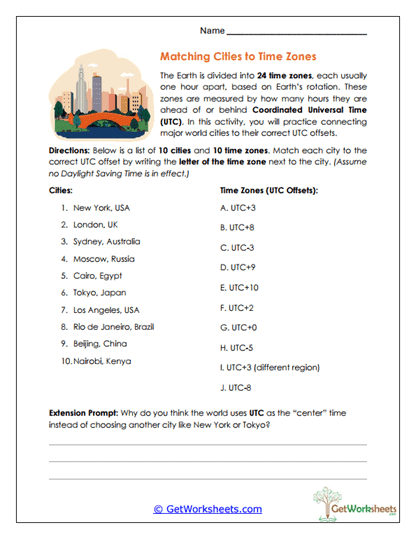
City-Time Zone Match
Students match ten world cities to their correct UTC offsets and explain why UTC serves as the global standard. This task promotes geographic literacy and awareness of international cooperation. Learners strengthen reasoning about why a shared time reference supports travel, trade, and communication.
Longitude and Global Time
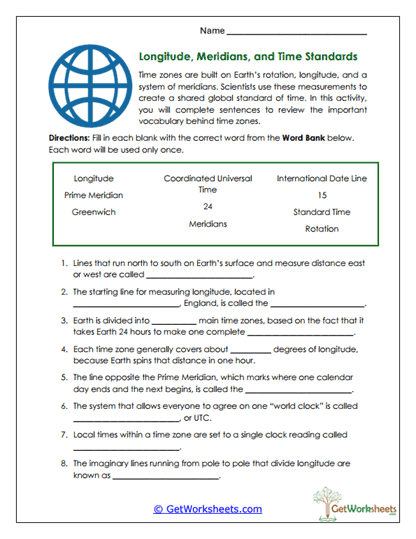
In this fill-in-the-blank worksheet, students apply key vocabulary like longitude, Prime Meridian, and International Date Line. Each sentence connects physical geography to time division. The task develops understanding of Earth's grid system and reinforces spatial reasoning. It also builds vocabulary precision within a scientific context.
Origins Quiz
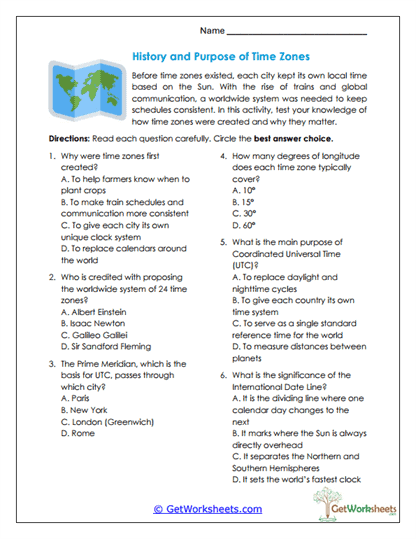
This multiple-choice quiz assesses knowledge of how and why time zones were created. Students learn about pioneers like Sir Sandford Fleming and the historical need for global standardization. The quiz integrates history and science to highlight how innovation in timekeeping transformed transportation and communication.
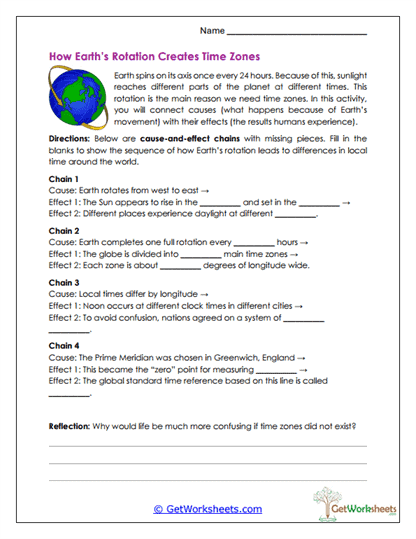
Earth's Rotation and Time
Learners complete cause-and-effect charts showing how Earth's rotation produces day and night, leading to the establishment of 24 time zones. A reflection prompt invites students to imagine a world without standardized time. This worksheet promotes logical sequencing and conceptual understanding of rotation-based time measurement.
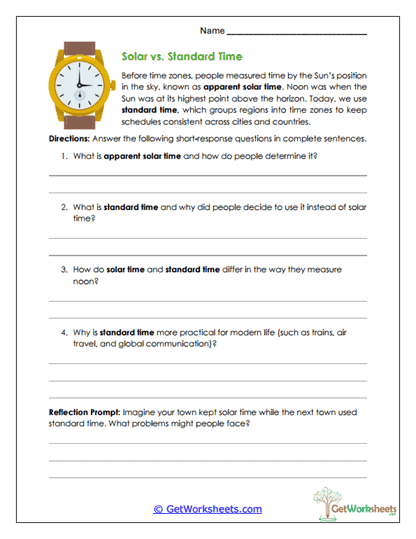
Solar vs. Standard Time
Students compare solar and standard time, explaining why humanity transitioned from local to standardized systems. They respond to short written prompts exploring the practicality of each method. The activity builds historical reasoning and appreciation for technological progress. It reinforces understanding of why global consistency became essential.
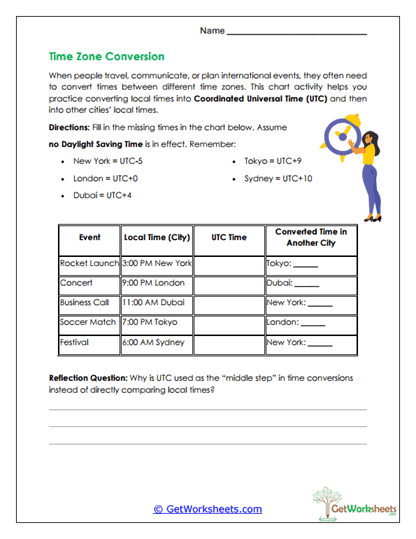
Converting Global Times
Learners calculate time conversions between major cities using UTC as a base reference. The chart format promotes accuracy and visual organization. A reflection question encourages understanding of UTC's importance for fairness and coordination. The task integrates arithmetic, geography, and global reasoning.
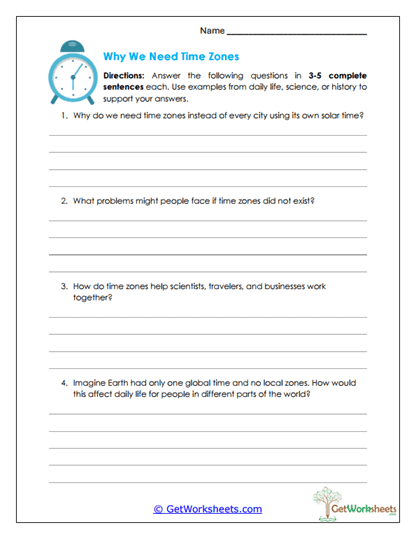
Why They Matter
This open-ended worksheet asks students to write about why time zones exist, their global importance, and potential consequences of having only one universal time. It blends science with social reasoning. The exercise builds argumentation and perspective-taking about how time structures modern civilization.
Fixing Errors
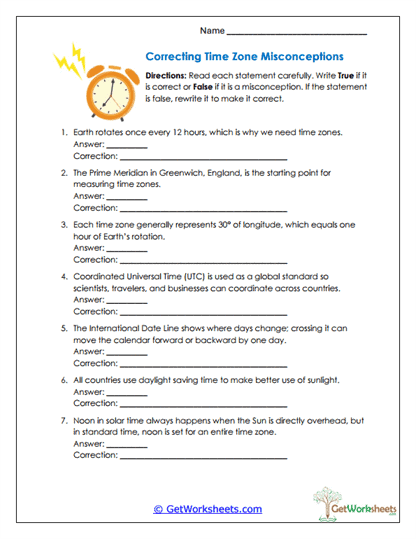
Students identify and correct false statements about time zones, UTC, and Earth's rotation. The activity reinforces conceptual understanding through evaluation and revision. It encourages accuracy and strengthens comprehension of common misconceptions in geography and science.
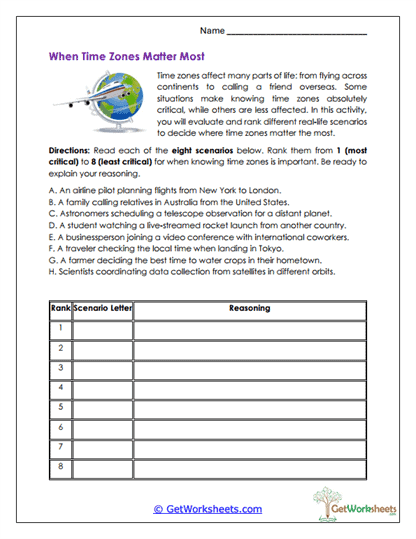
When They Matter
Learners rank eight real-life professions and situations by how much they rely on accurate time zone knowledge. They justify their choices through written reasoning. The task promotes prioritization, analysis, and awareness of global interdependence. It connects classroom learning to real-world careers and technology.
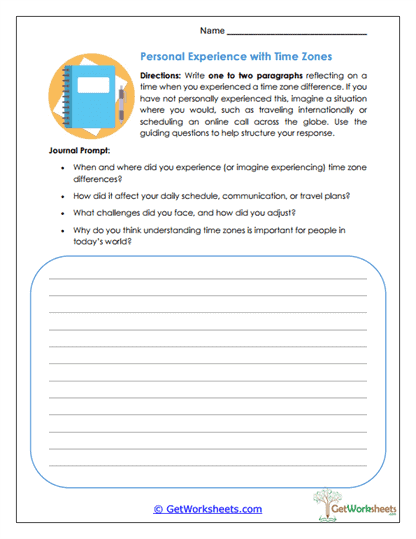
Reflections
In this journal-style worksheet, students write about personal or imagined experiences involving time zone changes, travel, or global communication. Guiding questions encourage empathy and insight into modern connected life. The activity fosters self-awareness and global perspective while applying time zone knowledge meaningfully.
Bookmark Us Now!
New, high-quality worksheets are added every week! Do not miss out!