The Sun Worksheets
About This Worksheet Collection
The Sun collection helps students uncover the science behind our star-the source of light, warmth, and life on Earth. These worksheets blend astronomy, physics, and literacy to explain how the Sun functions, influences Earth's systems, and drives renewable energy. Through reading passages, vocabulary games, cause-and-effect charts, and writing prompts, learners deepen their understanding of solar structure, energy production, and interactions between the Sun and our planet.
Each activity supports critical thinking, scientific reasoning, and creative expression. Students learn how the Sun's stability sustains life, how solar activity affects technology, and how humans can harness sunlight for energy. The collection encourages appreciation of the Sun as both a scientific phenomenon and a daily source of inspiration, making complex space concepts accessible and engaging.
Detailed Descriptions Of These Worksheets
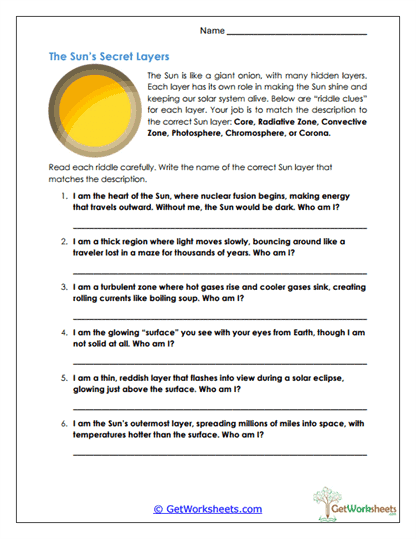
Solar Layer Riddles
Students solve riddle-style clues describing the Sun's layers, identifying terms like core, radiative zone, and corona. Each clue emphasizes the layer's role in producing or transferring energy. Learners use inference and context to make accurate matches. The activity reinforces comprehension of the Sun's structure and its processes of energy flow.
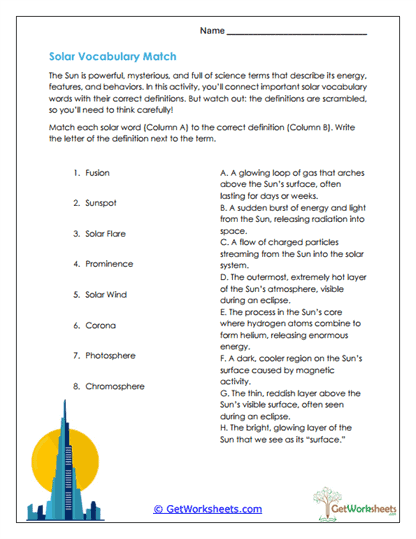
Solar Term Match
Learners match solar vocabulary words-such as fusion, sunspot, and solar flare-to detailed definitions. The exercise strengthens scientific terminology and reading precision. It supports memory retention through context-based clues. Students develop a clearer understanding of solar activity and atmospheric features.
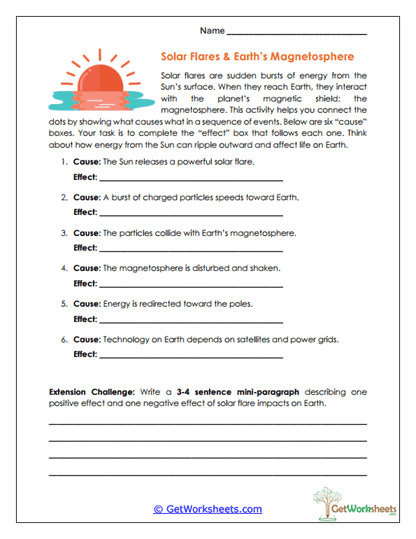
Solar Flare Effects
In this cause-and-effect activity, students link solar events to real-world outcomes like satellite interference or auroras. Each example connects solar energy and magnetic effects to changes on Earth. Learners also write a paragraph explaining benefits and risks of solar flares. This worksheet promotes logical reasoning and scientific communication.
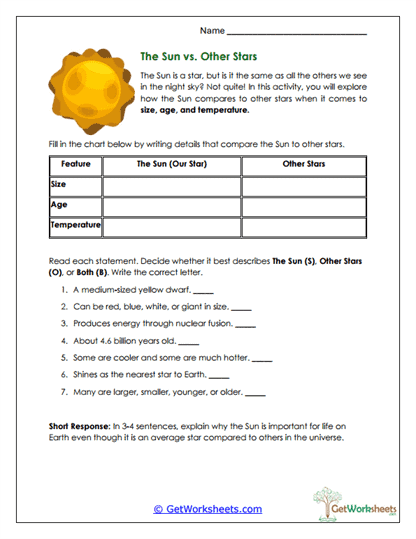
Sun Star Comparison
Students compare the Sun to other stars using a chart and sorting exercise. They note similarities and differences in size, color, and temperature, then explain why the Sun is vital to Earth. The activity builds comparative reasoning. It helps learners recognize the Sun as one of many stars yet unique in its life-sustaining role.
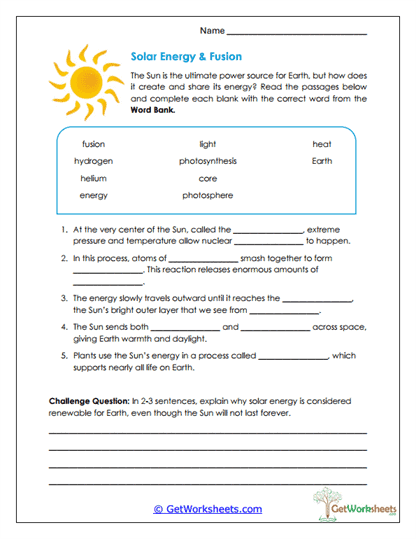
Solar Fusion Fill-In
Learners complete an informational passage about nuclear fusion using a word bank of key science terms. Sentences explain how hydrogen atoms combine to form helium and release energy. A short writing question encourages reflection on renewable energy. This cloze task integrates vocabulary, comprehension, and scientific reasoning.
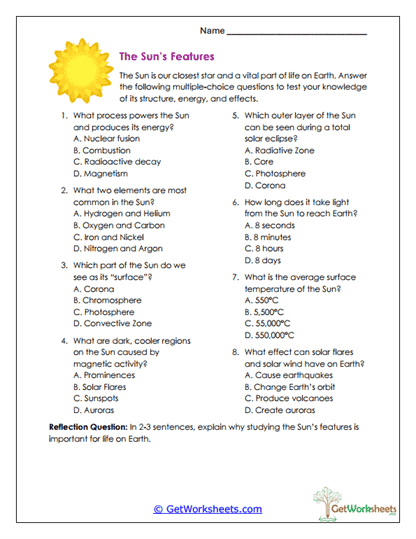
Sun Features Quiz
This multiple-choice quiz reviews concepts such as the Sun's layers, elements, and magnetic activity. Students identify correct answers about solar phenomena, energy transfer, and visible regions. A reflection question asks why studying the Sun matters for life on Earth. The worksheet provides a balanced mix of recall and application.
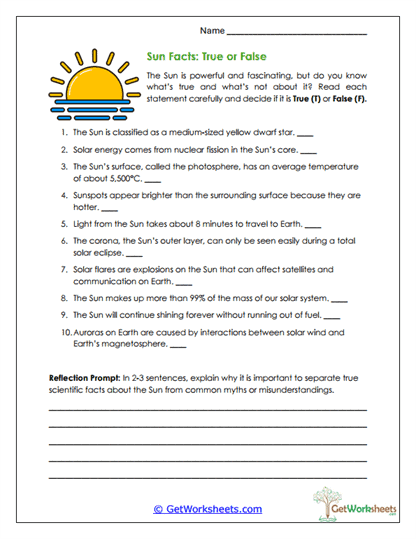
Sun Facts Check
Students determine whether statements about the Sun are true or false, evaluating facts on solar temperature, energy, and structure. They then explain why distinguishing scientific truth from myth is important. The activity encourages critical reading and fact-based reasoning. It clarifies key misconceptions about solar science.
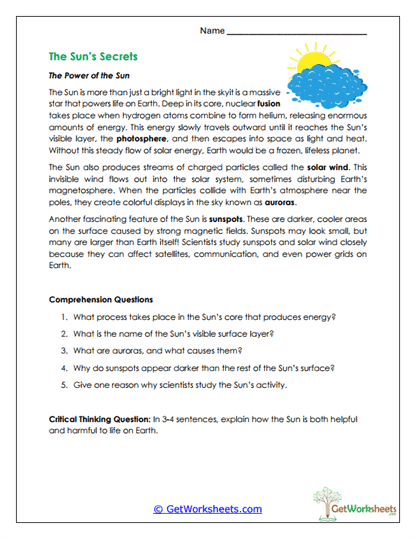
Solar Secrets Reading
Learners read a passage on nuclear fusion, solar wind, and the Sun's dual effects on Earth. Comprehension and critical-thinking questions follow, prompting explanations and synthesis. The worksheet integrates literacy and science by requiring evidence-based written responses. It builds both understanding and communication skills.
Solar Energy Uses
Students match real-world scenarios to specific solar energy technologies, such as panels, ovens, and heaters. The exercise connects scientific ideas to environmental applications. A short reflection encourages students to explain solar energy's ecological benefits. This worksheet blends sustainability education with practical science.
Solar Activity Impacts
Learners analyze four examples of solar activity-flares, winds, and ejections-and describe their effects on Earth. Structured charts help organize cause-and-effect reasoning. A reflection question emphasizes why solar monitoring is essential. The activity fosters applied understanding of space weather and its technological influence.
Effects of Solar Change
Students respond to hypothetical questions about how increases or decreases in solar energy would affect Earth's systems. Each open-ended prompt requires logical and creative reasoning. Learners connect solar balance to temperature, ecosystems, and human life. The task builds advanced comprehension and environmental awareness.
A Day Without Sunlight
This creative writing worksheet challenges students to imagine a world where the Sun fails to rise for a day. They describe environmental, emotional, and biological consequences in a short story. A reflection question ties the narrative to scientific concepts. The activity blends imaginative storytelling with real solar science.
Bookmark Us Now!
New, high-quality worksheets are added every week! Do not miss out!