Synonyms Worksheets
About This Worksheet Collection
The Synonyms worksheet collection transforms vocabulary practice from simple memorization into an exploration of precision, tone, and intent. Students learn that while words may share similar meanings, no two are truly identical-each carries a specific flavor that shapes how sentences sound and feel. Through comparison, rewriting, categorizing, and tone analysis, learners gain a nuanced command of language that sharpens both reading comprehension and expressive writing.
Each worksheet invites active decision-making: learners must choose, justify, or create synonyms that preserve meaning while shifting intensity, register, or emotion. The result is a deepened appreciation for word choice as a tool for clarity, persuasion, and creativity.
Detailed Descriptions Of These Worksheets
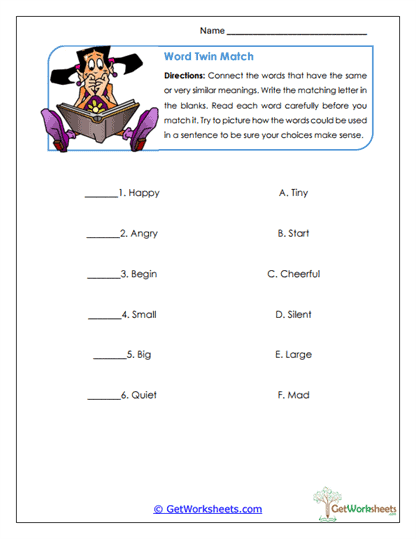
Word Twin Match
In this foundational activity, students match common word pairs-happy-cheerful, angry-mad, brave-courageous-to reinforce the concept of synonymy. But beyond simple pairing, the worksheet encourages learners to imagine real-life scenarios where each pair fits naturally, strengthening retention through context. This activity is ideal for building early confidence in word relationships and for reinforcing that synonyms aren't just interchangeable-they're contextual partners in meaning.
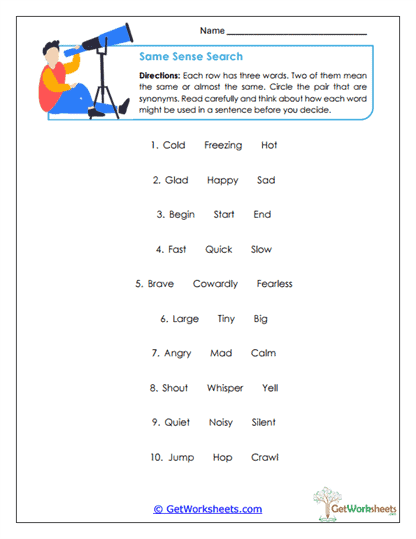
Same Sense Search
Learners analyze trios of words, circling the two that share similar meanings. For example: cold, freezing, hot. The exercise introduces "degrees of similarity," prompting students to reason through shades of meaning rather than relying on rote memory. Through comparison, they develop a mental hierarchy of intensity and formality-skills essential for richer, more precise writing and comprehension.
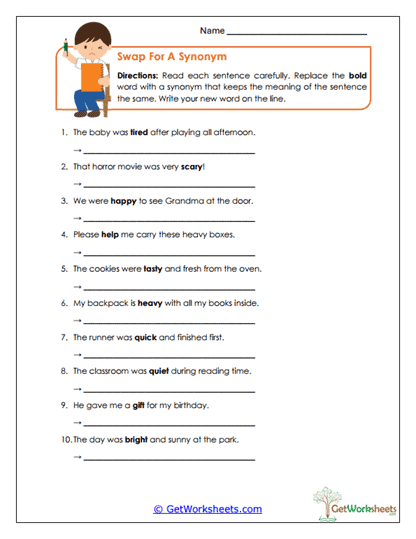
Swap for a Synonym
Here, students replace bolded words in sentences with fitting synonyms while keeping the sentence's tone and intent intact. The focus is not just substitution, but preservation of meaning. A sentence with "tired" might shift to "sleepy" or "exhausted," depending on context. This activity doubles as a mini writing workshop: it improves revision skills, strengthens vocabulary flexibility, and reinforces that great writers are expert word-swappers.
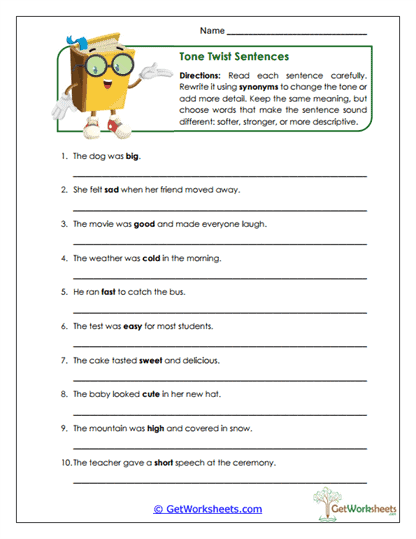
Tone Twist Sentences
Students see how swapping synonyms changes tone and mood. Turning big into enormous amplifies impact, while changing sad to heartbroken deepens emotion. Learners rewrite sample sentences to test how their synonym choices reshape meaning. This worksheet bridges creative writing with stylistic analysis-showing that synonyms aren't equal substitutes, but tools for emotional color and precision.
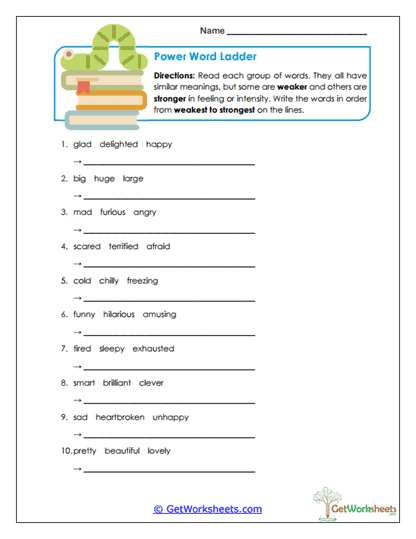
Power Word Ladder
In this "vocabulary gradient," students arrange sets of synonyms by intensity-from cold → chilly → freezing or happy → glad → ecstatic. The visual ladder helps them internalize the concept of degrees in meaning, giving them language to match exact emotional or descriptive levels. It's an excellent scaffold for descriptive and persuasive writing, where word strength matters.
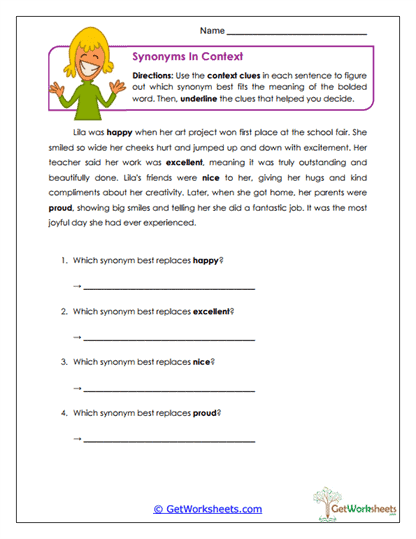
Synonyms in Context
Through a short reading passage, students identify and replace target words like happy, excellent, or proud with stronger or more precise synonyms based on contextual clues. They underline evidence that guided their choice, reinforcing text-based reasoning. This worksheet bridges reading comprehension with word-learning-students learn to infer meaning, not just recall it.
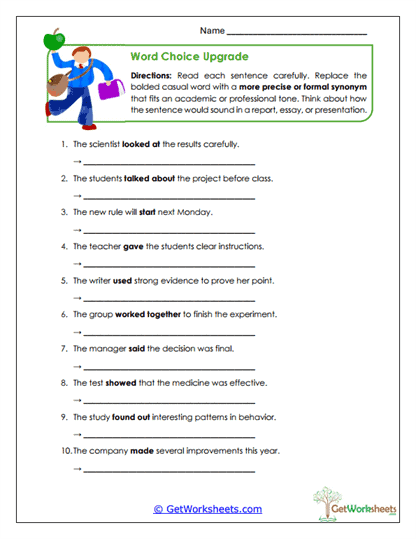
Word Choice Upgrade
Learners elevate casual phrasing into more formal academic language: looked → examined, talked about → discussed. This activity emphasizes register-matching vocabulary to audience and purpose. Students see how synonym choice transforms tone and professionalism, a key skill for essays, presentations, and academic communication.
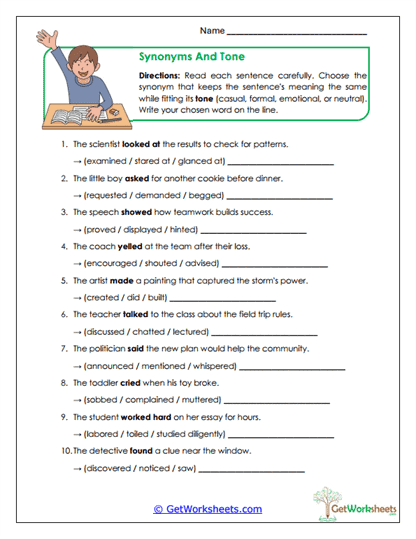
Synonyms and Tone
This exercise refines tone sensitivity by offering multiple synonym options for one context. Students decide which maintains meaning while fitting an emotional or formal tone-said might become remarked, confessed, or snapped depending on intent. By analyzing emotional nuance, learners practice reading and writing with an ear for voice and precision.
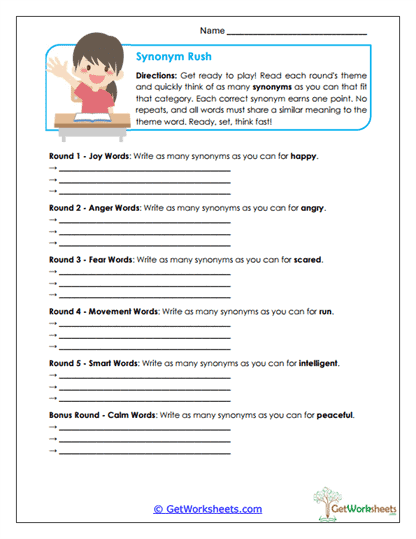
Synonym Rush
In a timed challenge, students brainstorm as many synonyms as possible for categories like joy words or smart words. It turns vocabulary review into a lively competition that fosters fluency and recall. Learners realize how broad and interconnected English vocabulary can be, boosting confidence in word retrieval for both writing and speech.
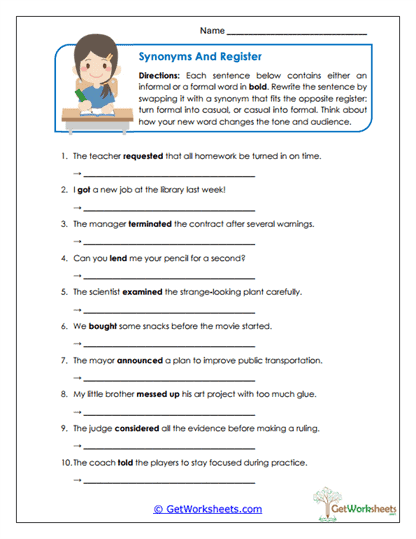
Synonyms and Register
Learners switch tone by rewriting sentences across formal and informal contexts-changing terminated to let go, or got to obtained. The contrast reveals how word choice signals professionalism, respect, or casualness. This worksheet is particularly effective for teaching audience awareness in writing, ensuring students understand why language shifts across settings.
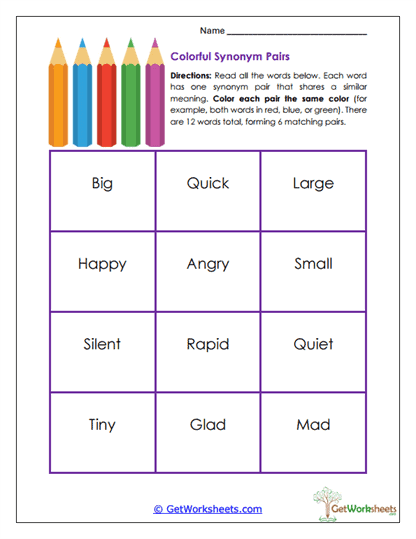
Colorful Synonym Pairs
This visual matching activity invites students to identify synonym pairs (like big/large, quiet/silent) and color them alike. The kinesthetic, color-coded design strengthens memory through visual association while reinforcing meaning recognition. It's especially effective for younger learners or multilingual students who benefit from multisensory vocabulary practice.
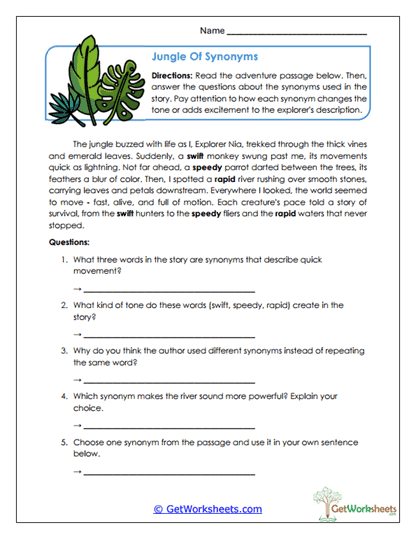
Jungle of Synonyms
In an adventurous short story filled with rich adjectives-swift, speedy, rapid-students explore how synonym variety shapes pacing and tone. Follow-up comprehension questions guide them to analyze how different word choices influence imagery, atmosphere, and reader perception. The exercise models how authors consciously select synonyms to achieve vivid, rhythmic writing.
Bookmark Us Now!
New, high-quality worksheets are added every week! Do not miss out!