Story Structure Worksheets






About This Worksheet Collection
The Story Structure (Beginning, Middle, End) Worksheets collection supports young writers as they learn how narratives are built, ordered, and developed. These worksheets provide a range of scaffolds-from picture sequences and fill-ins to full narrative expansions-that help students understand how stories progress logically from start to finish. Teachers will find these resources especially useful for strengthening foundational storytelling skills, supporting reluctant writers, and reinforcing clear sequencing.
Across the collection, students practice identifying story stages, filling in missing narrative parts, revising for clarity, and creating their own coherent storylines. They learn how beginnings introduce situations, how middles develop challenges or actions, and how endings offer resolution. By working through these varied tasks, learners build confidence in narrative planning, event sequencing, and writing stories that flow smoothly and logically.
Detailed Descriptions Of These Worksheets
Sunny Trail Story
Students examine a three-picture sequence of a squirrel's small adventure and write what happens first, next, and last. This encourages close observation and helps learners understand how events connect in simple narratives. They practice writing complete sentences that reflect logical sequencing. The task builds essential beginning-middle-end awareness.
The Missing Middle
Learners read the beginning and ending of a story about Jada and a mysterious wooden box, then craft the missing middle. This exercise deepens understanding of story progression and encourages logical event development. Students practice connecting plot points with clear actions or discoveries. It also nurtures creativity while reinforcing narrative flow.
Smooth Story Steps
Students complete a short narrative by inserting temporal transition words like "first," "then," "finally," and "meanwhile." They determine where each word fits to maintain logical sequencing. The activity helps them recognize how transitions clarify event order. It also supports writing fluency and cohesive storytelling.
Tiny Seed Tale
Students read the beginning of a story about Luca finding a seed and write both the middle and the ending. They consider how events unfold naturally and how a story resolves. The task encourages creativity while reinforcing structured storytelling. Learners practice connecting ideas smoothly from start to finish.
Puzzle Plot Mapper
Students receive the middle of a narrative-a clay project cracking just before it's due-and must create a beginning that leads to it and an ending that resolves it. This activity highlights the importance of conflict in storytelling. Learners build cause-and-effect connections and practice designing clear story arcs. It strengthens understanding of how narrative parts depend on one another.
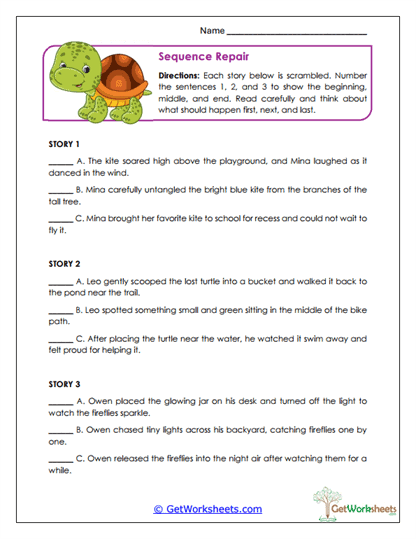
Sequence Repair
Students reorder scrambled mini-stories by numbering each sentence as beginning, middle, or end. This helps them analyze story logic and identify typical narrative patterns. They practice sequencing skills and develop stronger comprehension of short texts. The activity builds reasoning and recognition of story flow.
Fairy Tale Rebuilder
Learners rewrite a familiar fairy tale using their own words, ensuring a clear beginning, middle, and end. They outline characters, setting, main events, and resolutions. This task supports summarizing skills and reinforces understanding of traditional plot structure. It also encourages creative reinterpretation of classic stories.
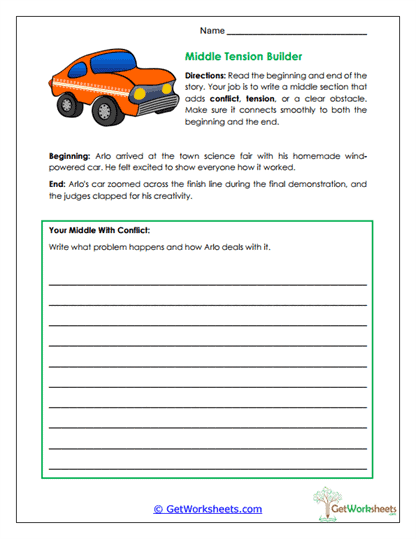
Middle Tension Builder
Students read the beginning and ending of a story about Arlo and his wind-powered car, then write a middle that introduces an appropriate challenge. The exercise teaches how conflict strengthens a narrative's middle section. Learners deepen their understanding of plot progression and event connection. It promotes more engaging, purposeful storytelling.
BME Story Checker
In this peer-review activity, students analyze a partner's story using a checklist focused on beginning-middle-end structure. They note strengths, identify missing elements, and offer constructive suggestions. This strengthens revision and editing skills while reinforcing narrative expectations. The worksheet also builds collaboration and reflective thinking.
Stronger Start Rewrite
Students revise a bland opening sentence to create a more engaging story beginning. They can add setting details, character goals, or hints of conflict. This activity teaches the importance of strong leads in narrative writing. Learners practice crafting openings that draw readers in and set up the plot effectively.
BME Cloze Fill-Ins
Students complete a short cloze story using a word bank, ensuring the narrative reads clearly from beginning to end. They use context clues to choose correct words and maintain logical flow. This strengthens reading comprehension, sequencing skills, and vocabulary application. The activity reinforces recognition of story structure within a guided passage.
Narrative Builder
Learners expand three labeled sentences-beginning, middle, and end-into full paragraphs. They add details, actions, and transitions to build a complete three-part narrative. This exercise teaches how each story stage contributes to overall structure. It supports elaboration, plot development, and writing cohesive, well-organized narratives.
Bookmark Us Now!
New, high-quality worksheets are added every week! Do not miss out!