Stars and Constellations Worksheets
About This Worksheet Collection
The Stars and Constellations collection blends science, history, and mythology to illuminate humanity's enduring fascination with the night sky. Through reading, observation, creative design, and analysis, students learn how stars form, evolve, and connect into recognizable patterns called constellations. These worksheets emphasize both scientific understanding-such as stellar life cycles and composition-and cultural significance, showing how civilizations across time have looked to the stars for navigation, storytelling, and meaning.
Each activity promotes literacy and scientific reasoning while inspiring curiosity about the cosmos. Learners engage with factual astronomy, explore myths from diverse cultures, and reflect on how observation has advanced human knowledge. Together, the worksheets build comprehension, creativity, and critical thinking as students connect the physical universe with the imaginative stories it inspires.
Detailed Descriptions Of These Worksheets
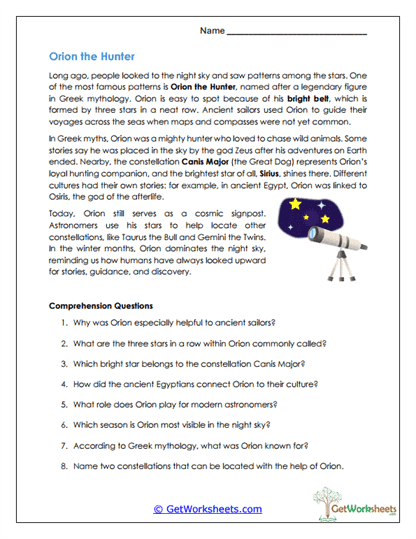
Orion the Hunter
Students read about the constellation Orion, exploring its mythological origins, historical significance, and role in navigation. Comprehension questions reinforce understanding of how science and culture intersect in celestial study. The worksheet encourages connections between legend and observation. It supports literacy, reasoning, and cultural appreciation through astronomy.
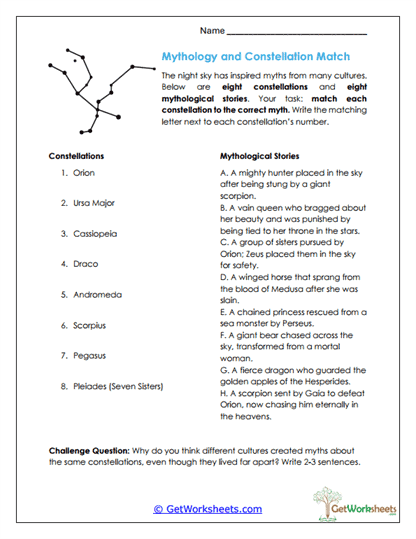
Mythology and Constellation Match
Learners match constellations like Orion, Pegasus, and Draco to their corresponding myths. A reflection question deepens understanding of how different cultures interpret the same stars. The activity strengthens comprehension and pattern recognition. It highlights how mythology and astronomy reflect shared human curiosity.
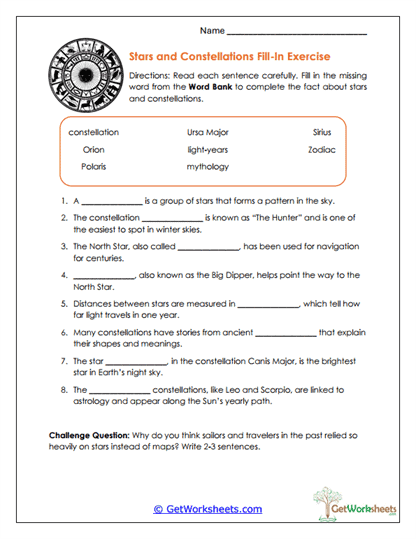
Fill-In Exercise
Students complete sentences about stars and constellations using a scientific word bank featuring terms like light-years, Sirius, and Zodiac. The exercise blends factual astronomy with cultural insight, reinforcing vocabulary and comprehension. Learners connect language to meaning and understand how humans have used stars for navigation and measurement.
Star Characteristics Quiz
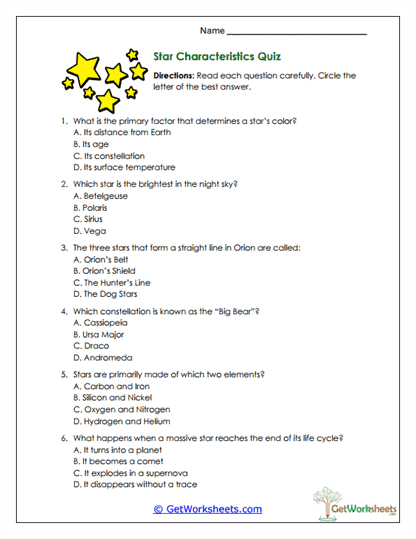
This multiple-choice quiz assesses students' understanding of stellar properties, color, composition, and life cycles. Questions also address constellation recognition and famous stars. The quiz reinforces factual recall and conceptual application. It serves as an efficient review of foundational astronomy knowledge.
The Stages of a Star's Life
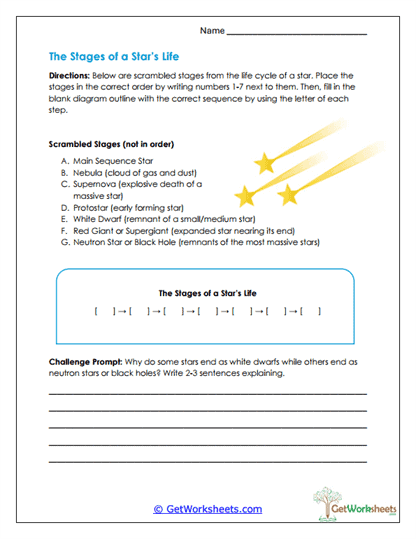
Students sequence the stages of stellar evolution-from nebula to final form-and complete a labeled diagram. They then explain why different stars end as white dwarfs or black holes. This structured activity builds comprehension of cause and effect in astronomy. It promotes logical organization and scientific reasoning.
Night Sky Observation Journal
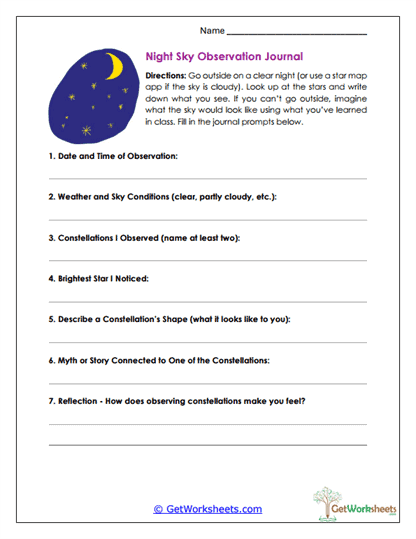
Learners record and reflect on their night sky observations, describing visible constellations, brightness patterns, and weather conditions. The journal encourages descriptive writing and personal engagement. It connects direct observation with scientific understanding while nurturing curiosity and appreciation for celestial beauty.
Compare and Contrast: Two Celestial Figures
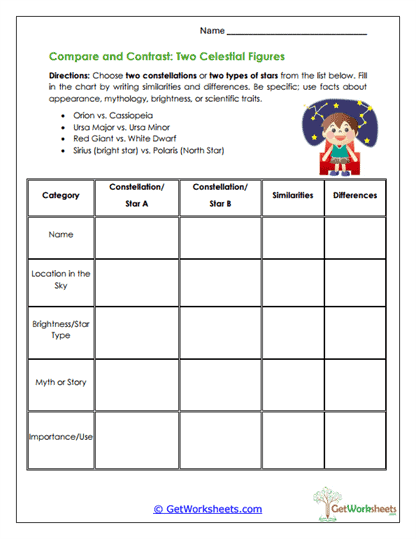
Students use a chart to compare two constellations or types of stars based on appearance, mythology, and characteristics. The task integrates data organization and analytical writing. It develops higher-order thinking and helps learners synthesize differences and similarities between celestial entities.
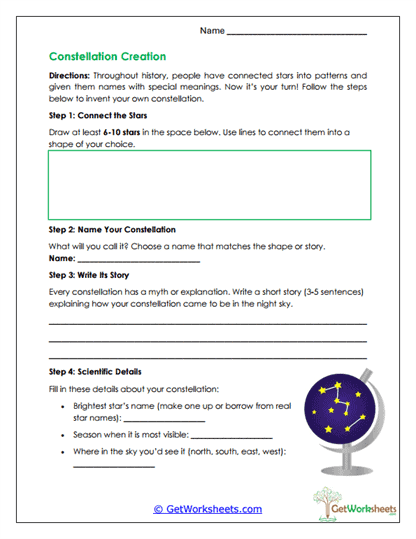
Constellation Creation
In this creative exercise, students design their own constellation, invent a myth explaining it, and describe its position in the sky. The worksheet merges art, science, and storytelling. It promotes imagination, comprehension of celestial mapping, and cultural understanding of how constellations are created and named.
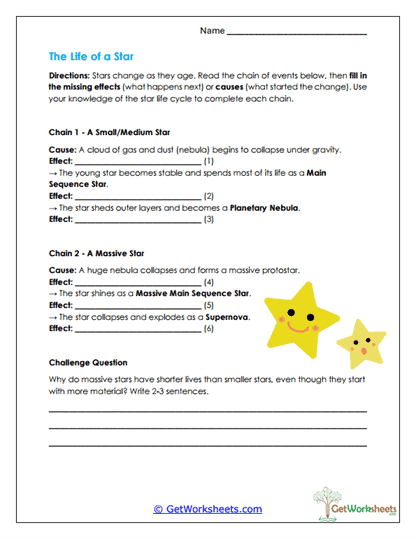
The Life of a Star
Learners complete missing steps in the life cycles of small and massive stars, then explain differences in lifespan. The exercise emphasizes energy conversion, sequence, and transformation. Students gain insight into how size determines stellar fate while practicing cause-and-effect reasoning.
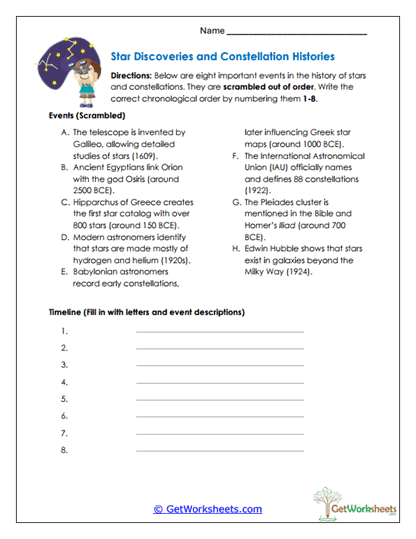
Discoveries and Histories
Students place key astronomical discoveries-from ancient star charts to modern telescope findings-in chronological order. This timeline activity links science and history, highlighting humanity's growing understanding of the universe. It strengthens sequencing skills and contextual awareness of scientific progress.
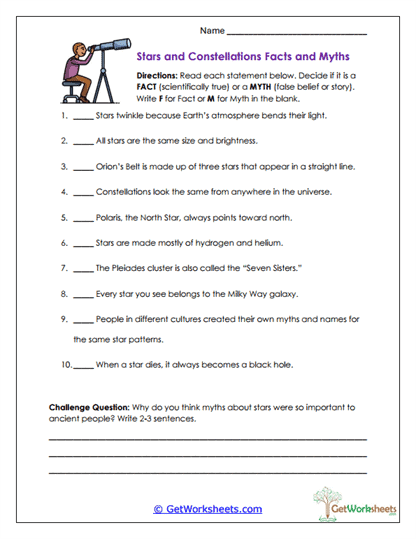
Facts and Myths
In this evaluative worksheet, learners determine whether ten statements about stars and constellations are factual or myth-based. A reflection prompt connects ancient storytelling to modern science. The exercise builds critical thinking and encourages distinguishing between observation and legend.
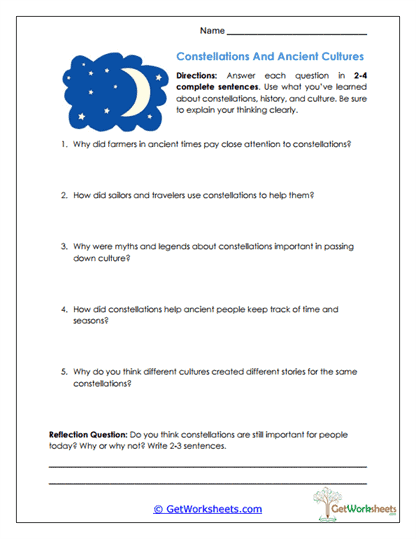
Constellations and Ancient Cultures
Students explore how ancient civilizations used constellations for navigation, farming, and storytelling. Short-response questions foster analytical writing and cross-cultural understanding. A concluding reflection invites students to consider the modern relevance of constellations. This worksheet connects history, science, and human curiosity across time.
Bookmark Us Now!
New, high-quality worksheets are added every week! Do not miss out!