Solar System Worksheets
About This Worksheet Collection
The Solar System collection takes students on a guided journey through our cosmic neighborhood, combining scientific discovery, critical thinking, and creativity. Each worksheet builds understanding of how the planets, moons, and the Sun interact through gravity, motion, and energy. Students learn factual details-like planetary order, composition, and orbital patterns-while also exploring the human curiosity that drives space exploration.
The activities encourage analytical reasoning, literacy in science vocabulary, and historical awareness of astronomical discovery. Learners engage through matching games, creative design, sequencing, and cause-and-effect mapping, making planetary science both informative and engaging. This collection connects big scientific ideas to real-world observation and imagination, helping students see the Solar System as a dynamic, interconnected system.
Detailed Descriptions Of These Worksheets
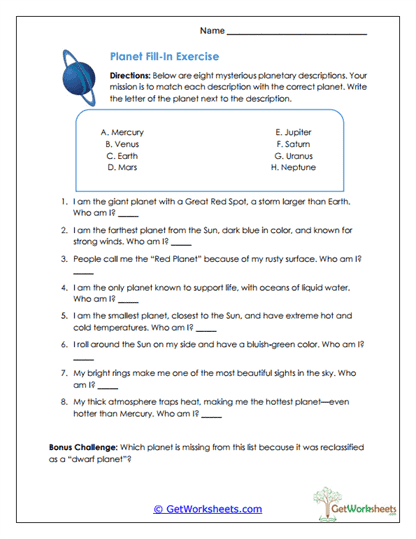
Planet Fill-In Exercise
Students read planetary descriptions and match each one to its correct name based on clues about size, atmosphere, or distance from the Sun. A bonus challenge revisits Pluto's reclassification as a dwarf planet. The exercise promotes factual recall and classification skills. Learners strengthen comprehension of planetary traits and categories.
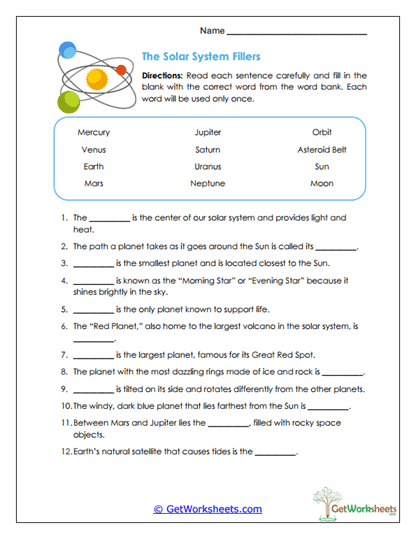
The Solar System Fillers
Learners complete ten sentences using a word bank of astronomy terms such as Mercury, Orbit, and Asteroid Belt. Each sentence reinforces relationships between planets, orbits, and structure. The task builds vocabulary precision and comprehension through context. It helps students understand how components of the Solar System work together.
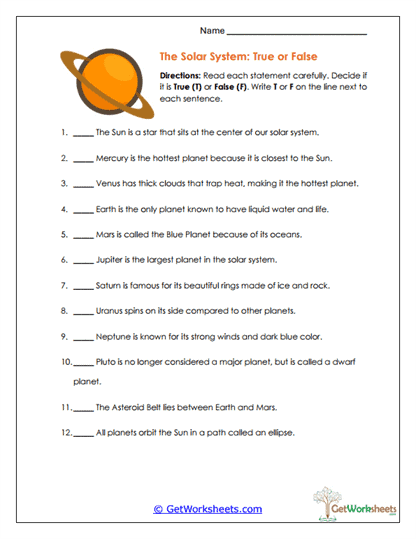
The Solar System: True or False
Students evaluate a series of statements about planets and orbits, marking each as true or false. Misconceptions are addressed through reasoning and fact-checking. The activity encourages analytical reading and discussion. It helps learners differentiate scientific fact from common myth in planetary science.
Guess the Planet
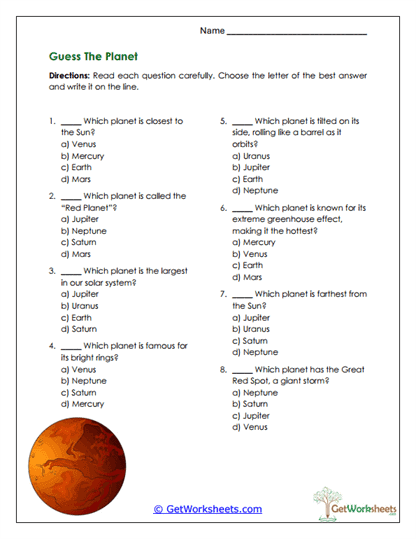
In this quiz-style worksheet, students use deductive reasoning to identify planets based on clues about appearance, atmosphere, and temperature. Multiple-choice options guide comprehension and recall. The format encourages engagement while reinforcing planetary recognition. It provides an interactive way to review essential astronomy knowledge.
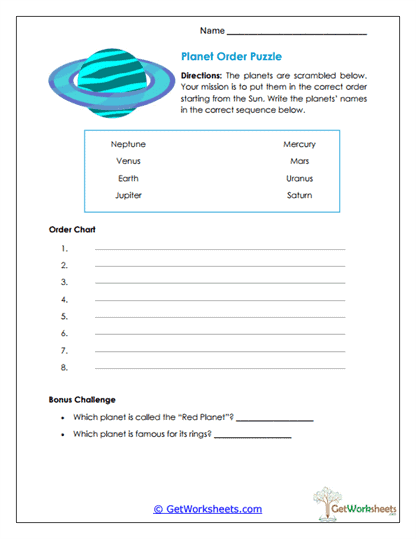
Planet Order Puzzle
Students list all planets in order from the Sun and answer related challenge questions about distinctive features. The exercise reinforces understanding of Solar System structure and sequencing. It encourages spatial and logical reasoning. Learners improve memory retention of planetary order and relationships.
Inner vs. Outer Planets
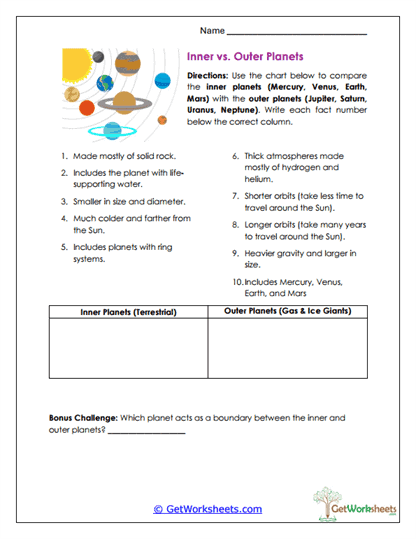
Learners categorize facts about terrestrial and gas giant planets into a two-column chart. Each characteristic-like solid surface or ring system-is classified correctly. A challenge prompt asks students to explain transitional boundaries in the Solar System. The task strengthens comparative thinking and structural analysis.
The Center of the Solar System
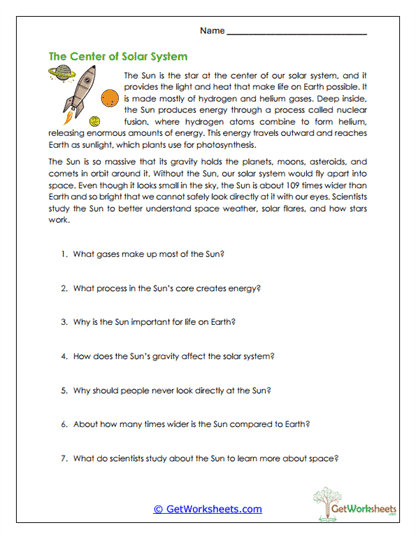
Students read about the Sun's composition, nuclear fusion, and gravitational influence. Comprehension questions test understanding of energy production and planetary motion. The worksheet develops science literacy and reasoning. It connects solar processes to their impact on life and planetary behavior.
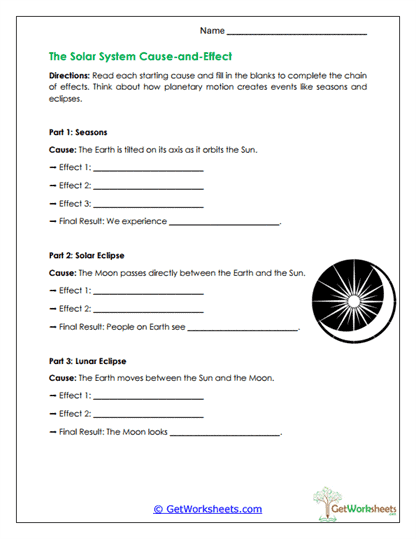
The Solar System Cause and Effect
In this activity, students complete chains linking causes like planetary tilt or revolution to effects such as seasons or eclipses. The exercise illustrates interconnections between celestial movement and natural phenomena. It builds logical reasoning and visualization of cosmic systems.
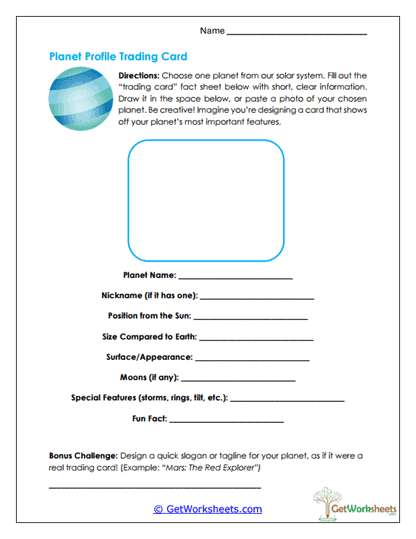
Planet Profile Trading Card
Students design a "trading card" summarizing a planet's size, atmosphere, moons, and fun facts. They can add artwork or slogans for creativity. The task blends factual accuracy with design and expression. It reinforces synthesis and communication of scientific details.
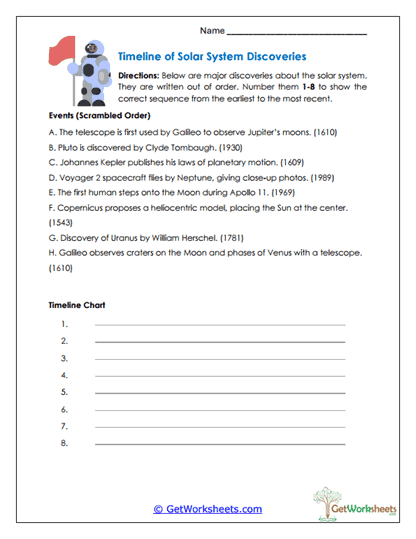
Timeline of Solar System Discoveries
Learners organize eight major discoveries-from the heliocentric model to modern missions-into chronological order. The sequencing activity highlights progress in scientific understanding. It combines history with astronomy to show how ideas and exploration evolve over time.
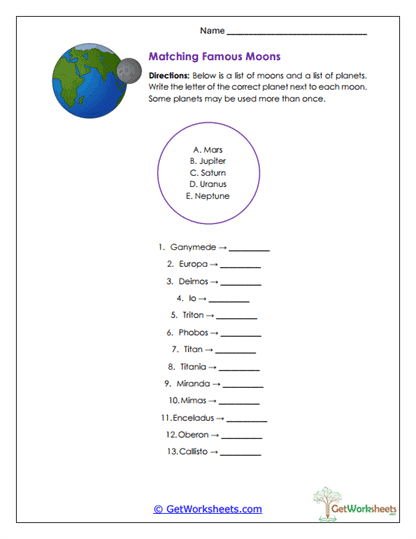
Matching Famous Moons
Students match moons like Titan, Ganymede, and Enceladus to their parent planets. Some planets appear multiple times, requiring attention to detail. The exercise promotes recall, pattern recognition, and comprehension of planetary systems. It deepens understanding of natural satellites and their relationships.
Design Your Own Planet
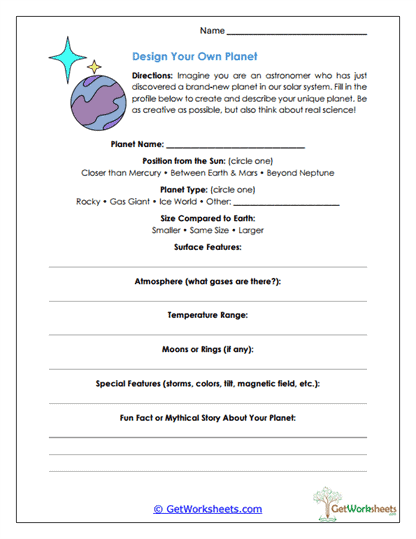
In this creative challenge, learners invent a new planet and describe its atmosphere, orbit, and appearance using real scientific principles. They include imaginative details such as rings, weather, or myths. The worksheet merges creativity with science literacy. It fosters curiosity, expression, and applied astronomical understanding.
Bookmark Us Now!
New, high-quality worksheets are added every week! Do not miss out!