Short Prompt vs. Long Prompt Worksheets
-
Basics on Prompt Length
-
Comparing AI Responses
-
Essential vs. Confusing Details
-
-
Expanding Short Prompts
-
Fixing Messy Prompts
-
Predicting Prompt Differences
-
Prompt Choice Scenarios
-
Prompt Makeover Practice
-
Prompt Power Ranking
-
Prompt Type Decision-Making
-
Repairing Misinterpreted Prompts
-
Short vs. Long Prompt Effects
About This Worksheet Collection
This collection helps students understand how the length and detail of an AI prompt influence the clarity, tone, and usefulness of the response. Through direct comparisons, prediction tasks, editing challenges, and decision-making scenarios, learners explore how short prompts offer speed and creativity while long prompts provide structure, accuracy, and control. Each worksheet guides students to look closely at how instructions shape output, building essential skills for intentional and effective AI use.
As students move through the set, they develop stronger reasoning, clearer writing, and sharper digital-literacy habits. They practice expanding and condensing prompts, repairing confusing instructions, predicting AI misunderstandings, and comparing outputs generated from different prompt types. By analyzing control level, identifying missing details, and choosing the best prompt for a given task, students gain confidence in designing prompts that match their goals and improve communication with AI tools.
Detailed Descriptions Of These Worksheets
Prompt Length Basics
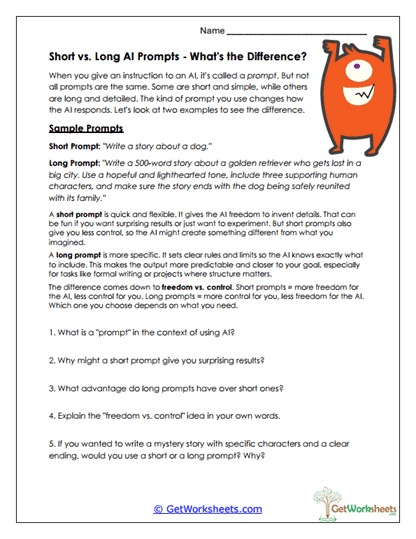
Students compare short and long prompts to understand how detail affects an AI's response. They read explanations, analyze sample story prompts, and answer open-ended questions about structure, predictability, and surprising outcomes. This worksheet builds comprehension and encourages thoughtful reflection on how prompt detail shapes output.
Prompt Choice Scenarios
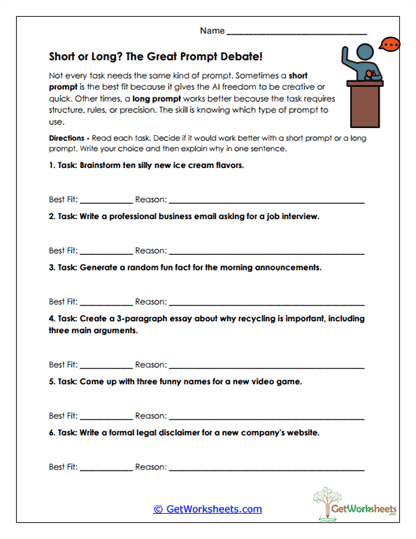
Learners read real-world situations-each requiring different levels of clarity-and decide whether a short or long prompt is the better fit. They write brief explanations to justify their choices. The activity teaches students to match prompt length to task demands and strengthens decision-making skills.
Essential vs. Confusing Details
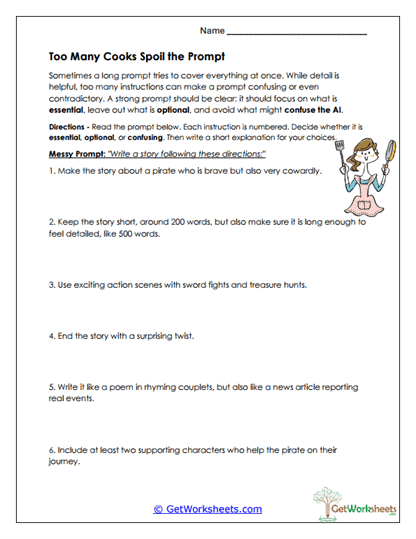
Students study an overloaded pirate-themed prompt and decide which instructions are essential, optional, or confusing. They analyze each line and explain their reasoning. This task builds clarity in writing and helps students understand how too much detail can make AI outputs unpredictable.
Expanding Short Prompts
Learners take six short prompts and transform them into richer, more descriptive long prompts. They add tone, structure, and key details to make instructions more precise. This worksheet strengthens elaboration and helps students see how added context improves AI responses.
Predicting Prompt Differences
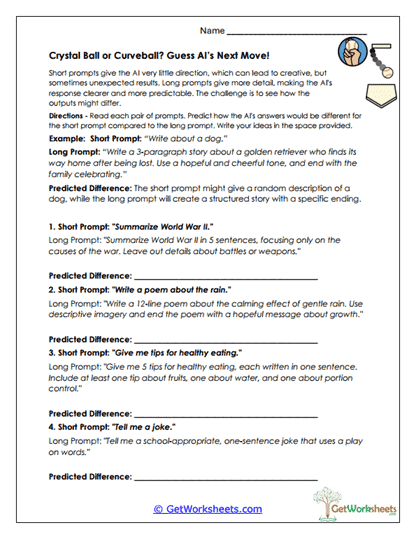
Students compare short and long prompts and predict how an AI's output will change in tone, structure, and depth. They examine detail differences and explain their predictions. The worksheet builds comparative thinking and reinforces how specificity affects results.
Prompt Power Ranking
Learners rank six prompts from least to most controlling. They justify their choices by explaining how much freedom each prompt gives the AI. This activity helps students understand how constraints guide accuracy, creativity, and detail.
Fixing Messy Prompts
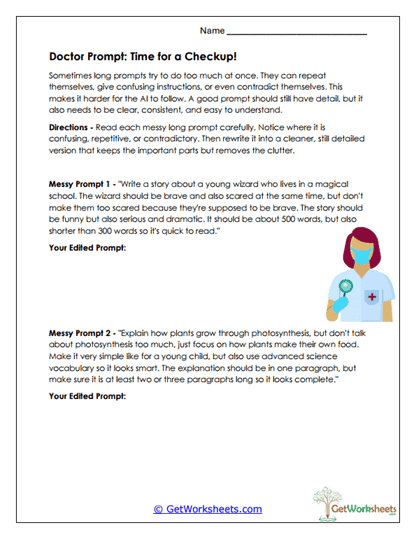
Students revise two long prompts that contain redundancy, contradictions, or unclear goals. They rewrite them into focused, well-structured versions. The worksheet develops editing skills and highlights how strong long prompts balance clarity with detail.
Prompt Type Decision-Making
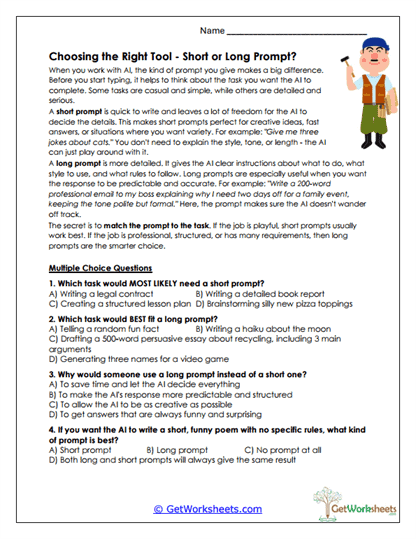
Learners read several task scenarios and choose whether a short or long prompt is more appropriate, explaining their reasoning. This builds purposeful writing skills and helps students think critically about instruction style.
Comparing AI Responses
Students read two AI outputs-one from a short prompt and one from a long prompt-and compare tone, structure, evidence, and detail. They identify which is better for academic use and why. This worksheet strengthens critical reading and analytical interpretation.
Repairing Misinterpreted Prompts
Learners examine examples where short prompts caused AI misunderstandings. They identify missing details and rewrite the prompts for clarity. This task deepens understanding of ambiguity and shows how precise wording prevents misinterpretation.
Prompt Makeover Practice
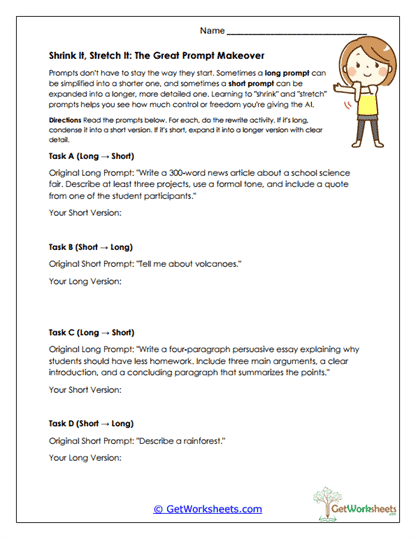
Students practice switching between long and short prompts. They condense long prompts to essential information and expand short prompts with added context. The activity builds summarization, elaboration, and flexible writing skills.
Short vs. Long Prompt Effects
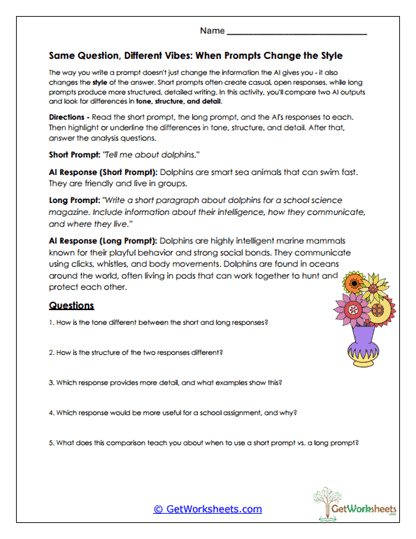
Learners analyze two AI responses-one generated from a short prompt about dolphins and one from a long prompt. They compare differences in tone, accuracy, structure, and detail. This worksheet builds analytical thinking and reinforces how prompt design shapes communication.
Bookmark Us Now!
New, high-quality worksheets are added every week! Do not miss out!