Salem Witch Trials Worksheets
About This Worksheet Collection
This Salem Witch Trials worksheet collection provides educators with an engaging set of activities that help students explore one of the most dramatic and unsettling episodes in colonial American history. Through matching tasks, primary-source analysis, reflection prompts, debate preparation, classification challenges, and timeline building, learners gain insight into the social pressures, beliefs, and fears that fueled the hysteria of 1692. The worksheets illuminate how individual actions, community tensions, and flawed legal procedures contributed to a climate of suspicion and injustice.
Students strengthen essential literacy and historical reasoning skills as they work through close reading tasks, evidence-based responses, biographical analysis, and argument writing. The collection encourages learners to distinguish fact from opinion, identify bias, analyze cause and effect, and make connections between past and present issues related to fairness, justice, and credibility. Each worksheet supports thoughtful engagement with the events of Salem while helping students develop a deeper understanding of how fear and misunderstanding can shape human behavior.
Detailed Descriptions Of These Worksheets
Salem Figures
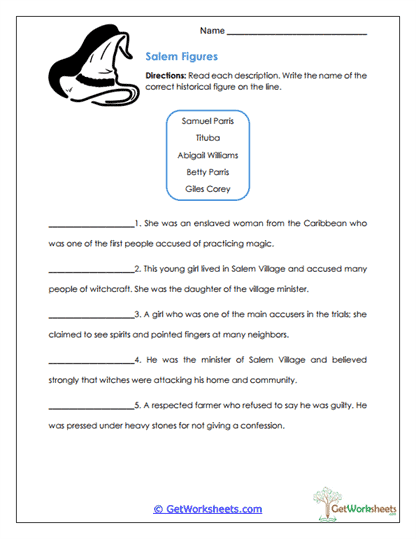
Students read brief descriptions of notable individuals from the Salem Witch Trials and match each profile to the correct historical figure. They pay close attention to roles, accusations, and personal backgrounds, reinforcing understanding of key participants such as Tituba, Abigail Williams, and Samuel Parris. The activity also encourages recognition of how individual choices shaped the escalation of events. It strengthens biographical comprehension and attention to historical detail.
Trial Fairness
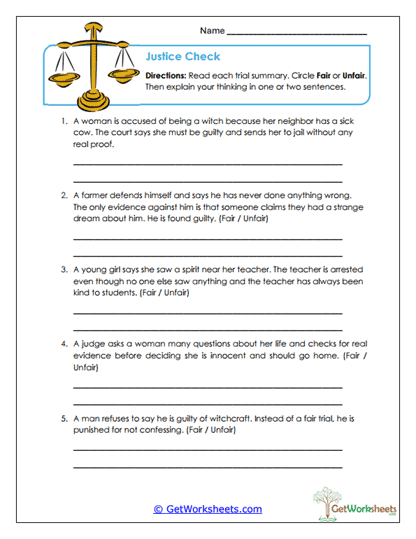
Learners review short trial-inspired scenarios and decide whether each situation represents a fair or unfair proceeding. They support each judgment with a brief explanation, prompting reflection on evidence, bias, and due process. Through this analysis, students connect past legal injustices to modern principles of fairness. The task promotes clarity in reasoning and opinion writing.
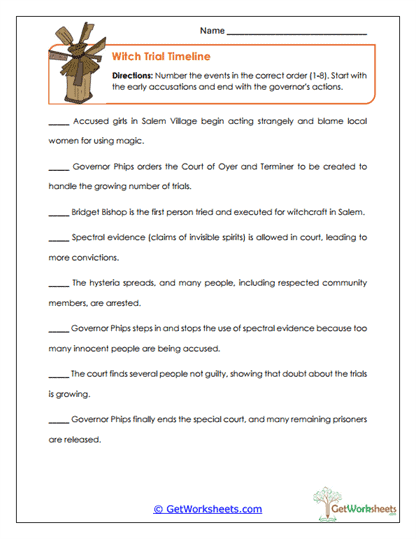
Event Timeline
Students place eight major Salem Witch Trials events in chronological order, beginning with early accusations and ending with the governor's intervention. The exercise highlights how the trials escalated and which developments-such as spectral evidence-intensified the hysteria. Learners strengthen their sequencing abilities and identify cause-and-effect relationships. This activity builds a clear narrative of how the crisis unfolded.
Quote Analysis
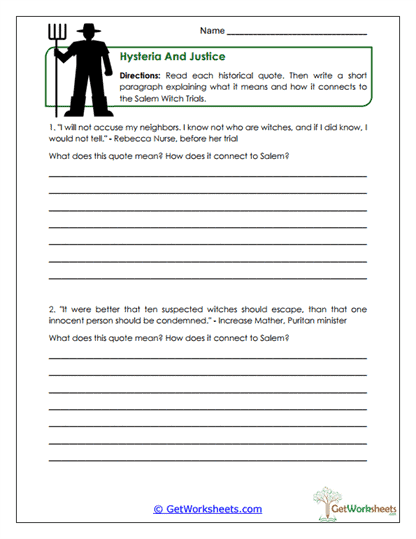
This worksheet invites students to interpret two historical quotes from the Salem era, explaining each one's meaning and connection to the trials. They consider the speaker's perspective and how themes such as fear, justice, or morality influenced actions. Through paragraph writing, learners practice interpreting complex language and linking it to historical context. The activity reinforces skills in primary-source analysis.
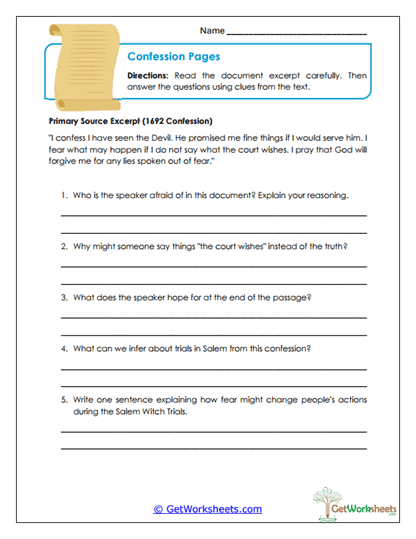
Confession Reading
Students examine an excerpt from a 1692 confession and answer questions that require inference and text-based reasoning. They explore motivations behind false confessions and consider the psychological pressures created by fear. The worksheet encourages reflection on how social climate shapes behavior. It also strengthens comprehension of emotional and historical context.
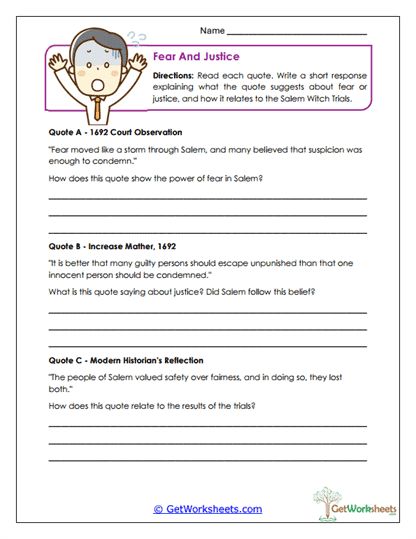
Fear and Justice
Learners analyze three quotes from observers, leaders, and historians to evaluate differing perspectives on fear and justice during the trials. They write short responses explaining each viewpoint and how fear influenced decisions. This strengthens their ability to compare perspectives and interpret evidence. The activity promotes careful reading and thoughtful reflection.
Liberty Reflection
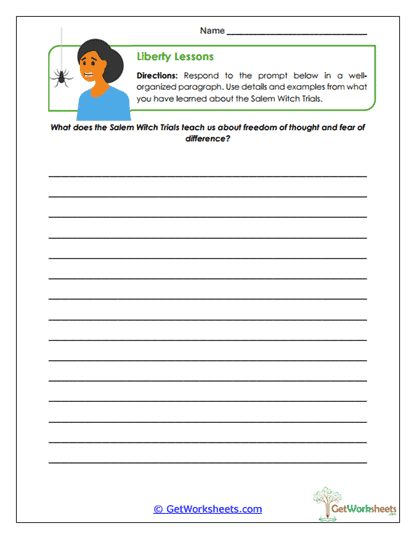
Students write a paragraph responding to a prompt about freedom of thought and fear in the Salem Witch Trials. They support their ideas with specific details and historical examples, emphasizing the role of social pressure and justice. This encourages deep reflection on civic themes and clear paragraph construction. Learners build skills in forming arguments connected to historical events.
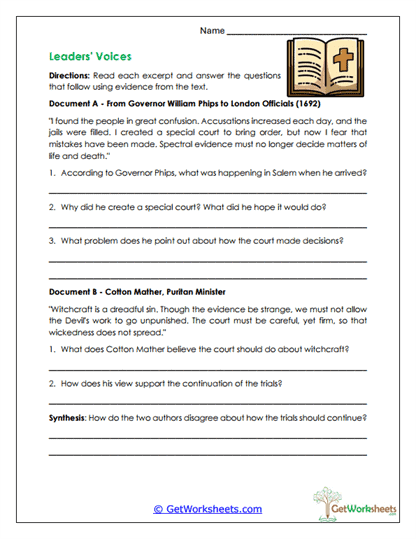
Leaders' Perspectives
Students read two excerpts-one by Governor Phips and one by Cotton Mather-and answer questions requiring text evidence. They analyze motivations, disagreements, and proposed approaches to the trials. A synthesis question prompts comparison of the two perspectives. This activity develops analytical thinking and understanding of leadership decisions.
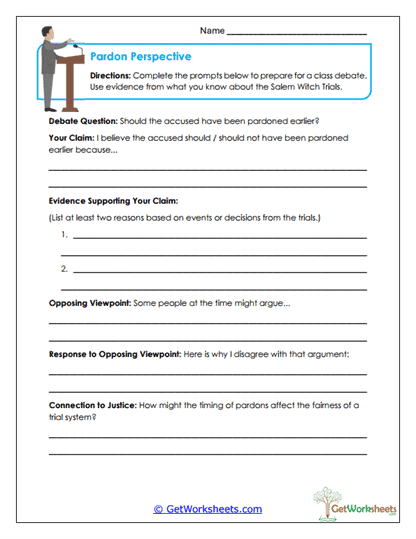
Debate Preparation
Learners prepare for a structured debate on whether the accused should have been pardoned earlier during the trials. They craft a claim, list supporting evidence, outline an opposing viewpoint, and write a rebuttal. The process strengthens argument writing and evaluation of fairness. Students practice connecting historical justice issues to broader principles.
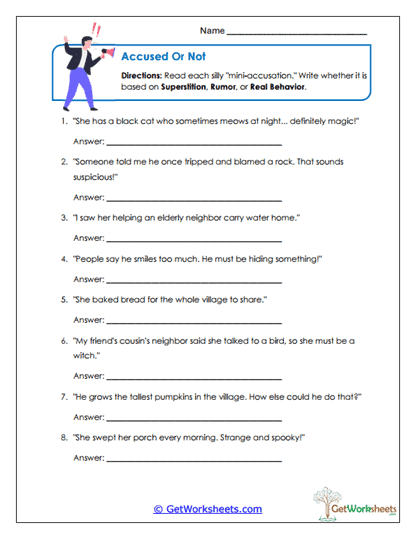
Accusation Sorting
Students read short "mini-accusations" and classify each as superstition, rumor, or real behavior. This helps them distinguish between evidence-based claims and unsupported assumptions, mirroring challenges faced in Salem. The activity strengthens critical thinking and encourages discussion about fairness. It also highlights how misinformation can fuel hysteria.
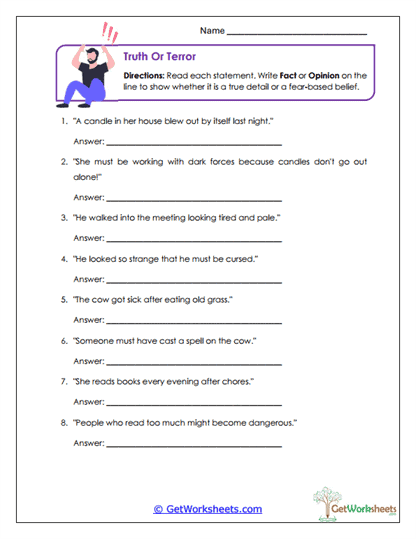
Fact or Fear
Learners determine whether each statement represents a factual claim or an opinion shaped by fear. They consider evidence, reliability, and emotional language when making their decisions. The task reinforces skills in evaluating the accuracy of information. It builds awareness of how fear can distort judgment and lead to false conclusions.
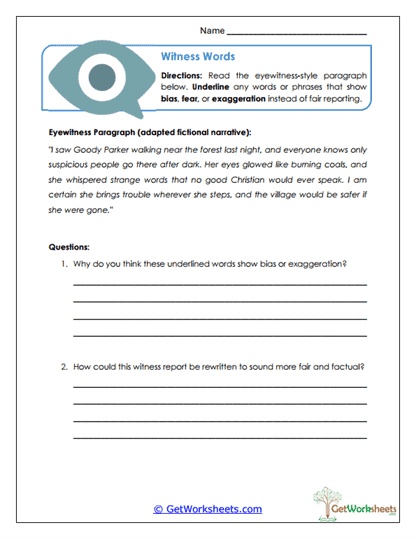
Eyewitness Bias
Students analyze a fictional eyewitness-style paragraph to identify words or phrases that reveal bias, exaggeration, or fear-based interpretation. After marking these elements, they answer reflective questions about credibility and truthfulness. The task encourages students to think critically about how fear influences testimony. It also strengthens media literacy and the ability to revise biased statements into more objective language.
Bookmark Us Now!
New, high-quality worksheets are added every week! Do not miss out!