Root Words Worksheets
About This Worksheet Collection
This Root Words worksheet collection provides a comprehensive set of activities designed to strengthen students' understanding of how words are built. Through puzzles, riddles, analogies, reading passages, sentence completions, and creative rewriting tasks, learners interact with roots, prefixes, and suffixes in meaningful and varied ways. The worksheets invite students to break words apart, build them back up, and apply them across contexts-supporting both foundational literacy skills and more advanced vocabulary development.
As students work through these materials, they develop morphological awareness, decode multisyllabic academic terms, and deepen their understanding of how Greek and Latin roots shape English vocabulary. These tasks reinforce critical-thinking skills, promote flexible word analysis, and equip students with strategies that transfer directly to reading comprehension across subjects. By engaging with roots in multiple formats, learners build confidence, expand their lexicon, and gain tools that support lifelong literacy.
Detailed Descriptions Of These Worksheets
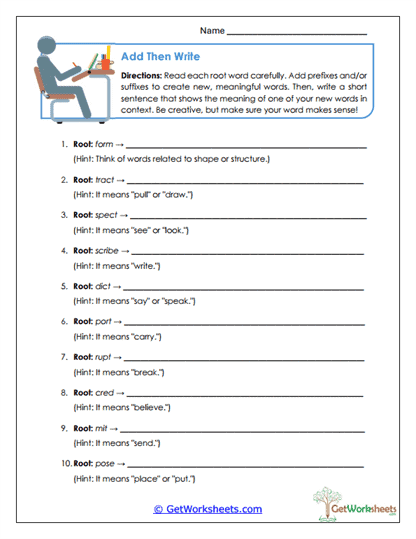
Add Then Write
Students experiment with root words by adding prefixes and suffixes to create new vocabulary terms. This hands-on word-building process strengthens understanding of how affixes transform meaning. Learners also craft a sentence using one of their constructed words, ensuring they can apply it accurately in context. The worksheet blends creativity with structural analysis to reinforce strong vocabulary habits.
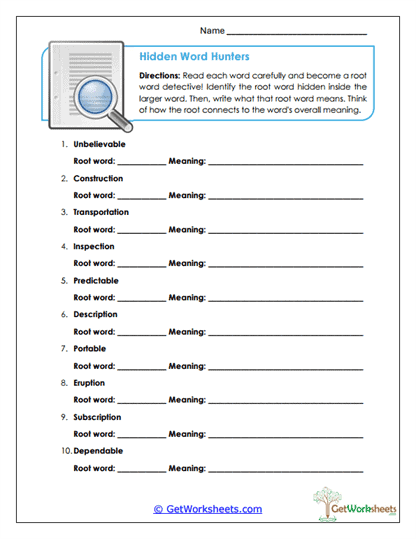
Hidden Word Hunters
Students examine complex words and identify the smaller root hidden within each one. After locating the root, they explain its meaning and consider how it shapes the larger word's definition. This task helps learners see recurring patterns in vocabulary and strengthens decoding skills. It also builds confidence by revealing that even long, intimidating words are built from familiar parts.
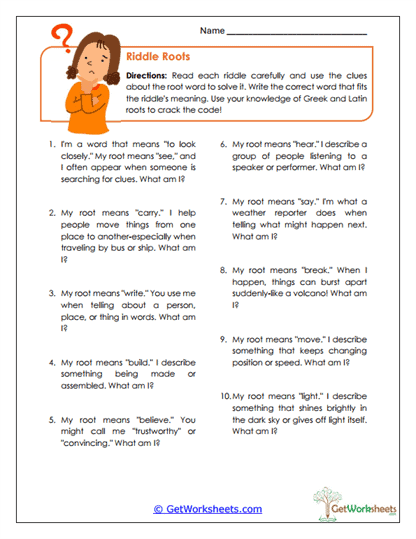
Riddle Roots
Learners solve riddles that each point to a specific Greek or Latin root. They use clues about meaning, origin, and usage to determine the correct answer. This format turns vocabulary practice into a puzzle-solving experience that encourages inferential thinking. It also reinforces students' ability to connect roots with broader word families.
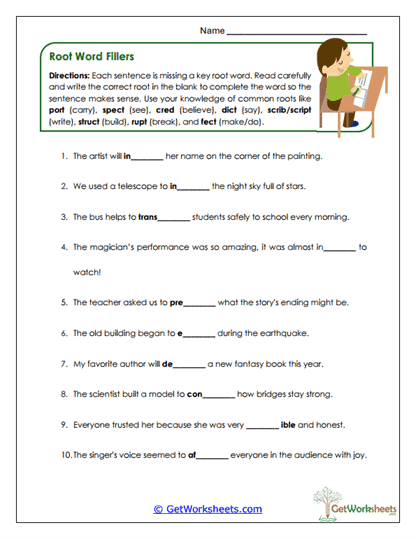
Root Word Fillers
Students complete sentences by selecting the correct root-based term that fits the meaning and structure of the sentence. To choose accurately, they must use their knowledge of common academic roots such as cred, dict, and spect. This worksheet reinforces comprehension through context as well as morphological reasoning. It also helps learners refine their sense of tone and precision in word choice.
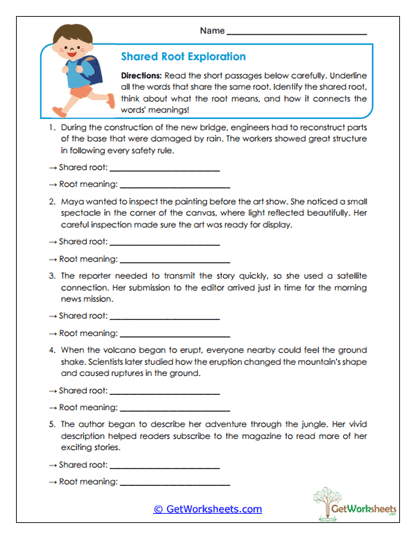
Shared Root Exploration
Learners read short passages and identify all words built from the same root. After collecting those examples, they explain the shared root's meaning and how it connects the related vocabulary. The activity shows how a single linguistic base can tie multiple words together. It strengthens close reading and supports students' understanding of semantic relationships.
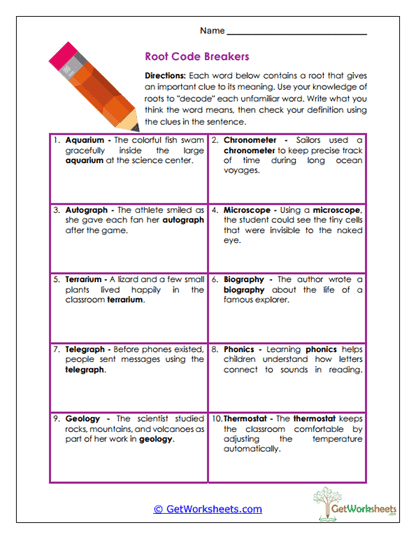
Root Code Breakers
Students decode unfamiliar words by identifying the root embedded within each term. After predicting the meaning based on the root, they confirm their interpretation using surrounding text. This dual strategy-structural analysis combined with context clues-promotes accurate vocabulary understanding. It also encourages flexible thinking about how roots shape complex words.
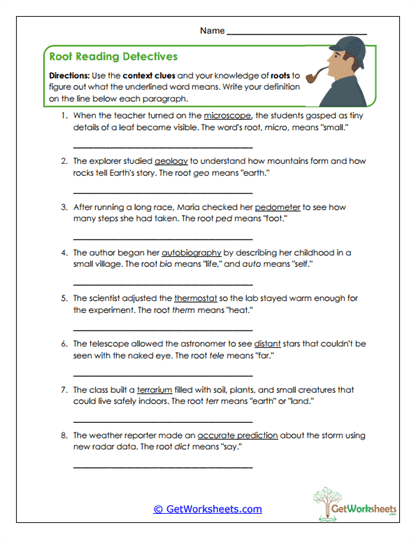
Root Reading Detectives
Learners read short paragraphs with an underlined root-based word and use both structure and context to determine its meaning. This worksheet integrates comprehension with morphological study in a balanced way. Students deepen their inferencing skills while learning academic vocabulary commonly found in content-area texts. The activity supports decoding of multisyllabic words across subjects.
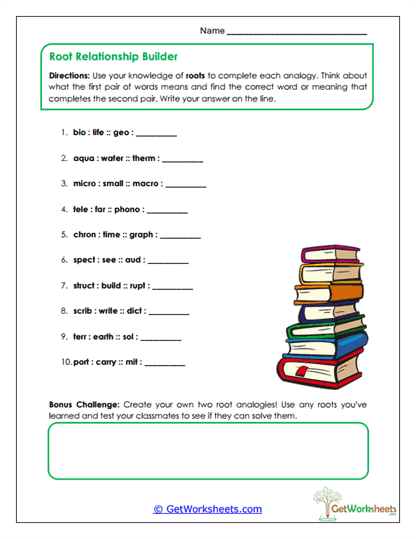
Root Relationship Builder
Students solve analogy pairs that rely on understanding root-based relationships. They must analyze how each root contributes to meaning and complete the analogy logically. This exercise strengthens reasoning skills and vocabulary analysis simultaneously. It also helps learners see how roots function across multiple semantic patterns.
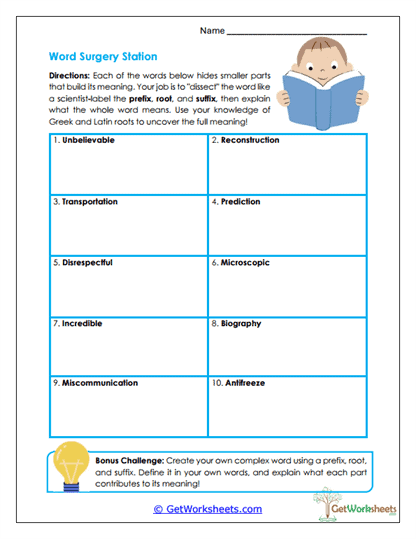
Word Surgery Station
Students break down complex words into prefix, root, and suffix components, then explain how those parts combine to form meaning. This visual, analytical task helps them see how vocabulary is constructed piece by piece. Learners build stronger decoding skills and deepen comprehension of academic language. A bonus option invites them to invent their own root-based word for creative reinforcement.
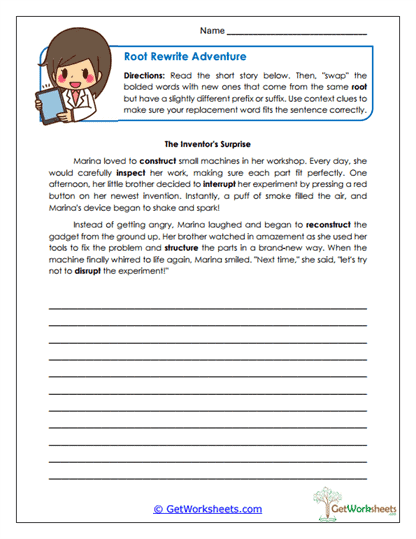
Root Rewrite Adventure
Learners read a short story containing bolded root-based vocabulary and then rewrite it using new variations formed from the same roots. They must ensure their replacements still fit the passage's meaning and tone. This activity demonstrates the flexibility of word families and strengthens revision skills. It also develops precision in choosing context-appropriate vocabulary.
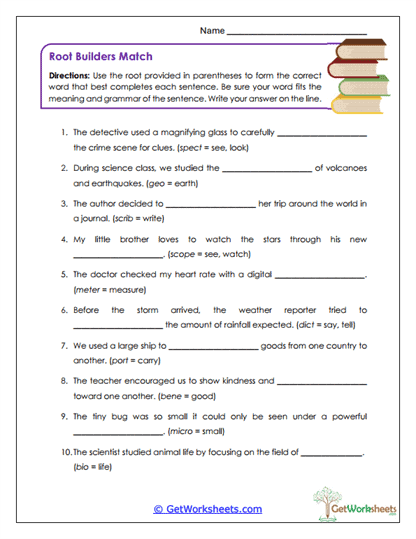
Root Builders Match
Students form complete vocabulary words by combining a provided root with the appropriate affix to fit each sentence. This practice strengthens morphological reasoning and ensures accurate word formation. Learners deepen their understanding of how roots and affixes work together to create meaning. The sentence-based format also supports comprehension and correct grammatical usage.
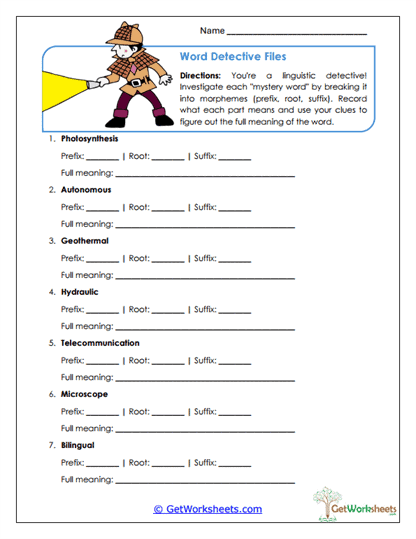
Word Detective Files
Students analyze complex academic terms by breaking them into prefix, root, and suffix and recording the meaning of each morpheme. They then use these components to determine the word's full definition. This worksheet highlights how small units of meaning can unlock sophisticated vocabulary. It builds strong analytical skills essential for reading scientific and technical texts.
Bookmark Us Now!
New, high-quality worksheets are added every week! Do not miss out!