Root Word Families Worksheets
-
Advanced Root Study
-
Common Root Finder
-
Exploring Root Meanings
-
-
Finding Common Roots
-
Greek Root Word Families
-
Latin Root Expansion
-
Latin Root Word Families
-
Mixed Root Practice
-
Root Family Builder
-
Root Mapping Practice
-
Root Word Builders
-
Root Word Recall
-
Sorting Root Families
-
Word Family Check
-
Word Family Connections
About This Worksheet Collection
The Root Word Families worksheet collection gives students a powerful framework for understanding how English words are built and how meanings connect across language. Instead of treating vocabulary as memorization, these worksheets teach it as a system-where roots, prefixes, and suffixes create webs of meaning that cross science, literature, and daily life. Through analysis, classification, and word-building challenges, learners come to see words not as isolated facts but as families that share structure, history, and logic.
Each activity blends morphology, etymology, and creative reasoning. Students practice decoding academic terms, building new words, and connecting linguistic patterns from Latin and Greek to modern English. These lessons deepen reading comprehension, improve spelling accuracy, and cultivate lifelong tools for independent vocabulary growth.
Detailed Descriptions Of These Worksheets
Root Word Builders
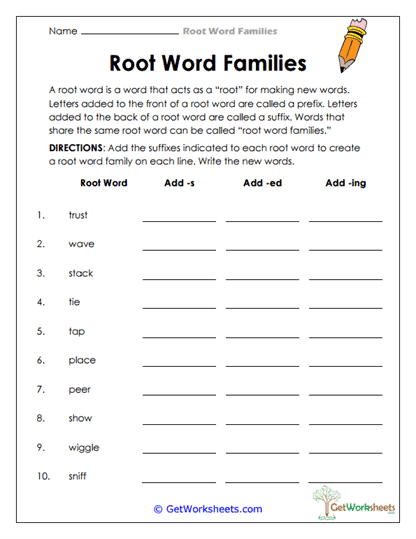
Students start with familiar base words-trust, wave, tap-and expand them into full word families using suffixes such as -s, -ed, -ing. What begins as a mechanical task quickly becomes a discovery process: learners notice spelling adjustments (double consonants, dropped es) and part-of-speech shifts. The worksheet reinforces that morphology governs both grammar and meaning-teaching, for instance, that wave becomes waving to describe action and waves to mark plurality. Perfect for early morphology introduction or intervention review.
Finding Common Roots
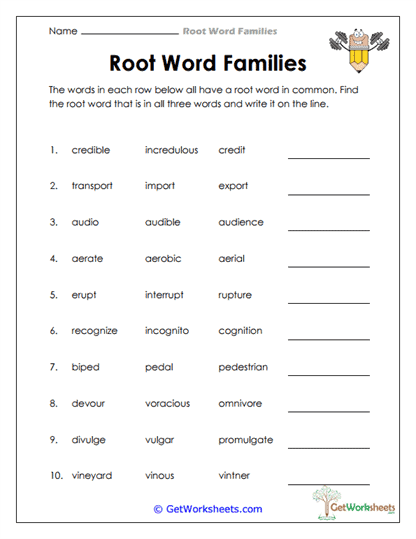
Learners analyze groups like credible/incredulous/credit or transport/import/export to locate the shared root and explain its meaning. By comparing word families across prefixes, they see how port ("carry") unites an entire cluster of vocabulary across subjects. This activity turns root spotting into a decoding game: once you find the hidden "core," the word's meaning unfolds logically. It's ideal for supporting academic reading in content areas such as history and science.
Greek Root Word Families
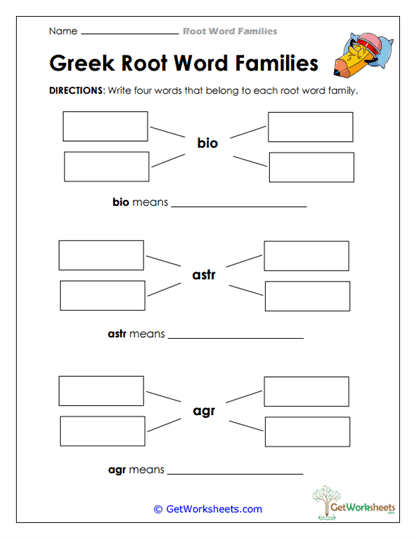
Students explore Greek roots such as bio ("life"), astr ("star"), and agr ("field"), building four-word families and short definitions for each. As they list and define words like biology, astronaut, and agriculture, they trace patterns that reach from classical study to modern STEM. The exercise encourages etymological curiosity and shows that ancient Greek still shapes the language of science, medicine, and art today.
Latin Root Word Families
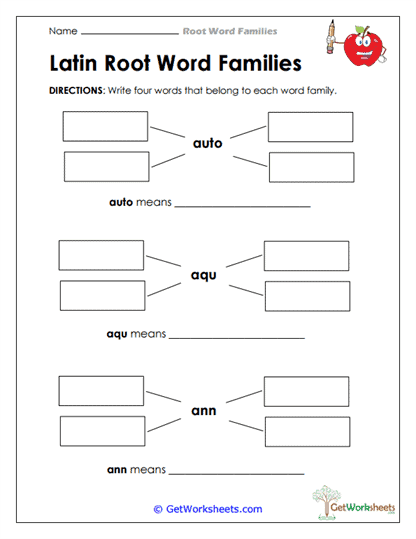
Focusing on Latin-derived roots like auto, aqu, and ann, this worksheet guides learners to identify meaning patterns and generate connected vocabulary (automatic, aquarium, annual). It invites reflection on how Latin precision lends structure to English. Students move from rote definition toward morphological reasoning-recognizing, for instance, that ann- links any term about years or cycles.
Mixed Root Practice
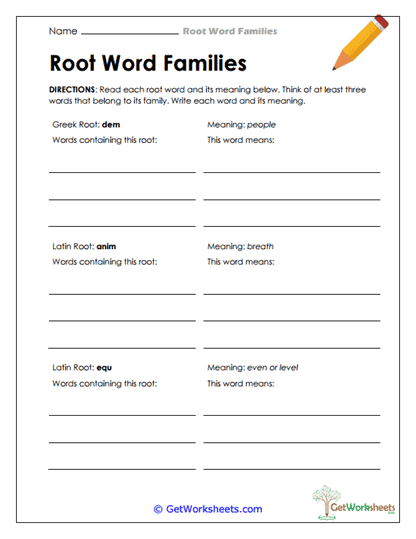
By combining Greek and Latin roots-dem (people), anim (life/spirit), equ (equal)-students strengthen analytical flexibility. They must identify each root, construct related words, and paraphrase meanings. The mixed approach promotes word consciousness: recognizing that equation, animate, and democracy may look unrelated on the surface yet all reveal a linguistic story about human values, logic, and life.
Latin Root Expansion
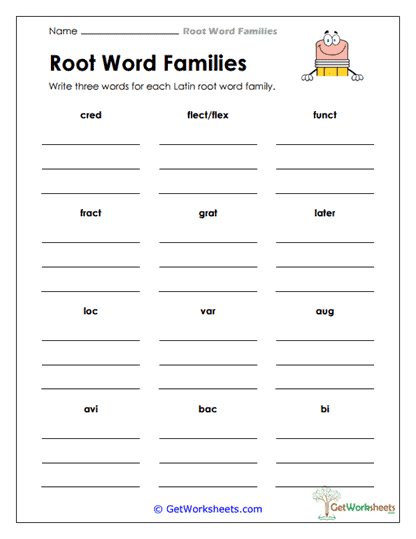
Learners deepen fluency with classic Latin roots such as cred (believe), fract (break), and later (side). They list three examples per root, analyze meaning shifts, and discuss patterns. By seeing how fracture, fraction, and fragile connect, students gain clarity on how small morphological changes yield broad conceptual differences. This worksheet blends vocabulary study with analytical grammar awareness.
Advanced Root Study
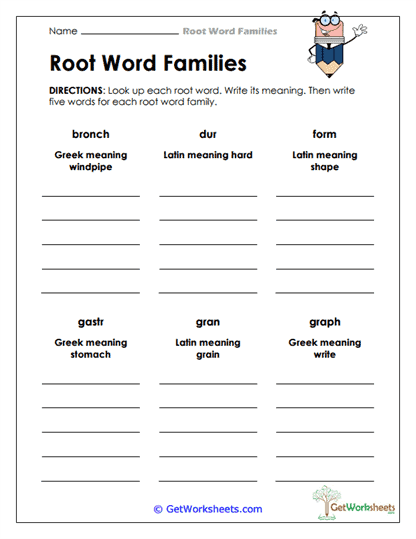
At the upper level, roots such as bronch, dur, and form challenge learners to think scientifically and linguistically. Students define each root, generate five examples, and write their own contextual sentences. By exploring terms like durable and conformity, they practice applying roots in abstract and disciplinary contexts, bridging everyday language with technical vocabulary across biology, physics, and social science.
Word Family Check
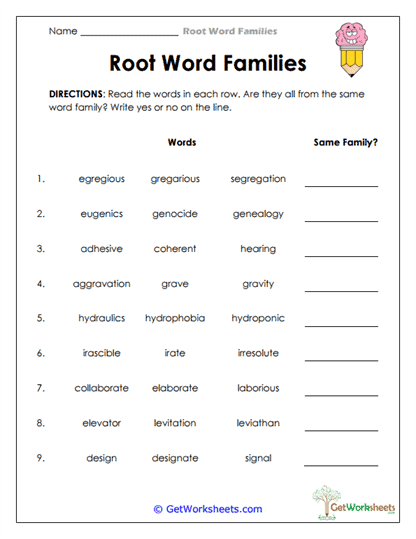
Students encounter word groups such as hydraulics/hydrophobia/hydroponic and must judge whether they share a true root or only a visual similarity. This analytical puzzle develops precision: learners discover that not all look-alike words belong to the same family. The task strengthens discernment, encouraging them to check etymological meaning instead of relying solely on spelling cues.
Exploring Root Meanings
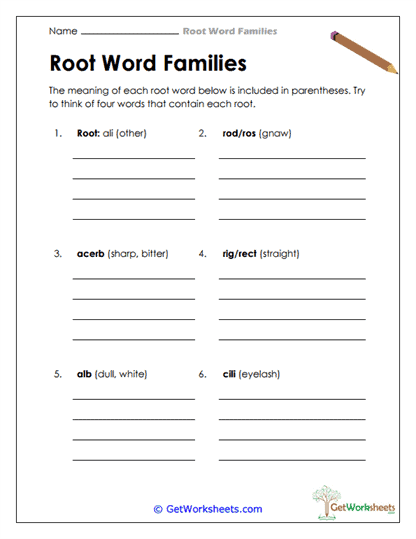
With lesser-known roots like ali (other), rod/ros (gnaw), and acerb (sharp/sour), students expand beyond common vocabulary to learn sophisticated, college-prep terms. For each, they write meanings and generate four examples, practicing contextual reasoning and creative word construction. The exercise refines morphological insight while empowering students to tackle challenging vocabulary independently.
Common Root Finder
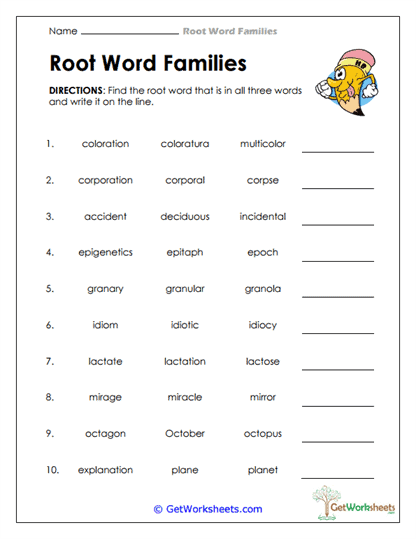
Students examine clusters such as corporation/corporal/corpse or mirage/miracle/mirror to uncover their shared root and interpret the connecting idea. The analysis illustrates how meaning evolves while the core sense remains. This worksheet encourages metalinguistic reflection-seeing that "body" (corp) and "wonder" (mir) act as hidden anchors beneath modern words.
Root Family Builder
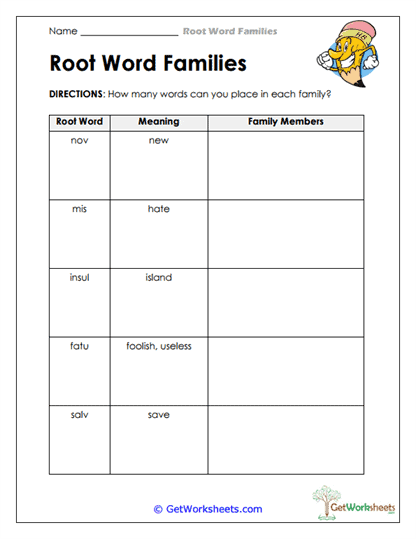
Learners expand vocabulary by listing multiple derivatives of Latin roots such as nov (new), mis (hate), and salv (save). Through brainstorming and word recall, they form semantic webs that illuminate how each root underpins an entire field of meaning-from novel and innovation to salvation and salvage. The activity supports both retrieval fluency and contextual application.
Sorting Root Families
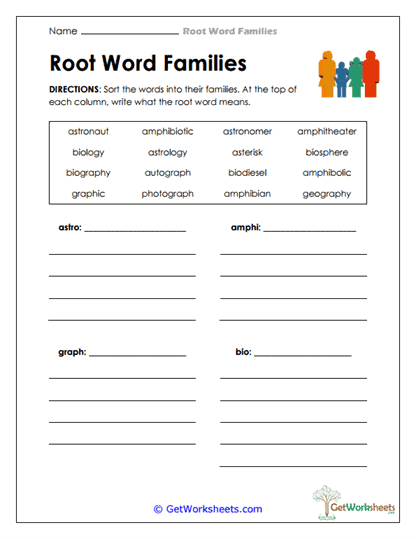
In this categorization challenge, students group words by shared Greek roots-astro, amph, graph, bio. They then define each root and identify examples like astronaut, amphibian, and biography. The exercise marries vocabulary recognition with visual organization, revealing how morphology functions as a classification system. Ideal for visual learners and concept mapping.
Word Family Connections
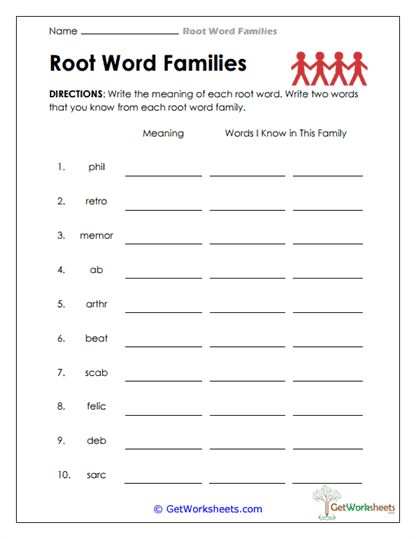
Working with roots such as phil (love), retro (backward), and memor (mind/memory), students connect meaning to usage by generating examples like philanthropy, retrofit, and memorial. This reflection-based activity invites discussion about how root meanings extend metaphorically through time-illustrating, for example, how retroactive and remember both reach backward in meaning.
Root Word Recall
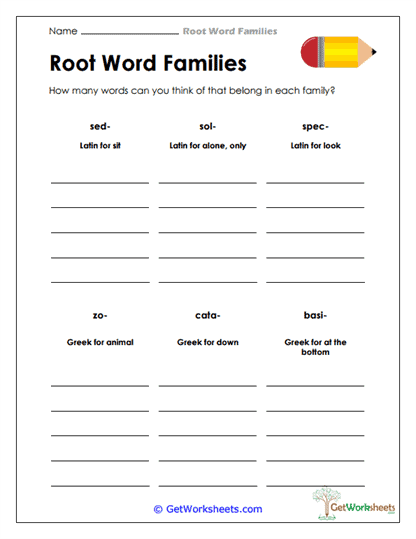
Students brainstorm extensive word families for roots like sed- (sit), spec- (look), and zo- (animal). This open-ended practice builds vocabulary breadth while emphasizing conceptual patterning. As they fill in webs of examples-sediment, spectator, zoology-learners realize that recognizing a root is like holding a master key for decoding entire sets of related words.
Root Mapping Practice
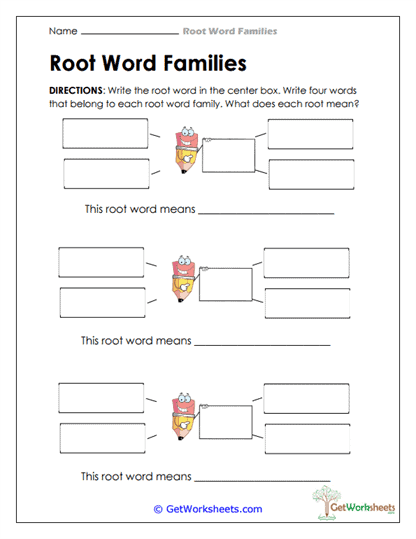
In a visual concept-map format, students place a root in the center, define it, and surround it with four or more connected words. This exercise translates linguistic analysis into a spatial model, helping learners "see" relationships between base meaning and derived terms. Perfect for integrating with digital tools or notebooks, this mapping approach reinforces morphological awareness through both structure and creativity.
Bookmark Us Now!
New, high-quality worksheets are added every week! Do not miss out!