Relative Pronouns Worksheets
-
Choosing Correct Pronouns
-
Choosing Who or That
-
Combining Sentences with Pronouns
-
-
Completing Clauses with Pronouns
-
Completing Relative Sentences
-
Fill-in Relative Pronouns
-
Forming Relative Clauses
-
Identifying Relative Pronoun Use
-
Identifying Relative Pronouns
-
Necessary Pronoun Identification
-
Relative Pronoun Clauses
-
Relative Pronoun Matching
-
Relative Pronoun Multiple Choice
-
True or False Grammar Review
-
Writing with Relative Pronouns
About This Worksheet Collection
The Relative Pronouns collection equips students to build clear, complex sentences by linking ideas with precision. Through approachable, theme-rich activities, learners practice how words like who, whom, whose, which, that, and where connect clauses, reduce repetition, and add detail. Teachers can flexibly deploy these pages for mini-lessons, stations, or targeted intervention, confident that each task blends direct practice with authentic reading and writing contexts.
Across the set, students identify pronouns in context, combine and revise sentences, and choose forms that match people, places, things, and possession. They also make higher-level decisions about restrictive vs. nonrestrictive clauses, analyze ambiguous cases, and reflect on why one pronoun communicates more clearly than another. The result is stronger syntax, sharper editing skills, and more cohesive writing.
Detailed Descriptions Of These Worksheets
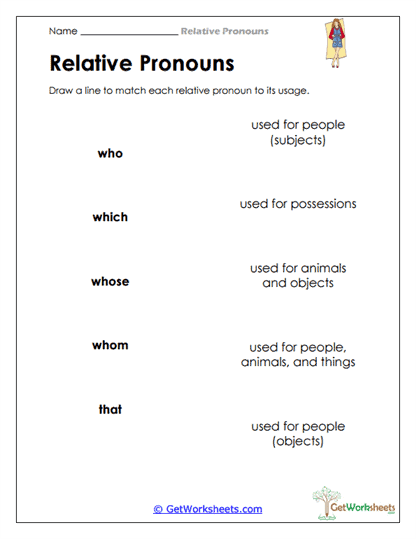
Relative Pronoun Matching
Students connect pronouns-who, which, whose, whom, and that-to the functions they serve. The visual mapping clarifies when each form refers to people, objects, animals, or possession. By distinguishing subject from object roles, learners solidify clause relationships and prepare for sentence-level application.
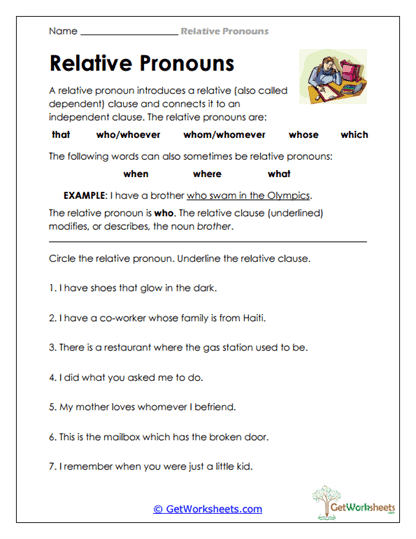
Relative Pronoun Clauses
Learners identify the relative pronoun in each sentence and underline the entire relative clause. They see how embedded information modifies a noun without starting a new sentence. This focused reading practice strengthens recognition of complex structure.
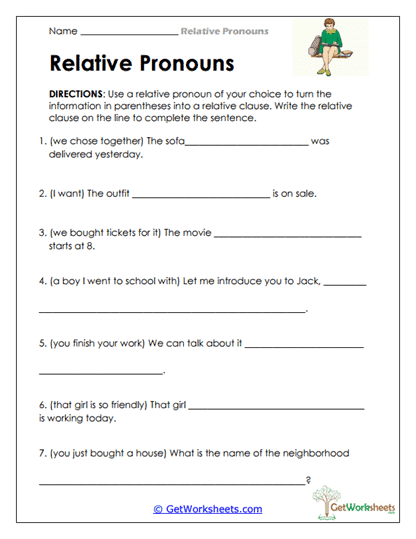
Forming Relative Clauses
Students turn parenthetical notes into smooth relative clauses, selecting the pronoun that fits meaning and grammar. As they fuse ideas, they practice punctuation and agreement. The exercise builds sentence fluency, coherence, and confident clause integration. It's a hands-on bridge from identification to production.
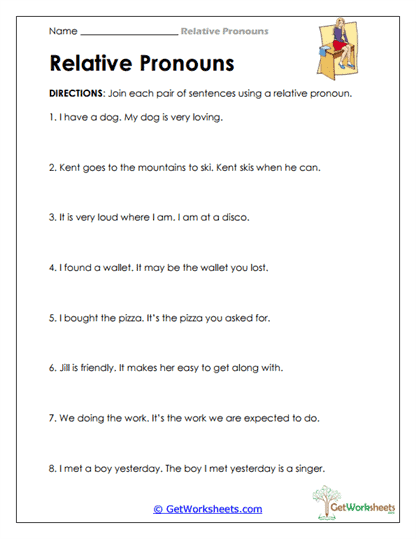
Combining Sentences with Pronouns
Pairs of simple sentences become one polished line using who, which, or that. Learners eliminate redundancy while maintaining meaning and emphasis. The activity highlights how relative clauses add variety and flow to informative or narrative prose.
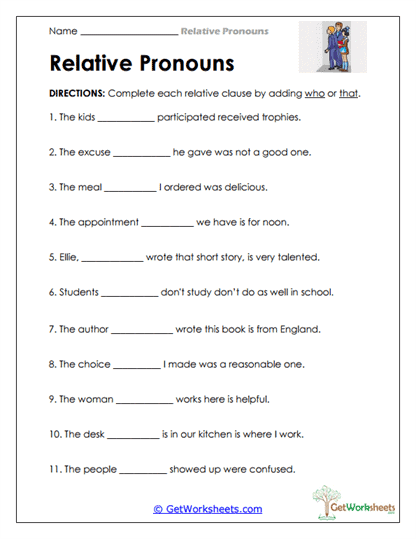
Choosing Who or That
This targeted drill asks students to choose between who and that based on context. They internalize the people/object distinction while noting accepted usage flexibility. Quick items promote accuracy and editorial judgment.
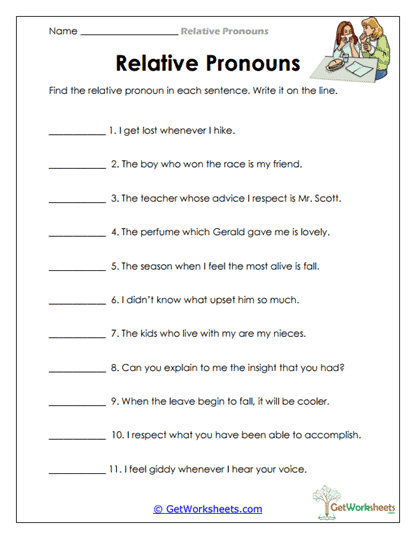
Identifying Relative Pronouns
Students pinpoint and write the relative pronoun used in each model sentence. Repeated recognition strengthens reading attention and clause awareness. Over time, learners build automaticity for spotting modifier clauses in authentic text.
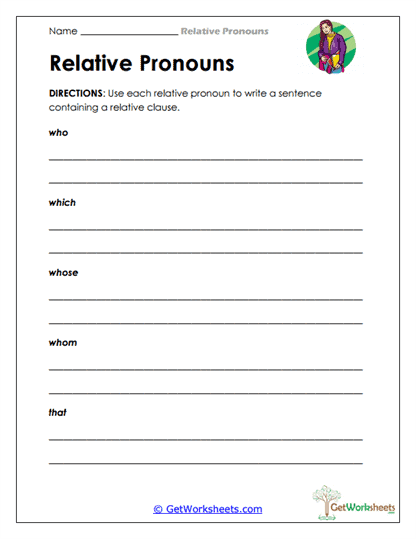
Writing with Relative Pronouns
Learners craft original sentences using who, which, whose, whom, and that. They demonstrate control of placement, agreement, and clarity. The creative prompt invites voice while keeping grammar precise.
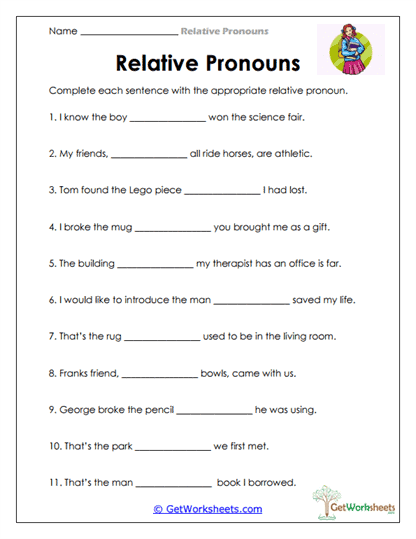
Completing Relative Sentences
With meaning as the guide, students supply the correct pronoun to complete each sentence. They weigh person vs. thing and possession vs. description to choose accurately. The practice reinforces clause linking and smooth sentence rhythm.
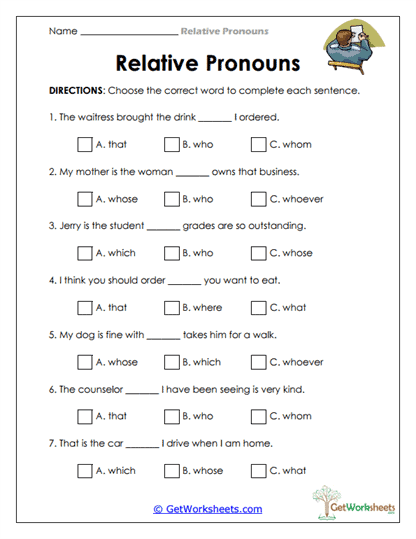
Relative Pronoun Multiple Choice
A quick-check format has learners select the best pronoun from close options. Items probe tricky distinctions and common confusions. It's an efficient review that builds confidence before longer writing tasks.
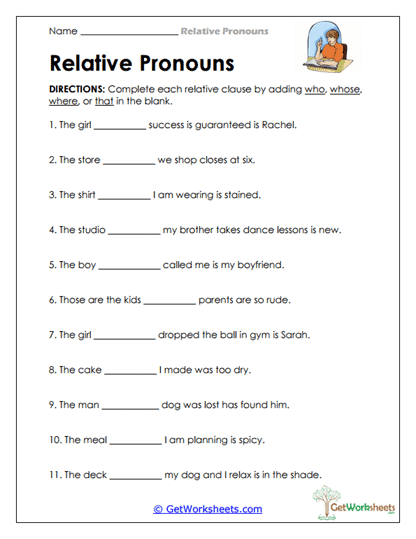
Completing Clauses with Pronouns
Students choose who, whose, where, or that to complete clauses tied to people, places, and things. The activity emphasizes semantic fit alongside grammatical correctness. It develops contextual reasoning and stronger sentence composition.
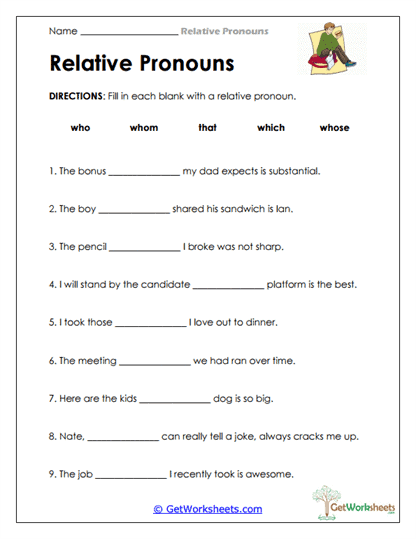
Fill-in Relative Pronouns
Learners analyze each sentence and insert who, whom, that, which, or whose to connect ideas. Attention to role and case sharpens usage and agreement. The consistent format supports independent practice and quick feedback.
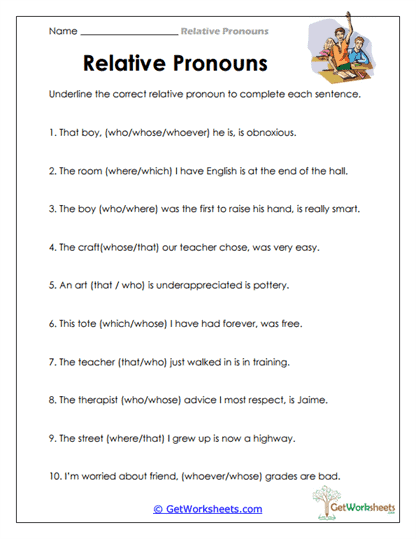
Choosing Correct Pronouns
Students underline the correct pronoun from two choices in parentheses, then reread for flow. This tight focus encourages editing habits and pronoun-antecedent awareness. It's a concise routine for daily warm-ups or centers.
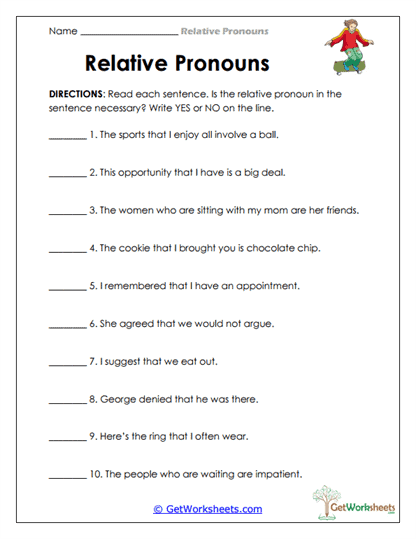
Necessary Pronoun Identification
Learners decide whether a relative clause is essential (YES) or extra information (NO). They begin to sense when commas are needed and why. This analytical step prepares students for accurate punctuation and style decisions.
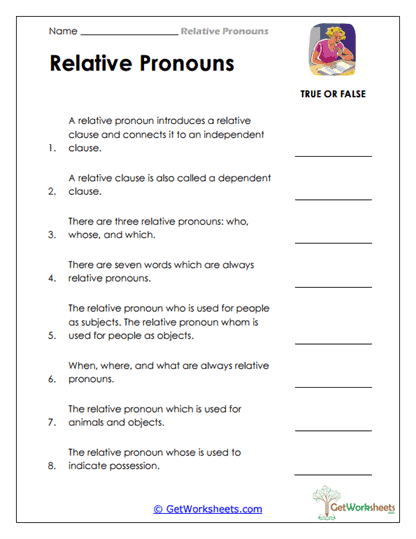
True or False Grammar Review
Students evaluate statements about pronoun roles, clause types, and usage rules. The format surfaces misconceptions quickly and invites discussion. It's a formative snapshot that consolidates foundational knowledge.
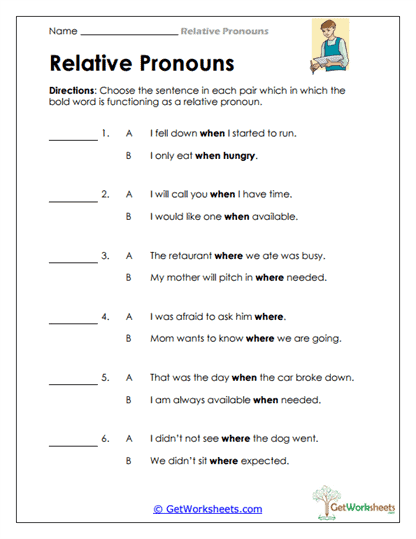
Identifying Relative Pronoun Use
Each pair of sentences contrasts a word's function, helping students spot when when/where/that act as relative pronouns rather than adverbs or conjunctions. Learners justify their choices with clause logic. The activity sharpens syntactic analysis and transfers directly to reading comprehension.
Bookmark Us Now!
New, high-quality worksheets are added every week! Do not miss out!