Moons and Their Features Worksheets
About This Worksheet Collection
The Moons and Their Features collection invites students to explore the fascinating diversity of moons that orbit planets across our Solar System. Through a mix of reading, matching, research, and creative reasoning tasks, learners investigate the composition, size, motion, and geological behavior of these celestial bodies. Each worksheet connects astronomy with literacy and critical thinking, helping students interpret scientific language, recognize planetary relationships, and explain how moons shape our understanding of space.
These activities build a well-rounded foundation in space science by blending factual knowledge with analytical and creative engagement. Students compare the features of moons like Europa, Titan, and Io, study historical discoveries, and examine how gravitational and geological forces transform lunar surfaces. The collection promotes curiosity, scientific literacy, and appreciation for the dynamic systems that exist beyond Earth.
Detailed Descriptions Of These Worksheets
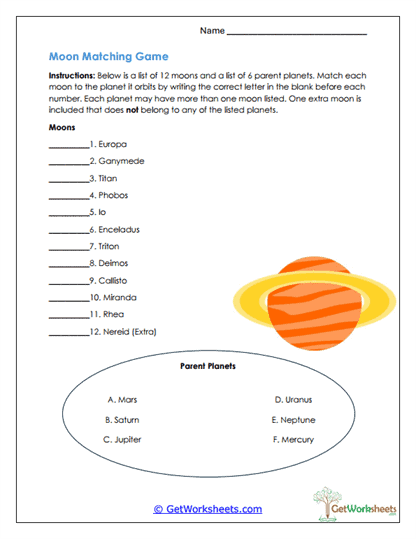
Matching Game
Students match twelve moons to the planets they orbit, such as Europa with Jupiter and Titan with Saturn. The extra moon provided adds a challenge that encourages careful reading and reasoning. Learners strengthen memory, pattern recognition, and classification skills. This task builds comprehension of how planetary systems are structured and interconnected.
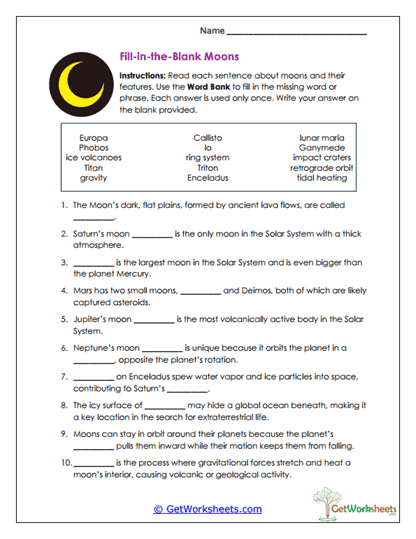
Fill-in-the-Blank
Learners complete ten sentences using a word bank of moon names and scientific terms like Ganymede, Titan, and tidal heating. Each statement highlights geological or atmospheric features that define major moons. The activity reinforces vocabulary, comprehension, and contextual application. It helps students grasp both surface characteristics and scientific significance.
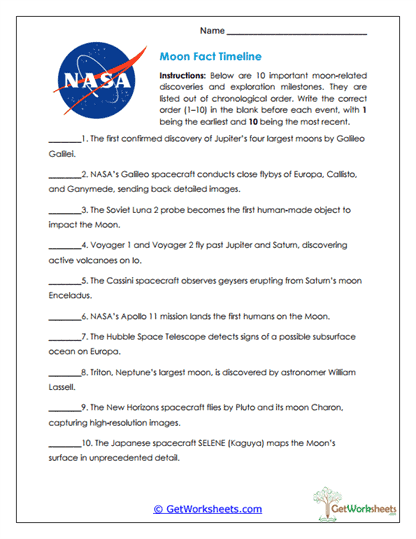
Fact Timeline
Students arrange ten key milestones in lunar and planetary discovery-from Galileo's observations to NASA's space missions-in chronological order. The sequencing task teaches historical progression in astronomy. It connects technological advancements to growing scientific understanding, blending literacy, history, and planetary science.
Research and Report
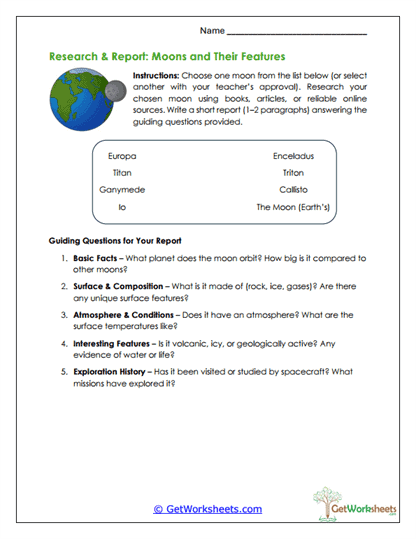
Learners choose one moon to research and compose a structured report using guiding questions. They describe its composition, atmosphere, unique traits, and exploration history. The worksheet strengthens research, organization, and writing skills while promoting independent inquiry. It fosters synthesis of information and effective scientific communication.
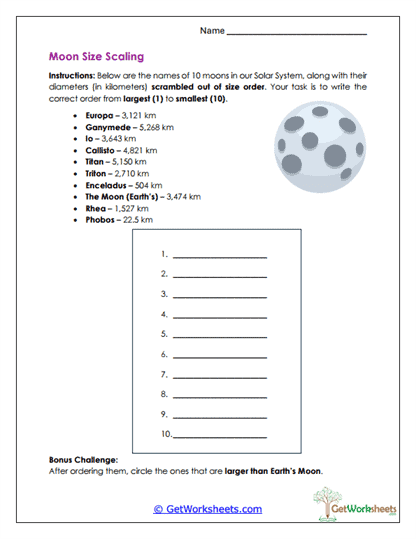
Size Scaling
Students rank ten moons by diameter from largest to smallest using provided data. They determine which are larger than Earth's Moon and visualize size comparisons. This quantitative exercise links math to astronomy, improving proportional reasoning. It deepens understanding of measurement, scale, and spatial relationships among celestial bodies.
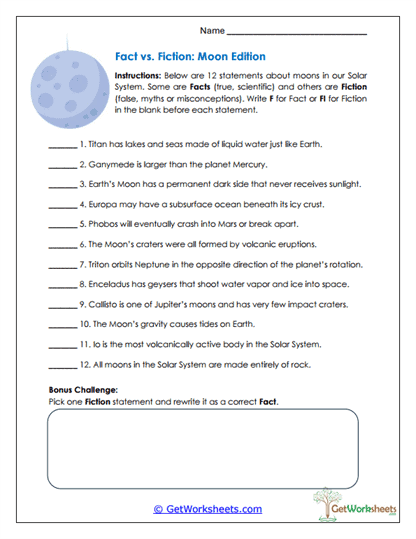
Fact vs. Fiction
In this evaluative task, students decide whether twelve moon-related statements are true or false, addressing misconceptions about volcanic activity, size, and composition. They then rewrite one incorrect statement to make it factual. The exercise promotes accuracy, critical thinking, and scientific reasoning through evidence-based correction.
Moons and Their Features
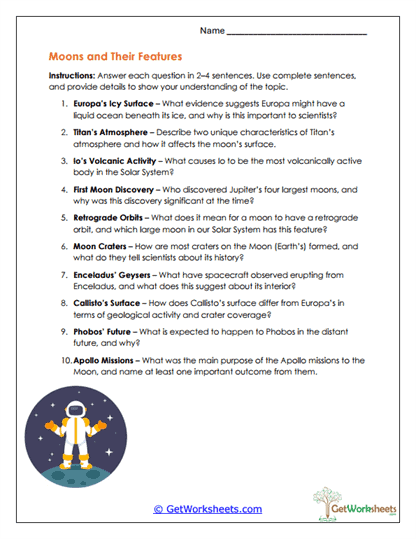
Students answer ten open-ended questions about moon discoveries, structures, and exploration. Topics include Io's volcanism, Europa's icy crust, and retrograde orbits. The task builds written communication skills and comprehension of key facts. Learners integrate detailed scientific explanations with concise, evidence-supported answers.
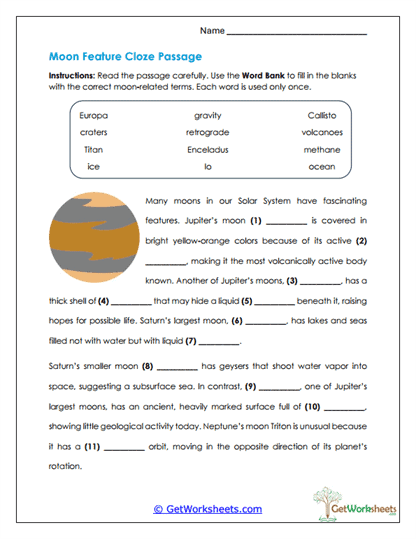
Feature Cloze Passage
In this fill-in-the-blank passage, learners use a word bank to describe the geology of Europa, Io, Titan, and Enceladus. The exercise strengthens contextual reading and vocabulary skills while reinforcing knowledge of lunar diversity. It supports literacy development in science by blending comprehension and terminology practice.
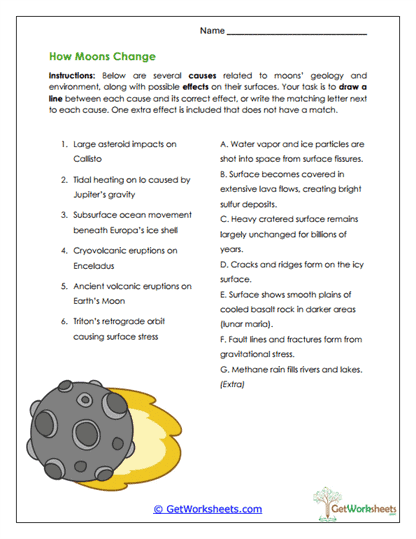
How Moons Change
Students match causes like tidal heating or cryovolcanism to corresponding surface effects, such as fissures or lava flows. One extra effect increases difficulty and promotes reasoning accuracy. The activity enhances understanding of dynamic geological processes. It encourages analysis of how energy and environment shape celestial surfaces.
Word Match
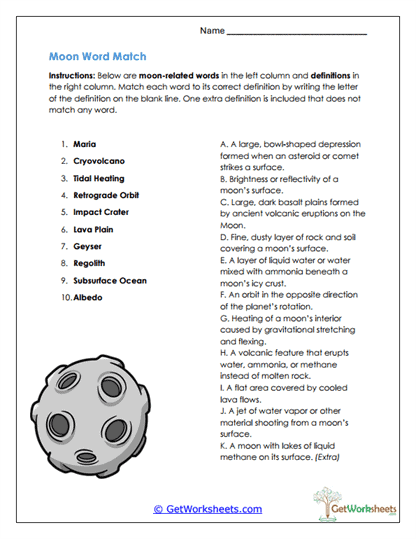
This vocabulary exercise focuses on lunar terms such as maria, geyser, and subsurface ocean. Students connect each word to its definition, distinguishing between similar scientific ideas. The task builds language precision, strengthens reading comprehension, and reinforces retention of planetary geology terminology.
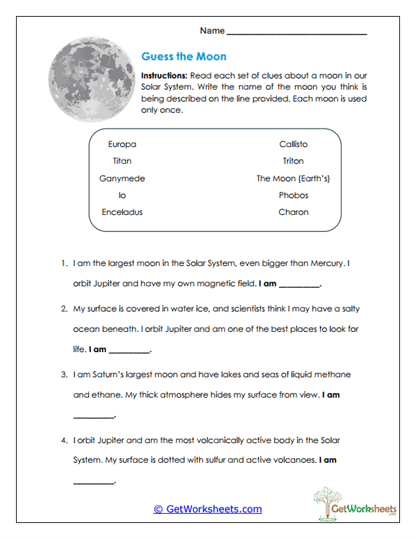
Guess the Moon
Learners identify famous moons using descriptive clues about features like icy crusts or dense atmospheres. Each clue requires deduction and knowledge of Solar System relationships. The challenge supports recall and analytical thinking while strengthening recognition of individual moon characteristics.
Multiple-Choice Quiz
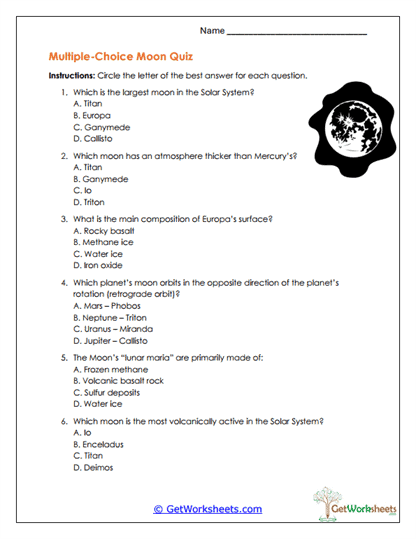
In this final assessment, students answer six questions covering moon composition, motion, and discovery. The quiz format reinforces factual recall, conceptual understanding, and test-taking skills. It serves as a comprehensive review of the unit, ensuring mastery of key ideas about moons and their features.
Bookmark Us Now!
New, high-quality worksheets are added every week! Do not miss out!