Missing Number Subtraction Worksheets
-
Basic Equation Completion
-
Basic Missing Withdrawals
-
Big Number Subtrahend Finder
-
-
Decrease Operations
-
Fill-In Missing Subtrahends
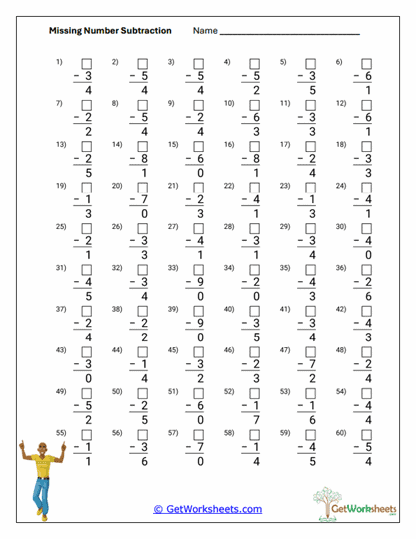
-
Find the Minuend
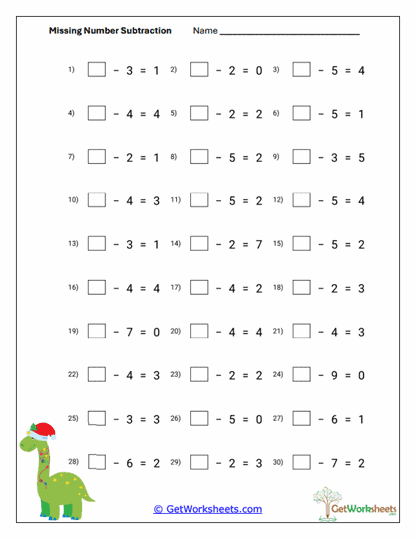
-
Find the Minuends
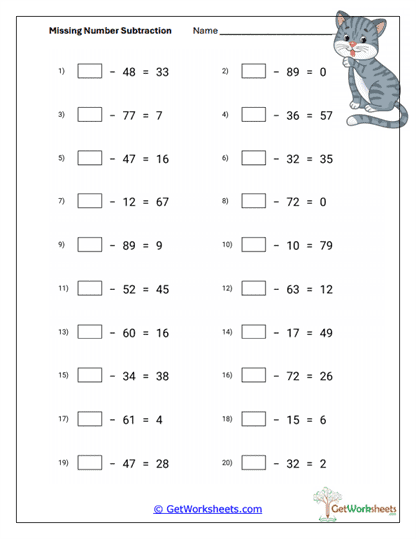
-
Find the Subtrahend (Hundreds)
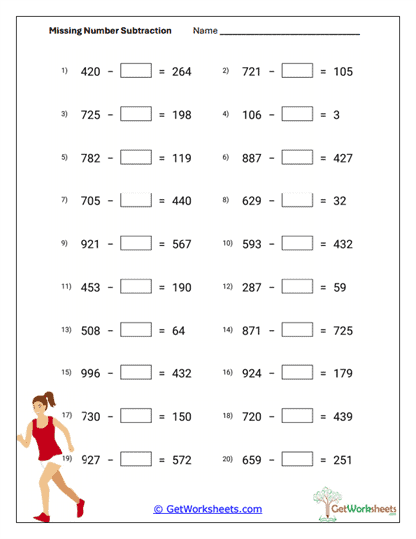
-
Four-Digit Missing
-
Four-Digit Missing
-
Missing Components Removal
-
Missing Digits
-
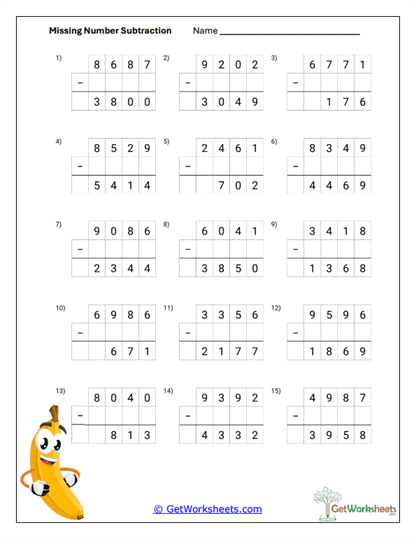
Missing Minuends
-
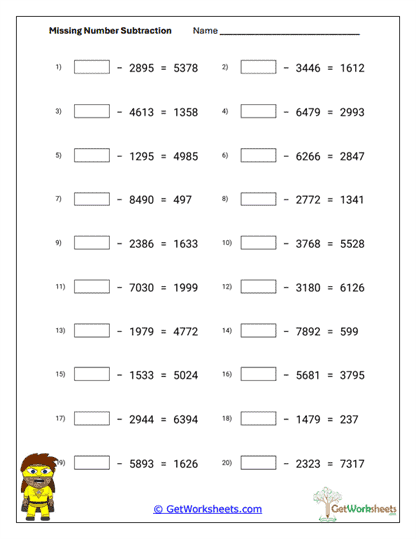
Missing Subtrahends
-
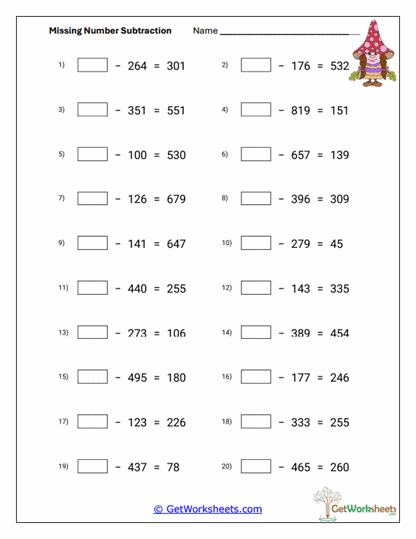
Search the Minuend
-
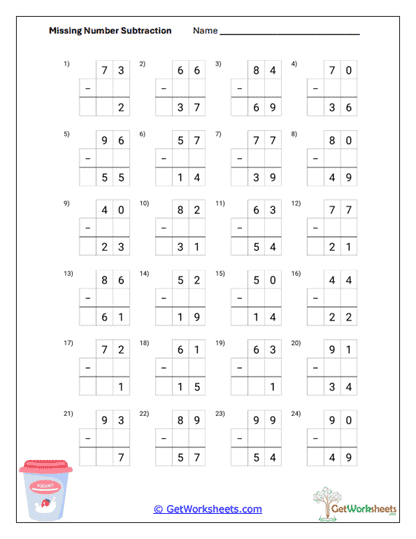
Structured Boxes
-
Subtraction Boxes
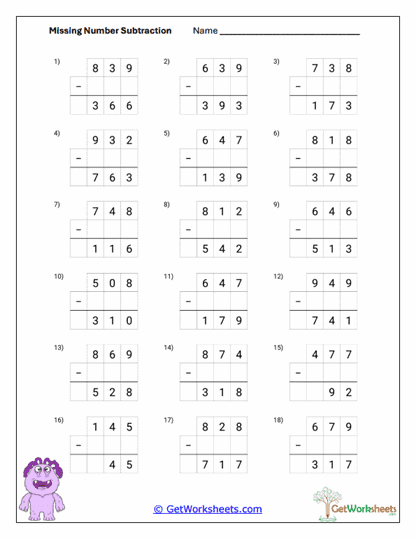
-
Three-Digit Missing Removals
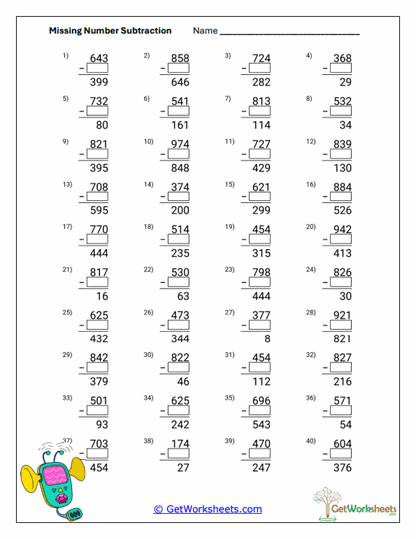
-
Triple-Digit Missing Boxes
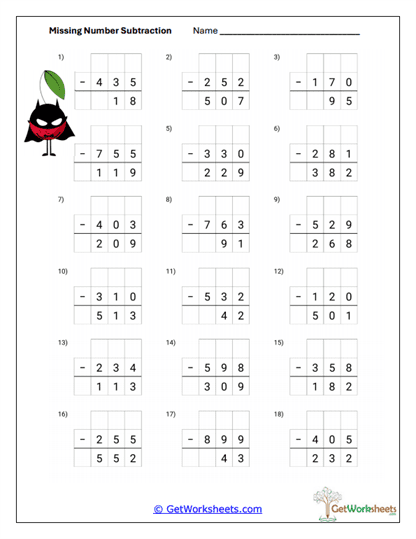
-
Two-Digit Column Subtraction
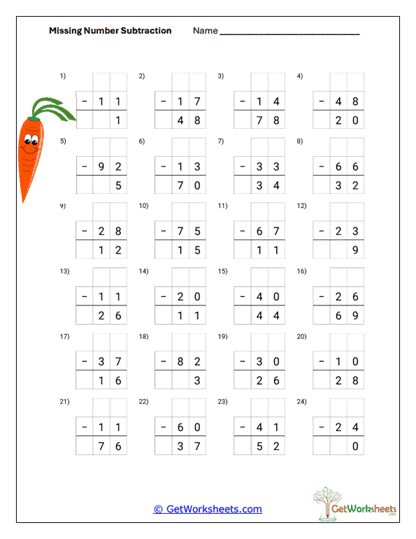
-
Two-Digit Equation Solving
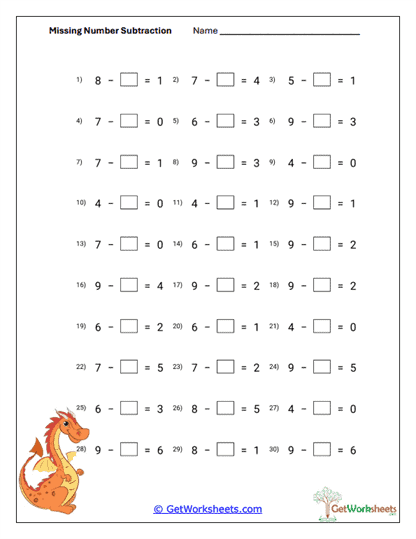
-
Two-Digit Missing
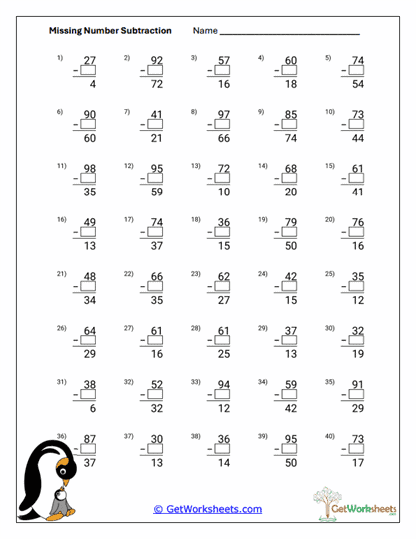
-
Two-Digit Unknowns
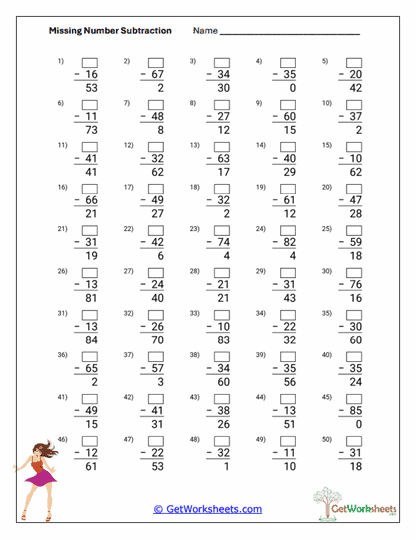
-
Unknown Negative Operations
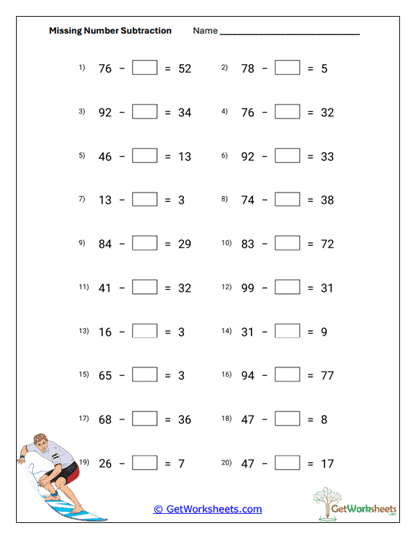
About This Worksheet Collection
This collection of missing number subtraction worksheets offers teachers a full spectrum of resources for helping students see subtraction as a flexible, relational operation rather than a one-way procedure. Across the set, learners work with single digits, two-digit values, and increasingly large multi-digit numbers, encountering unknowns in different positions within a subtraction equation. The variety of layouts-from straightforward equations to structured column boxes-makes these pages ideal for warm-ups, small-group lessons, independent practice, or targeted intervention.
As students progress through the worksheets, they build confidence using inverse operations, reasoning about place value, and reconstructing equations from partial information. They learn to identify missing minuends, subtrahends, and digits, and to check their thinking by relating subtraction back to addition. This steady exposure to unknown values strengthens number sense, mental math skills, and early algebraic thinking, laying a strong foundation for future equation solving and formal algebra.
Detailed Descriptions Of These Worksheets
Basic Missing Withdrawal
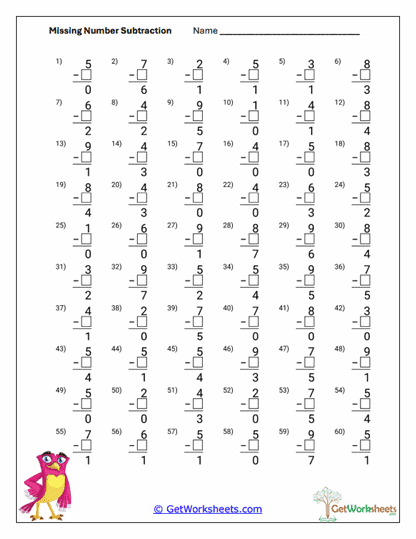
Students work with simple subtraction equations where one value is missing, using clues from the other numbers to determine the unknown. They practice identifying whether the blank represents the minuend, subtrahend, or difference, building flexibility in how they see subtraction. Single-digit facts keep the focus on reasoning rather than heavy computation. This sheet is an excellent way to introduce the idea of solving for unknowns using inverse operations.
Two-Digit Missings
Learners explore two-digit subtraction equations that each contain one missing number. They compare values, mentally compute differences, and decide which number correctly completes each statement. This page helps students connect subtraction and addition while strengthening their confidence with two-digit equations.
Three-Digit Missing Removals
On this worksheet, students extend their missing-number work into three-digit subtraction contexts. They analyze each equation, sometimes using regrouping or backward reasoning, to discover the value that makes the subtraction true. The problems encourage careful attention to place value across ones, tens, and hundreds. As they solve, students deepen their understanding of how subtraction behaves with larger numbers and more complex structures. The sheet works well for guided practice, homework, or independent review.
Four-Digit Missing
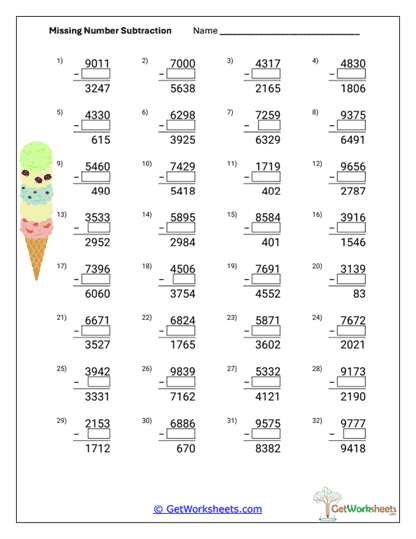
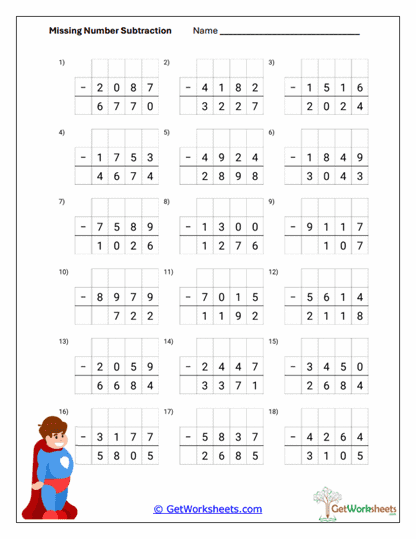
Students confront four-digit subtraction problems in which a single value is missing, inviting them to think flexibly about equation structure. They draw on inverse operations and strong place-value knowledge to determine the unknown. Several problems require regrouping across multiple digits, reinforcing multi-step subtraction fluency. This worksheet is ideal for learners transitioning into more advanced arithmetic and early algebraic reasoning.
Fill-In Missing Subtrahends
This worksheet focuses on subtraction equations where the unknown appears mainly as the subtrahend. Students must figure out which number must be taken away to produce the given result, emphasizing subtraction as a relationship. Problems span single- and two-digit values, giving a balanced level of challenge. It is a powerful tool for helping learners reason about what "goes with" the minuend and difference in each fact.
Two-Digit Unknowns
Students solve two-digit subtraction equations that feature blanks in different positions, including missing minuends, subtrahends, and differences. They examine how the numbers relate to one another and often use regrouping to reason out the solution. This worksheet strengthens flexible thinking because the unknown can move around within the equation. Over time, learners develop stronger computational fluency and a more robust understanding of equation balance.
Missing Components Removal
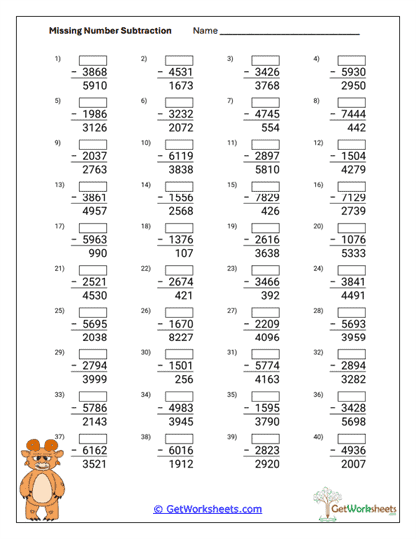
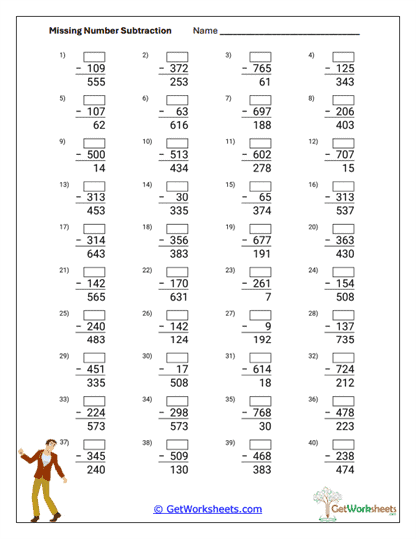
This page challenges learners with three- and four-digit subtraction equations that include an unknown term. Each problem asks students to reconstruct the missing element by thinking about place value and the interaction between digits in each column. Regrouping across several places frequently comes into play, reinforcing careful, multi-step reasoning. The worksheet supports upper-elementary students as they move toward pre-algebra concepts. By the end, students are more adept at working backward through extended subtraction problems.
Basic Equation Completion
Students encounter straightforward subtraction equations with a missing single-digit number, making this page perfect for early practice. They rely on the connection between addition and subtraction to determine what number completes each fact. The problems highlight fact families and simple equation structures. This sheet reinforces core fluency while nurturing early equation-solving confidence.
Two-Digit Equation Solving
Learners tackle two-digit subtraction equations in which one component is missing. They must decide which value keeps the equation balanced, often using mental math and regrouping. The problems promote flexible use of inverse operations and comparison strategies. This worksheet works well for practice sessions, review, or informal assessments.
Unknown Negative Operations
On this worksheet, students work with a mix of two-, three-, and four-digit subtraction equations that contain missing values. They examine each expression and determine the number that makes the subtraction valid, often needing to regroup across several columns. The tasks deepen understanding of the roles played by minuend, subtrahend, and difference in larger equations. Over time, learners build advanced subtraction fluency and stronger place-value reasoning. This resource is particularly helpful for students who are ready to connect arithmetic with emerging algebraic thinking.
Find the Subtrahend (Hundreds)
Students are given three-digit subtraction problems in which the middle number-the subtrahend-is missing. To solve, they must infer what was subtracted, reinforcing the use of inverse operations and reasoning with differences. The values stay accessible while still offering meaningful practice in the hundreds place. This worksheet is well-suited for quick checks, warm-ups, or independent reinforcement.
Big Number Subtrahend Finder
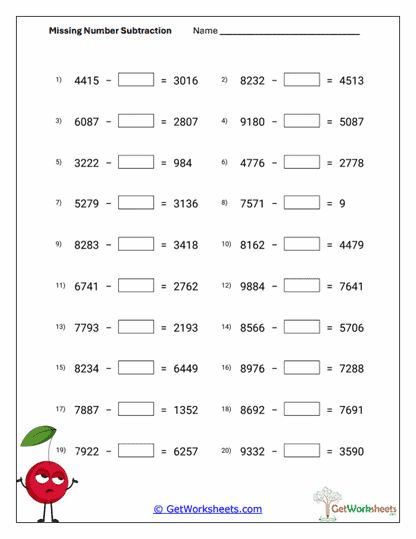
This worksheet invites learners to find missing subtrahends in large-number subtraction problems that extend into the thousands. Students must reconstruct what was taken away by using the given result and starting number, sharpening algebraic-style thinking. The wide range of values strengthens comfort with multi-digit place value and regrouping. It is an excellent choice for advanced practice, homework, or mastery checks.
Find the Minuend
Here, the missing value is the first number in the subtraction equation, so students must rebuild the minuend from the subtrahend and difference. Problems mix tens and smaller three-digit numbers, striking a balance between accessibility and challenge. This structure encourages learners to see subtraction as reversible and to think critically about how equations can be reconstructed. Teachers can use this page to model number-line strategies or algebraic reasoning. Students gain experience rebuilding equations rather than simply computing answers.
Find the Minuends
Students solve two-digit problems in which they must identify the missing starting number that, when decreased, yields the given result. The carefully chosen values make the task supportive for learners who are just beginning to work backward through equations. A clean, uncluttered format keeps attention on the relationships among the numbers. This worksheet is ideal for centers, small-group remediation, or early algebra-readiness instruction.
Search the Minuend
In this worksheet, students analyze three-digit equations where the minuend is missing and must be inferred. They combine the subtrahend and difference to reconstruct the original number, sometimes navigating regrouping situations. The problems vary in complexity, offering a mix of straightforward and more demanding tasks. This page helps upper-elementary learners practice higher-level reasoning about multi-digit subtraction.
Missing Subtrahends
Learners work through a set of short subtraction equations that all feature missing subtrahends. They rely on inverse thinking to decide which number was removed to reach each difference. Small values and a structured layout make the worksheet approachable for younger students. Over repeated practice, learners sharpen both mental subtraction and early algebraic reasoning. The sheet is perfect for quick practice sessions or targeted fluency drills.
Decrease Operations
This worksheet presents two-digit subtraction problems with unknown subtrahends, encouraging students to analyze how tens-based subtraction works. They decide which number must be taken away in each case, strengthening place-value understanding. The set includes a blend of easier and moderately challenging items. It fits naturally into math centers, warm-ups, or number-sense mini-lessons.
Structured Subtraction Boxes
Students see three-digit subtraction arranged in vertical boxes, with one digit missing in either the minuend or subtrahend. The boxed format emphasizes column alignment and regrouping logic. Learners must think carefully about how each column interacts to keep the subtraction valid. This worksheet is especially helpful for visual learners and for modeling careful, step-by-step reasoning. By the end, students display improved accuracy with multi-digit subtraction involving unknowns.
Subtraction Boxes
This page offers four-digit subtraction problems in a boxed format where one or more digits are missing. Students inspect each column to deduce what numbers must appear for the subtraction to work correctly. The tasks encourage disciplined thinking about regrouping and place-value relationships. Problems increase in complexity, preparing students for more advanced arithmetic and algebra readiness. It serves well as independent work, center practice, or a formative assessment tool.
Missing Minuends
Learners work with large-number subtraction problems in which the minuend is missing and must be reconstructed. They add the subtrahend and difference to recover the original number, reinforcing reversible thinking and multi-step reasoning. Strong place-value fluency is required, as many problems involve regrouping across several columns. This worksheet is well-suited for challenge activities or mastery practice in upper elementary grades.
Missing Digits
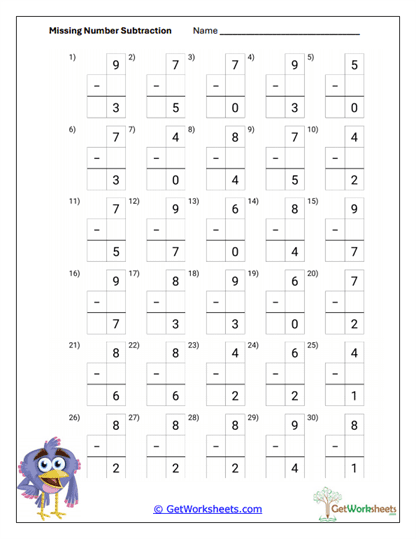
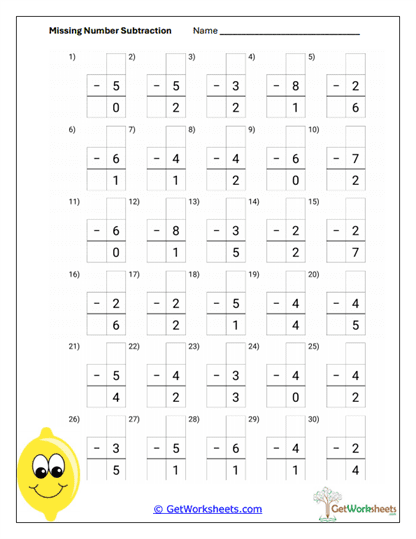
This worksheet provides single-digit column subtraction problems where one digit is missing in different positions. Students determine which digit completes each equation, focusing on logic and structure more than on difficult computation. The boxed layout helps them track columns and notice early regrouping ideas. It works beautifully for beginners, intervention groups, and fluency warm-ups. Learners build foundational subtraction reasoning as they experiment with which digits make each equation true.
Two-Digit Column Subtraction
Students encounter two-digit column subtraction problems with missing digits in the minuend or subtrahend. They use place-value logic and regrouping awareness to decide which numbers must fill the blanks. The grid layout supports careful, step-by-step checking. This worksheet is a strong fit for practice rotations or guided work, helping learners transition toward more formal algebraic reasoning.
Triple-Digit Missing Boxes
This worksheet features three-digit subtraction problems arranged in boxes, each containing one or more missing digits. Students must reason through complex regrouping situations to determine which numbers complete the subtraction accurately. The visual scaffolding keeps digits aligned and supports clear tracking of borrowing steps. A range of difficulty levels makes the sheet useful in mixed-ability classrooms. As learners fill in each missing value, they build analytical thinking, regrouping fluency, and confidence with multi-digit equations.
Four-Digit Missings
Students analyze four-digit subtraction equations with unknown values, often in the thousands place, and decide which digit or number makes each statement correct. Many problems require multi-column regrouping, prompting deep engagement with place-value logic. The structured boxes help learners visualize the algorithm and maintain accuracy. This worksheet is excellent for enrichment, mastery checks, or advanced practice. By the end, students demonstrate strong algebraic thinking foundations and a nuanced understanding of multi-digit subtraction with unknowns.
Bookmark Us Now!
New, high-quality worksheets are added every week! Do not miss out!