Mayflower Compact Worksheets
About This Worksheet Collection
This Mayflower Compact worksheet collection provides a rich set of resources designed to help students explore the foundations of early American self-government. Through vocabulary practice, sequencing tasks, reading comprehension, analogy work, and character-based decision-making, learners gain a deeper understanding of the Pilgrims' experiences and the significance of the agreement they created at sea. These worksheets are structured to support both whole-class instruction and independent practice, making them adaptable for a range of learning environments.
Across the collection, students strengthen essential academic skills including historical reasoning, contextual vocabulary use, summarization, argumentative writing, and comparative analysis. By engaging with a variety of activity formats, learners deepen their understanding of cooperation, rule-making, governance, and community-building in the colonial era. The worksheets also promote reflective thinking as students connect early colonial decisions to broader themes in civic life and democratic principles.
Detailed Descriptions Of These Worksheets
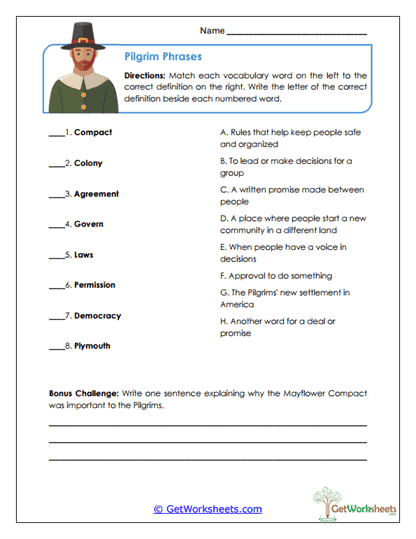
Pilgrim Phrases
Students match important terms connected to the Pilgrims and the Mayflower Compact with the definitions that best fit each concept. As they pair vocabulary and meaning, they gain clarity on early ideas related to agreements, leadership, and governing a new settlement. The activity also encourages learners to think about how the Compact shaped the Pilgrims' community. A brief bonus question prompts them to reflect on why the document mattered in early American history.
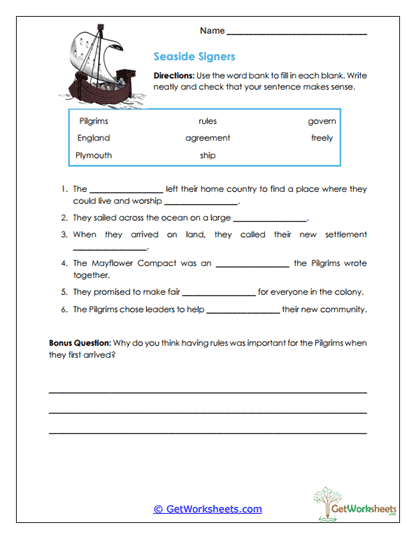
Seaside Signers
Learners complete sentences using a word bank of terms tied to Pilgrim life and colonial governance, reinforcing their understanding of settlement vocabulary. Each filled-in sentence helps students connect context clues with historical content. The worksheet also encourages deeper reasoning through a short bonus response about the need for rules in the new colony. Students strengthen reading comprehension and vocabulary usage while exploring foundational themes of cooperation.
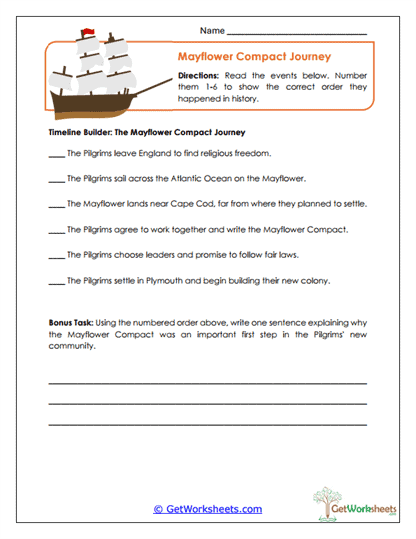
Mayflower Compact Journey
Students read six events from the Pilgrims' voyage and place them in the correct chronological sequence. This timeline-building exercise helps learners visualize the steps that led from leaving England to establishing the Plymouth Colony. By reconstructing the order, students better grasp cause-and-effect relationships within early settlement history. A bonus prompt invites them to explain why the Mayflower Compact represented an essential first step in building a functioning community.
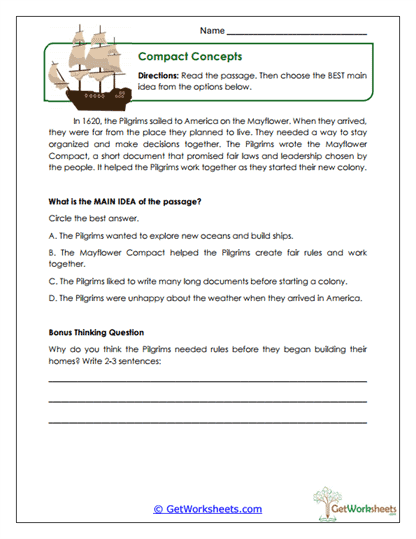
Compact Concepts
In this worksheet, students read a short passage describing why the Pilgrims wrote the Mayflower Compact and then choose the best main idea from a set of options. This task helps them practice distinguishing central ideas from supporting details. A follow-up writing activity encourages students to explain why rules were necessary even before homes were built. Through these steps, learners strengthen both reading comprehension and historical reasoning.
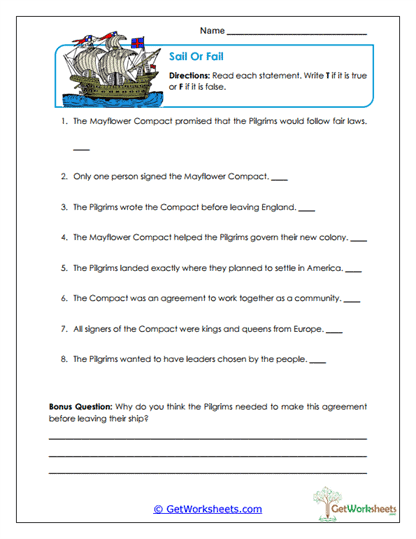
Sail or Fail
Students evaluate a series of True/False statements about the Mayflower Compact, deciding whether each one accurately reflects key historical ideas. They reinforce knowledge of cooperation, settlement, and leadership as they assess each statement. A bonus prompt encourages learners to reflect on why the Pilgrims needed an agreement before leaving the ship. This activity supports careful reading while correcting misunderstandings about early colonial governance.
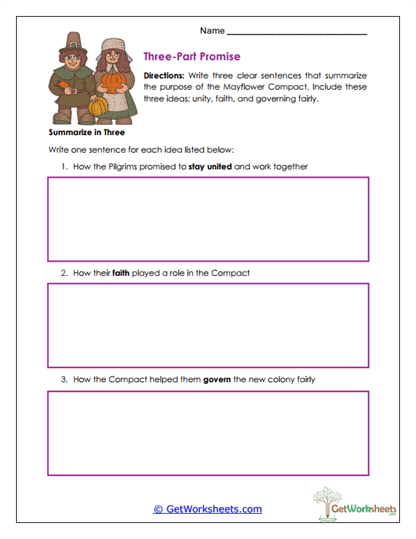
Three-Part Promise
Learners write three clear sentences explaining the core purposes of the Mayflower Compact, focusing on unity, shared beliefs, and fair governance. The exercise encourages them to summarize complex ideas in straightforward language. By expressing the key points in their own words, students improve comprehension and clarity in writing. The task also strengthens understanding of how the Pilgrims organized themselves as a community.
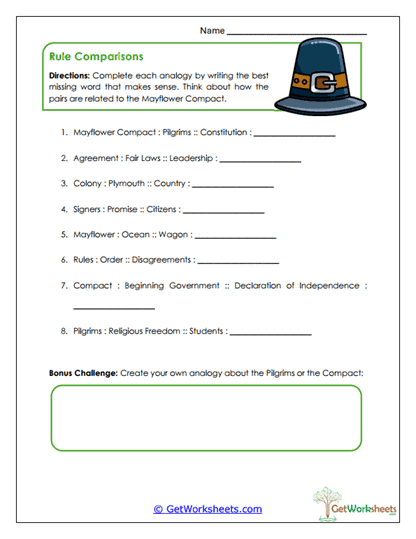
Rule Comparisons
Students complete analogies that connect Pilgrim vocabulary and concepts from the Mayflower Compact to broader ideas about leadership and governance. The activity helps learners understand how early colonial principles relate to larger civic structures. It also prompts them to think critically about relationships between words and ideas. A bonus challenge invites them to create their own analogy, demonstrating deeper conceptual mastery.
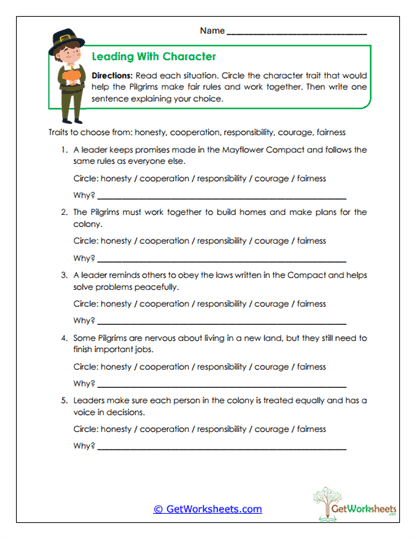
Leading With Character
Learners read short scenarios about the Pilgrims' early experiences and identify which character trait best fits each situation. They then justify their choice in a complete sentence, reinforcing the link between civic virtues and community-building. Through these examples, students see how honesty, fairness, cooperation, and other traits supported the Pilgrims' efforts. The task encourages thoughtful decision-making and responsible citizenship.
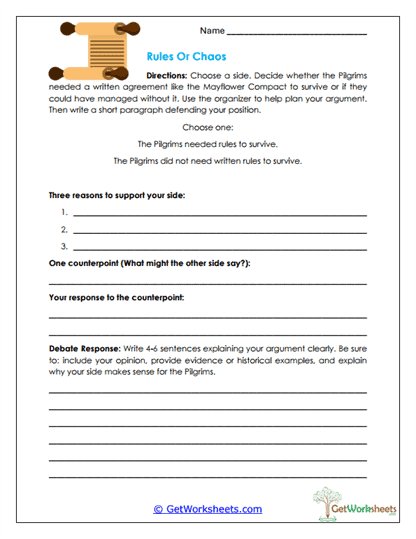
Rules or Chaos
Students take a position on whether the Pilgrims needed the Mayflower Compact and develop reasoning within an argument organizer. They list supporting evidence, acknowledge a counterclaim, and craft a well-organized paragraph that presents a clear stance. This assignment deepens understanding of why written rules were vital for survival in a new colony. It also builds essential argumentative writing skills tied to historical evidence.
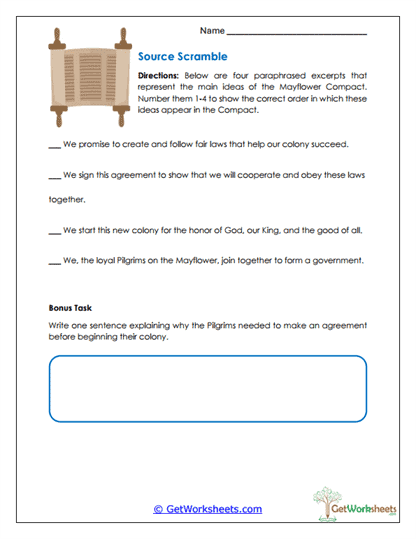
Source Scramble
In this worksheet, students number four paraphrased statements from the Mayflower Compact in their correct order. The sequencing task helps them grasp the organization and core themes of the agreement. Learners reflect on ideas such as cooperation, shared beliefs, and the creation of fair laws. A bonus prompt encourages them to consider why an agreement was necessary before building the colony. This activity supports comprehension of primary source ideas in an accessible format.
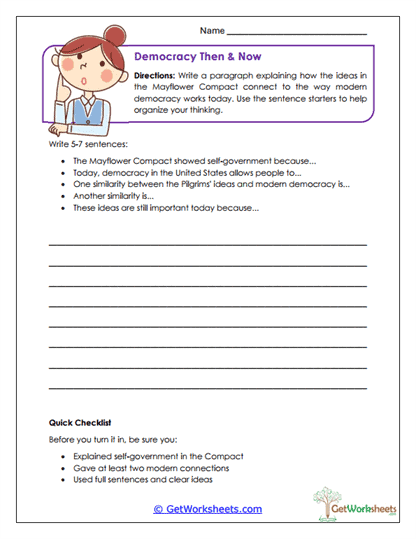
Democracy Then & Now
Students write a paragraph comparing democratic principles from the time of the Mayflower Compact to those practiced in the United States today. Sentence starters help guide their thinking as they analyze similarities and reflect on continuity over time. The activity requires complete sentences, clear explanations, and relevant evidence. A quick checklist reminds learners to include comparisons, historical details, and well-organized reasoning.
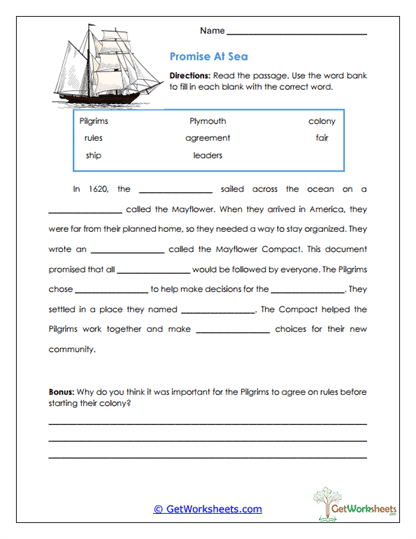
Promise at Sea
Learners complete a short passage by inserting vocabulary terms from a word bank, reinforcing comprehension of the Pilgrims' journey and early governance. The structured fill-in-the-blank format supports understanding of how and why the Mayflower Compact was created. Students then answer a bonus reflection question that builds connections between rules and successful settlement. This worksheet strengthens contextual vocabulary use and introduces key ideas about cooperation and leadership.
Bookmark Us Now!
New, high-quality worksheets are added every week! Do not miss out!