Marbury v. Madison Worksheets
About This Worksheet Collection
This Marbury v. Madison worksheet collection offers educators a complete set of learning tools for teaching one of the most influential Supreme Court cases in U.S. history. These resources guide students through core concepts such as judicial review, separation of powers, constitutional interpretation, and the political tensions of the early republic. The materials include timelines, text analysis activities, vocabulary building, paragraph writing, and comparative evaluations-making the collection adaptable for a range of instructional needs.
Across these worksheets, students strengthen essential skills in chronological reasoning, evidence-based writing, close reading of historical text, and civics understanding. They learn how to interpret judicial decisions, analyze the roles of government branches, and articulate informed claims about democratic principles. By progressing through varied activity types, learners build a deep, accurate, and confident understanding of why Marbury v. Madison remains a cornerstone of American constitutional law.
Detailed Descriptions Of These Worksheets
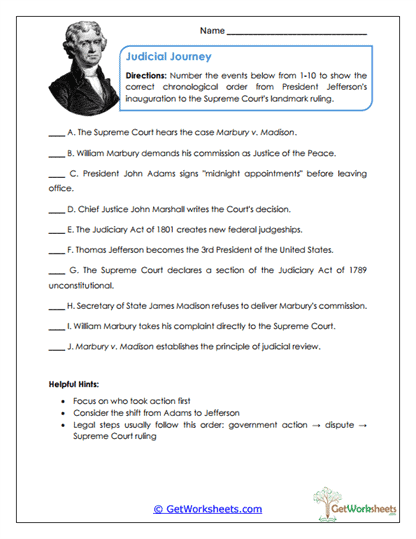
Judicial Journey
Students organize ten key events leading up to and following the Marbury v. Madison ruling, helping them see how political conflict unfolded step-by-step. As they sort each statement, they gain insight into how actions by presidents, cabinet members, and the Supreme Court shaped the final outcome. The activity strengthens students' ability to track cause-and-effect relationships in government decision-making. By completing the sequence, learners reinforce their understanding of judicial review and the emerging balance of power in the early republic. Helpful hints support accuracy and careful reasoning.
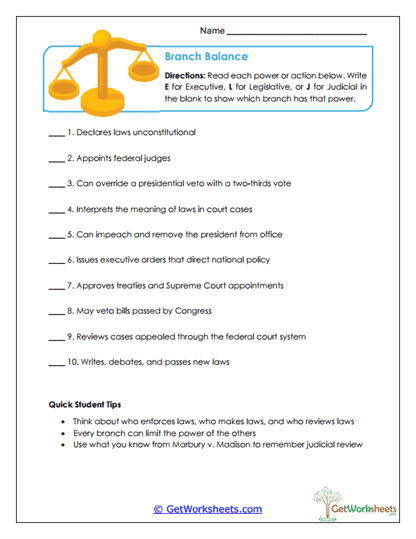
Branch Balance
Learners determine which branch of government carries out each listed function, labeling actions as belonging to the Executive, Legislative, or Judicial Branch. The activity sharpens their understanding of how authority is divided among the branches and how each contributes to constitutional government. Students also connect this knowledge to Marbury v. Madison as they think about the Court's responsibility to interpret laws. By practicing categorization, they build confidence in recognizing checks and balances in action.
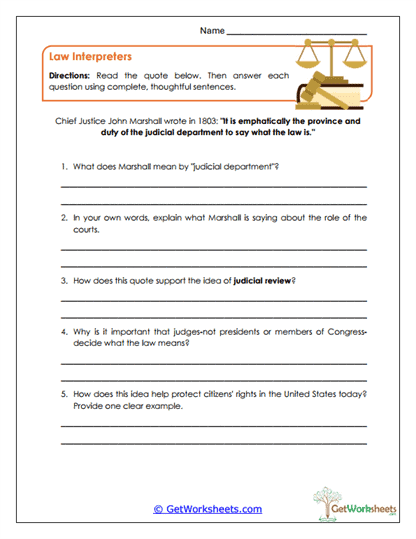
Law Interpreters
In this worksheet, students examine a statement from Chief Justice John Marshall and respond to several questions that require thoughtful interpretation. They unpack Marshall's view of judicial authority, consider its relationship to constitutional interpretation, and connect his ideas to the development of judicial review. The activity guides learners toward understanding why courts play a vital role in protecting individual rights. Through written responses, students refine both analytical thinking and clarity of explanation.
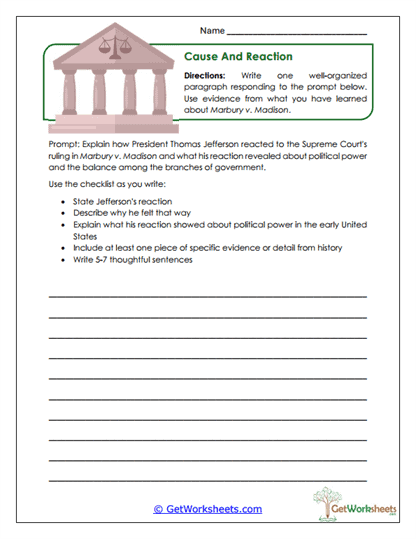
Cause and Reaction
Students write a well-developed paragraph examining how President Thomas Jefferson reacted to the Supreme Court's ruling in Marbury v. Madison. They explain his concerns about judicial overreach, analyze what his response revealed about early political tensions, and support their ideas with historical evidence. This assignment strengthens structured writing skills as learners craft a complete, coherent paragraph. It also deepens understanding of how leaders responded to the Court's evolving power.
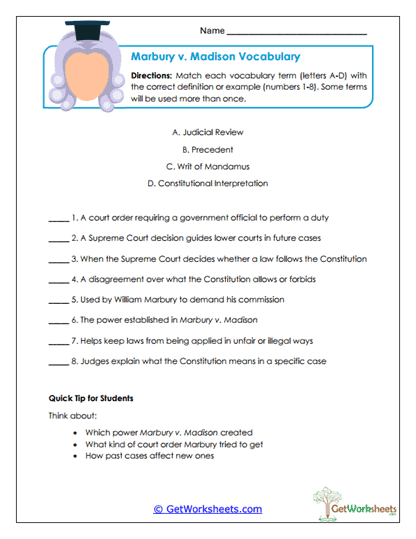
Marbury v. Madison Vocabulary
Learners match important constitutional terms to their correct definitions or examples, reinforcing foundational language needed to discuss the case accurately. The repeated use of several vocabulary items helps students solidify their understanding of judicial review, writs of mandamus, and legal precedent. By working through the matching activity, they build confidence with terminology that appears frequently in civics and legal studies. Quick tips encourage them to link each term to the case's legacy in American government.
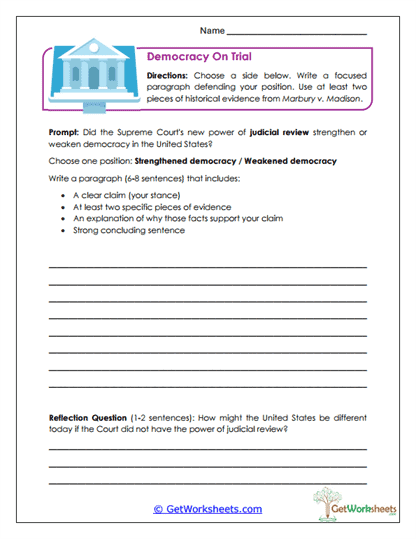
Democracy on Trial
Students choose a position on whether judicial review ultimately strengthened or weakened democracy and write a paragraph defending that viewpoint. They support their argument with specific evidence from the case and conclude with a clear, reasoned statement. The reflection prompt encourages them to imagine how the United States might function without judicial review, extending their thinking beyond the historical moment. This activity builds persuasive writing skills and sharpens historical evaluation.
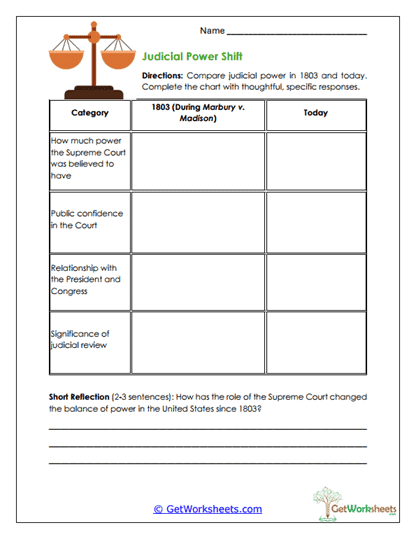
Judicial Power Shift
This worksheet invites students to compare the power and public perception of the Supreme Court in 1803 with its role today. They complete a chart that highlights how judicial influence, relationships with other branches, and public trust have evolved. A short written response encourages them to articulate how judicial review contributed to these long-term changes. The task strengthens comparative analysis and understanding of continuity and change in American government.
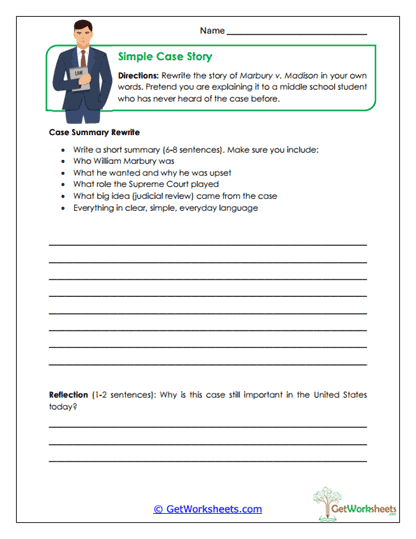
Simple Case Story
Learners retell the story of Marbury v. Madison in plain language suitable for a younger audience. They summarize the roles of Marbury, Madison, the Supreme Court, and Chief Justice Marshall while explaining the conflict that led to the ruling. This exercise reinforces students' ability to simplify complex ideas without losing accuracy. A brief reflection helps them connect the case's events to its lasting importance in U.S. history.
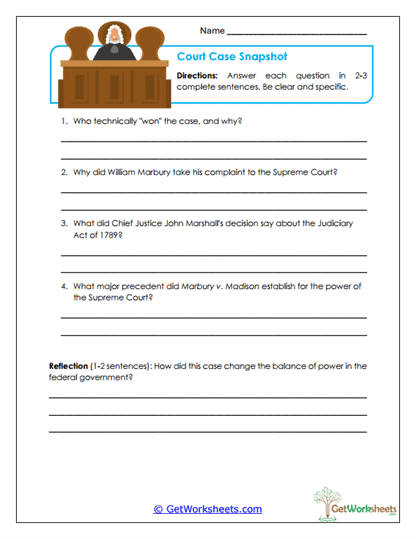
Court Case Snapshot
Students answer concise questions about the key outcomes of Marbury v. Madison, including who won, why the case reached the Supreme Court, and what the ruling established. Each response requires them to use clear, accurate details in complete sentences. A short reflection asks them to consider how the decision shifted federal power, encouraging deeper thinking. This worksheet strengthens factual understanding and precise written explanation.
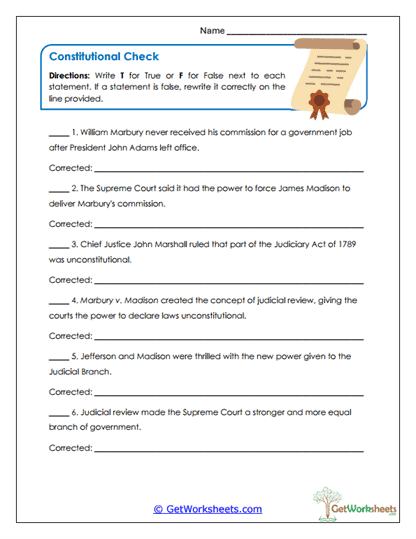
Constitutional Check
In this activity, students decide whether statements about Marbury v. Madison are true or false and correct any inaccurate ones. The process reinforces comprehension of judicial review, the Judiciary Act of 1789, and the Court's constitutional authority. By rewriting false statements, learners practice careful reading and factual precision. The task supports mastery of essential case details and strengthens general constitutional literacy.
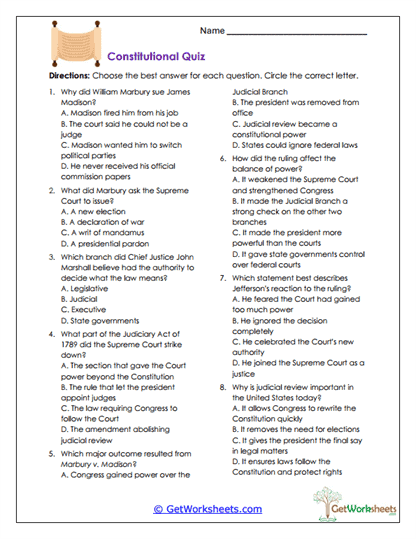
Constitutional Quiz
This multiple-choice quiz assesses students' understanding of the Marbury v. Madison case and its constitutional implications. The questions ask learners to identify key facts, understand judicial review, and evaluate shifts in the balance of power. The quiz format allows for efficient review and helps students solidify critical civics knowledge. It also encourages them to consider why the case remains a foundational Supreme Court decision.
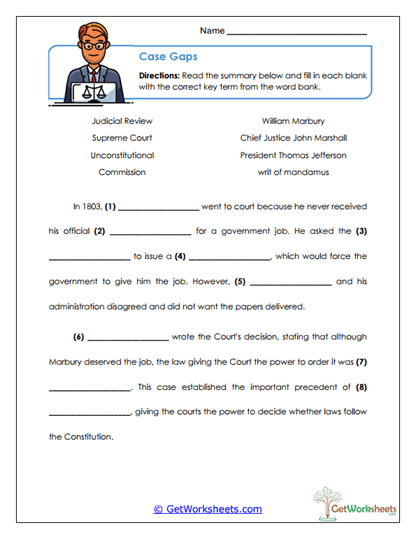
Case Gaps
Students complete a fill-in-the-blank summary of Marbury v. Madison using a word bank of essential terms. They apply vocabulary such as commission, writ of mandamus, judicial review, and unconstitutional in the correct context to reconstruct the case narrative. The activity improves comprehension while reinforcing both terminology and sequence of events. As they complete the summary, learners develop a clearer understanding of the conflict at the heart of this landmark ruling.
Bookmark Us Now!
New, high-quality worksheets are added every week! Do not miss out!