Irregular Plural Nouns Worksheets
-
Advanced Plural Practice
-
Choosing Correct Plurals
-
Choosing Multiple Plural Forms
-
-
Fill-in Plural Forms
-
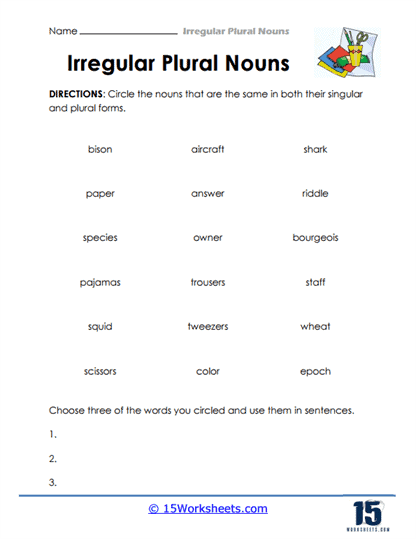
Identifying Same-Form Nouns
-
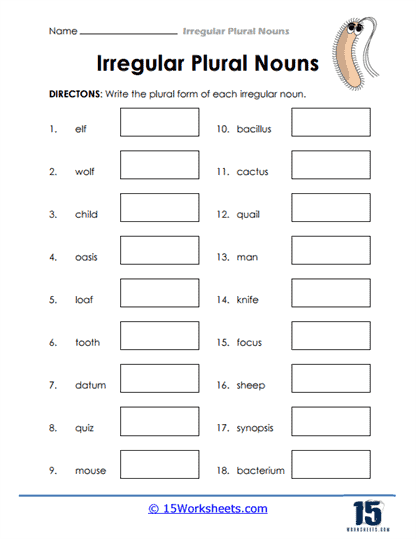
Irregular Plural Writing
-
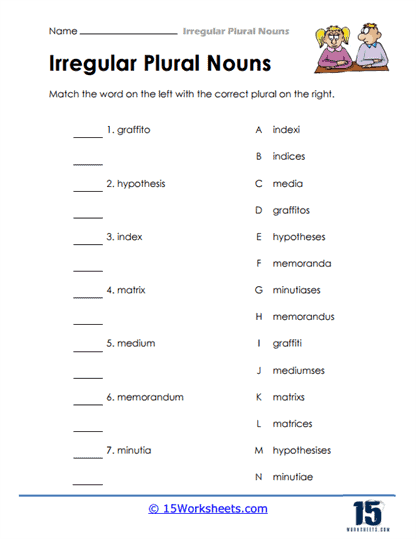
Matching Advanced Plurals
-
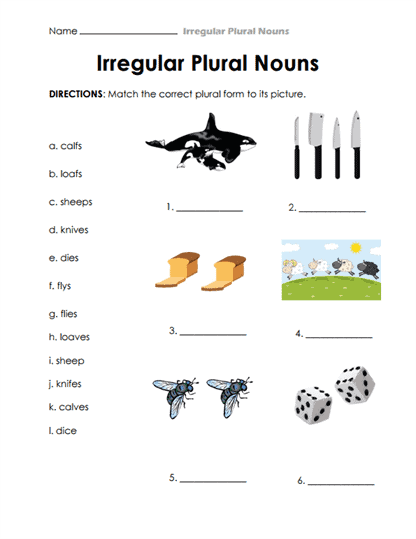
Matching Plural Forms
-
Matching Singular to Plural
-
Picture Word Bank Plurals
-
Picture-Based Plural Practice
-
Rewriting Sentences with Plurals
-
Selecting Correct Irregular Plurals
-
Sorting Plural Patterns
-
Writing Irregular Plurals
About This Worksheet Collection
The Irregular Plural Nouns collection turns one of English's trickiest grammar topics into accessible, engaging practice. Across picture prompts, matching games, editing tasks, and context-rich sentences, students encounter irregular patterns-from vowel shifts to classical endings-in ways that build confidence and retention. The variety supports whole-class lessons, small-group stations, and independent work, making it easy to spiral review or differentiate for diverse learners.
As students work through the set, they learn to recognize patterns, apply rules, and justify choices about nonstandard plurals. Activities emphasize morphology, spelling accuracy, and vocabulary growth while connecting forms to meaning in real sentences. By comparing regular and irregular change patterns, learners strengthen decoding, writing fluency, and academic language-skills that transfer directly to reading and content-area work.
Detailed Descriptions Of These Worksheets
Matching Plural Forms
Students match images of irregular plurals-such as knives, calves, and dice-to the correct written forms. The visual pairing anchors memory for spellings that diverge from "-s/-es" patterns. Learners develop morphological awareness as they compare singulars with their irregular counterparts. It's a concrete, confidence-building introduction to irregular plurals.
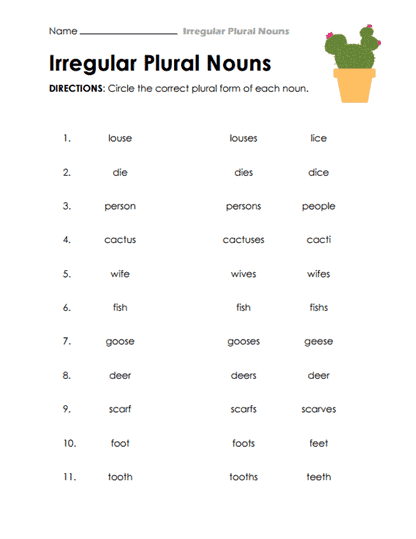
Choosing Correct Plurals
This multiple-choice practice asks students to select the accurate irregular plural for words like goose and cactus. Each item spotlights common error patterns and exceptions. Learners sharpen analysis as they eliminate near-miss spellings.
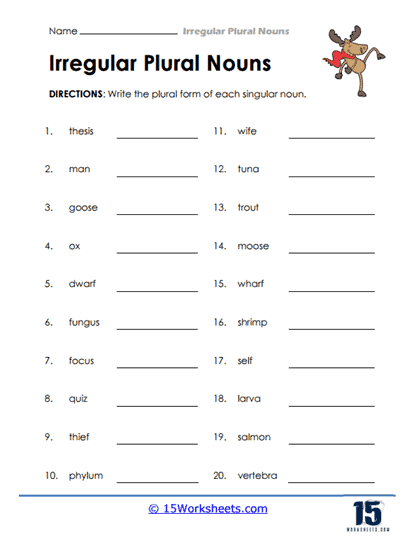
Writing Irregular Plurals
Students convert singular irregular nouns (e.g., man, fungus, ox) into their correct plural forms. The writing focus reinforces spelling conventions through deliberate practice. Repetition builds recall while revealing families of related patterns. It's a straightforward drill with high payoff for accuracy.
Picture-Based Plural Practice
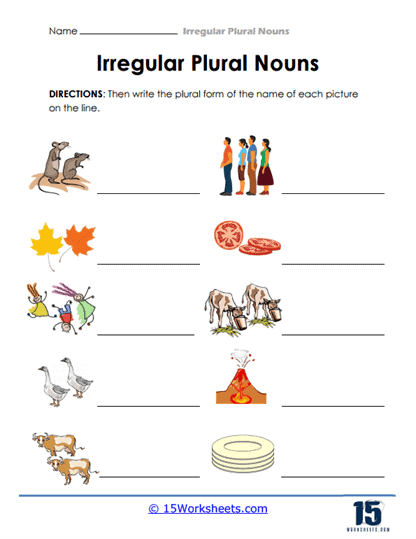
Learners study illustrations-leaves, geese, people-and write the matching irregular plural. The image-to-word link supports English learners and developing spellers. It's an engaging way to connect concrete visuals to abstract orthographic rules.
Identifying Same-Form Nouns
Students locate nouns that keep the same form in singular and plural (deer, fish, aircraft). They then craft sentences to prove understanding in context. The task highlights meaning over spelling cues, encouraging careful reading. It also builds syntactic flexibility and audience-ready sentence construction. A brief writing component cements long-term retention.
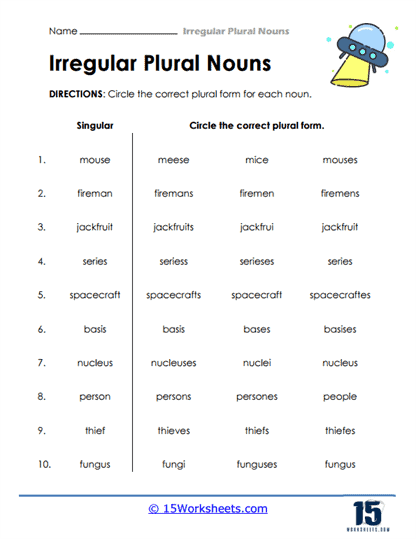
Selecting Correct Irregular Plurals
With pairs such as mouse/mice and person/people, learners circle the correct plural from close distractors. Items target common misconceptions and internal vowel changes. It's an efficient check for mastery and a quick formative assessment.
Picture Word Bank Plurals
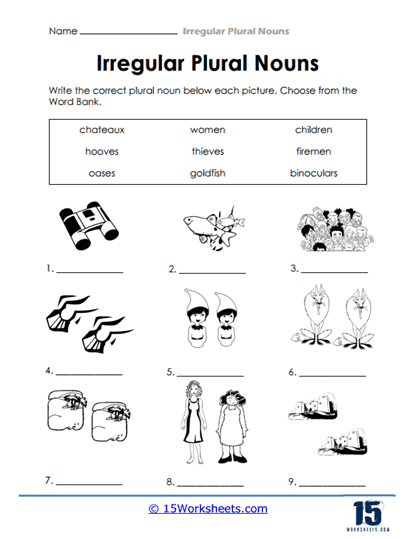
A curated word bank (e.g., children, hooves, thieves) guides students to label corresponding images. The scaffolded design supports learners at varying levels while emphasizing accurate spelling. Visual association deepens vocabulary recall. Students leave with a stronger mental map of high-frequency irregulars.
Irregular Plural Writing
Students generate plurals for a mixed list (wolf, child, datum, mouse), attending to diverse change patterns. The exercise blends memorization with analysis of endings and stems. It's ideal for reinforcing production skills needed in authentic writing.
Matching Singular to Plural
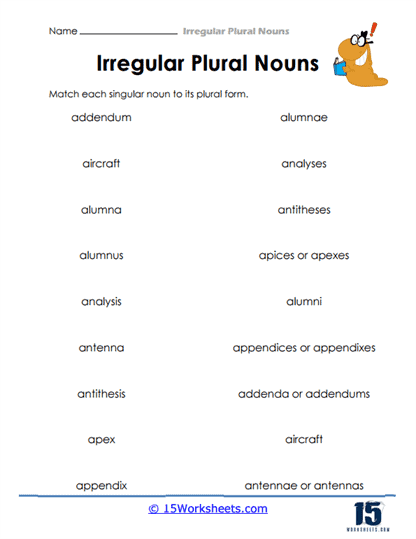
Learners match academic singulars like appendix and analysis to their correct classical plurals. The task introduces Latin and Greek morphology in approachable bites. Pattern noticing replaces guesswork, improving precision. It's a bridge to discipline-specific vocabulary in science and social studies.
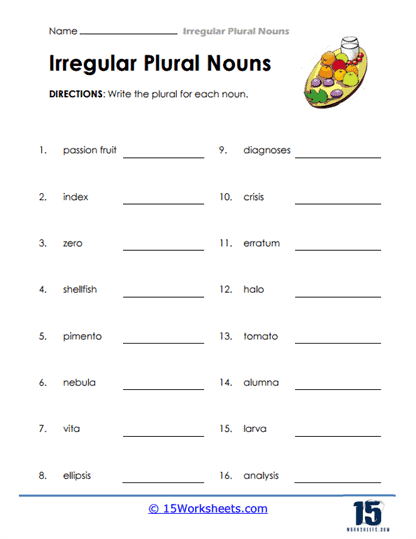
Advanced Plural Practice
Students write plurals for higher-level terms (index, crisis, larva), deciding when forms shift, stay the same, or take alternative endings. Brief exposure to variant plurals broadens academic register. Repeated retrieval strengthens spelling accuracy and morphological insight. The set prepares learners for content-area texts.
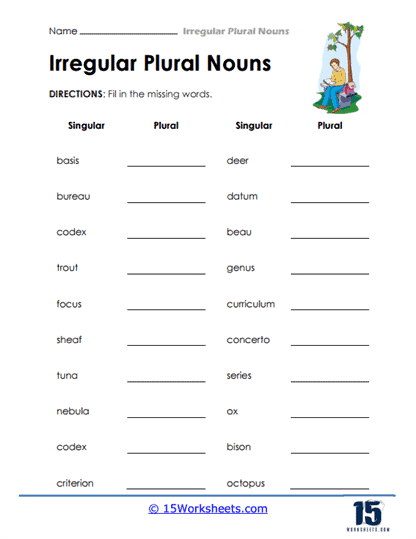
Fill-in Plural Forms
A chart prompts students to supply plurals for words like basis, datum, genus, and criterion. The structured grid highlights families of endings across roots and origins. It's a tidy format for quick practice and review.
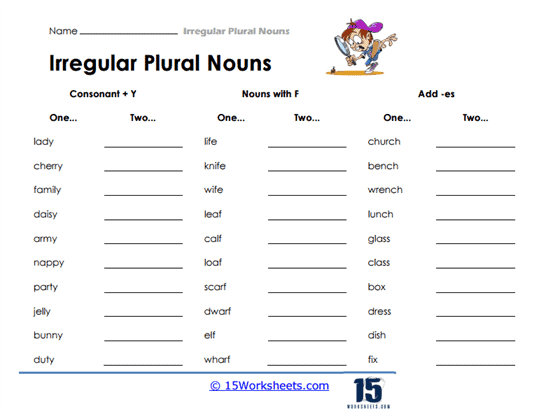
Sorting Plural Patterns
Learners sort words by transformation type: "-y to -ies," "-f to -ves," and "add -es." They record both singular and plural to visualize the shift. Sorting turns rules into discoverable patterns. Students compare exceptions, refine spelling choices, and articulate why a form belongs in a column. It's powerful metacognitive practice for long-term mastery.
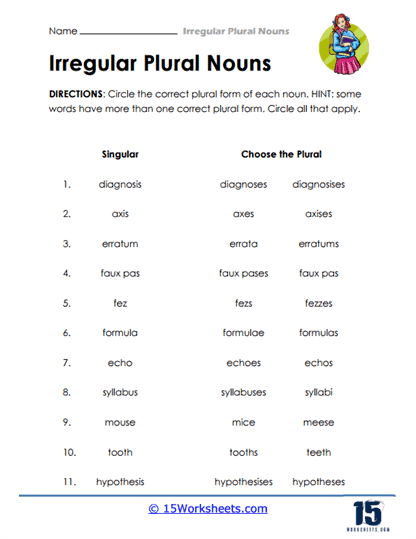
Choosing Multiple Plural Forms
Some nouns permit variants-this worksheet asks students to circle all acceptable plurals (e.g., formulae/formulas). Learners analyze origin, register, and context to justify choices. The activity builds flexibility and usage awareness. It's a smart step toward sophisticated academic writing.
Matching Advanced Plurals
Students connect singulars like index, matrix, medium to their precise plural partners. Close-look matching reinforces memory for classical endings. It's a concise, high-impact review for upper-level vocabulary.
Rewriting Sentences with Plurals
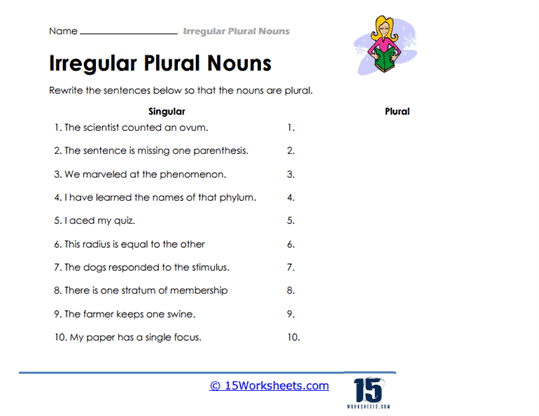
Learners rewrite full sentences by converting singular irregulars (ovum, stimulus, radius) into correct plurals. Contextual practice strengthens syntax, agreement, and fluency. The applied approach transfers directly to content writing and assessments. It's an authentic capstone task that blends morphology with clear, accurate prose.
Bookmark Us Now!
New, high-quality worksheets are added every week! Do not miss out!