Idioms Worksheets
About This Worksheet Collection
The Idioms worksheet collection is designed to move students beyond "guess-and-check" toward true figurative fluency. Across stories, riddles, analogies, and real-life scenarios, learners don't just memorize meanings-they practice why an idiom works, when it fits, and how it shifts tone. Each activity blends context clues, precise word choice, and creative expression so students internalize idioms as tools for vivid, efficient communication in both reading and writing.
Detailed Descriptions Of These Worksheets
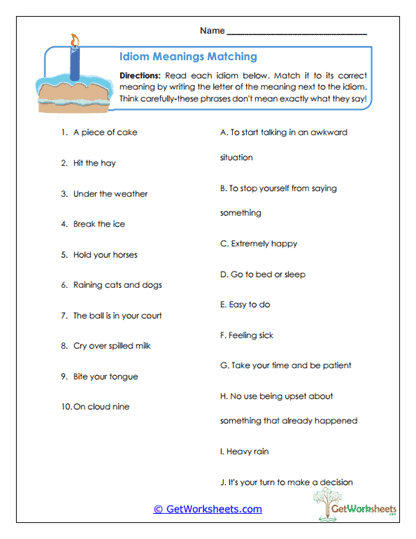
Idiom Meanings Matching
Students match common idioms to their figurative meanings, but the learning goal is deeper than a simple pair-up. Side-by-side choices force learners to reject tempting literal interpretations (e.g., "hit the hay" ≠ "punch straw") and to justify the figurative option using context logic they could explain aloud. Ideal as a diagnostic or spiral review, this task seeds a class "idiom wall" and gives you quick visibility into which expressions are secure and which need explicit reteaching.
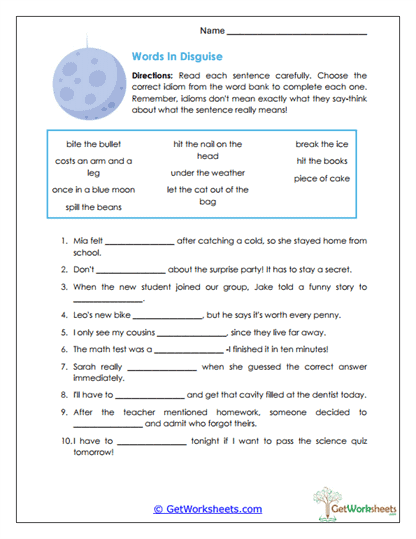
Words in Disguise
With a word bank of idioms (e.g., spill the beans, under the weather, hit the books), students select phrases that complete sentences naturally. Because each blank is embedded in a micro-scenario, learners must read for subtle tone and register-recognizing, for instance, that hit the books fits an academic setting while bite the bullet fits a moment of necessary discomfort. Encourage students to paraphrase their chosen idiom beneath each sentence; that extra line cements understanding and curbs "lucky guesses."
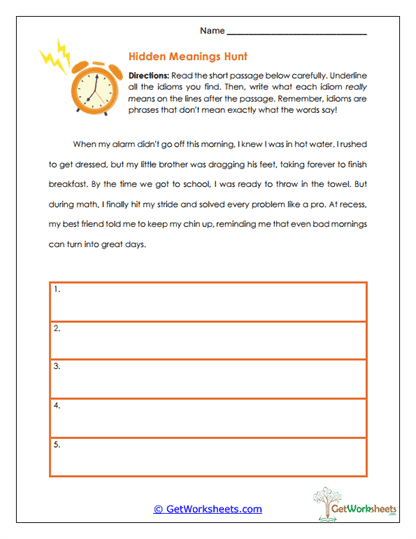
Hidden Meanings Hunt
A short narrative is packed with idioms (in hot water, throw in the towel, etc.). Students first locate each expression, then annotate the margin with what it truly means and how it shapes character attitude or plot. This dual focus-identification plus literary effect-teaches that idioms aren't decoration; they carry voice, mood, and pacing. Use color-coding (blue for idioms, green for paraphrases) to make thinking visible and to scaffold for multilingual learners.
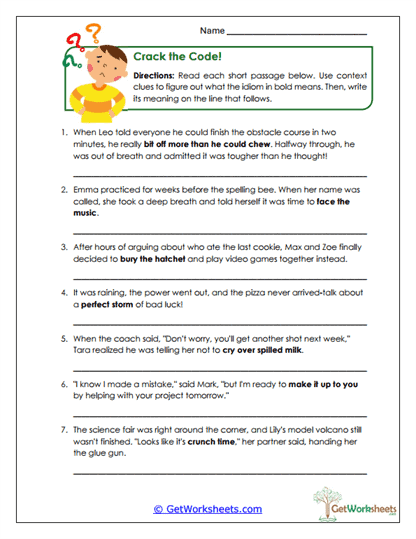
Crack the Code
In these context-rich mini-passages, target idioms appear in bold. Students derive meanings from textual evidence, then restate the idea in their own words. The routine-notice, infer, verify-mirrors authentic reading moves. For challenge, ask students to craft a fresh sentence that cannot take the idiom literally (e.g., a situation where "don't cry over spilled milk" is clearly about regret, not dairy). That boundary-setting locks in figurative sense.
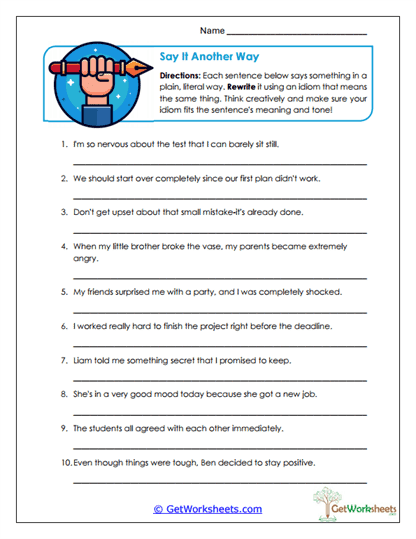
Say It Another Way
Learners transform plain statements into idiomatic ones ("start over completely" → "back to square one"). This is where style meets precision: students must preserve the original meaning while upgrading the expression. Peer swapping and quick oral read-alouds help test whether the chosen idiom really fits the situation and tone. It's excellent rehearsal for narrative voice and for tightening wordy drafts in writing workshop.
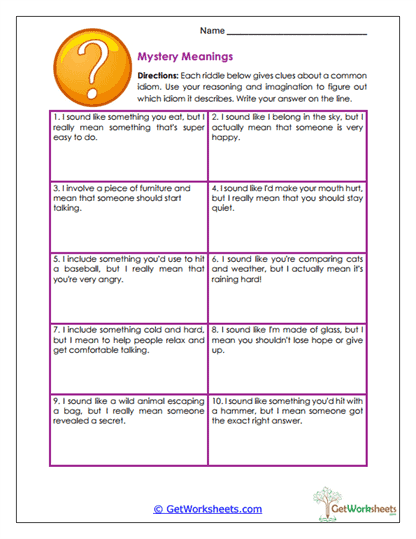
Mystery Meanings
Riddle clues point to familiar idioms (break the ice, raining cats and dogs). Solving requires triangulating hints-context, connotation, and logic-to land on a single best expression. After solving, students reverse the process by writing their own riddle for a new idiom, which demands nuanced understanding of both the phrase and its everyday uses. Display student-written riddles as a rotating warm-up or hallway literacy showcase.
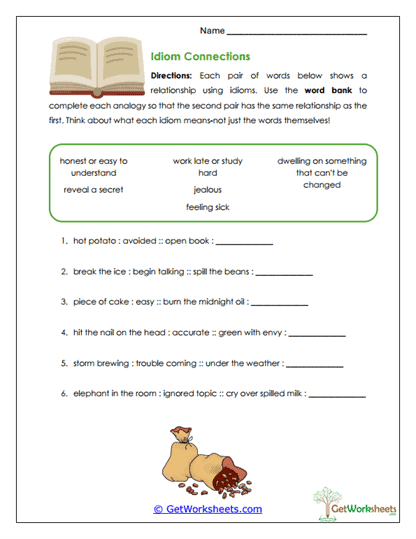
Idiom Connections
Using analogy-style prompts, learners pair idioms with related meanings (e.g., open book ↔ transparency; hot potato ↔ avoidance). This comparison work surfaces shades of meaning-how on thin ice differs from walking on eggshells, or how let the cat out of the bag isn't quite spill the beans. Students begin to sort expressions by emotional weight and context, building a mental "thesaurus" of figurative choices.
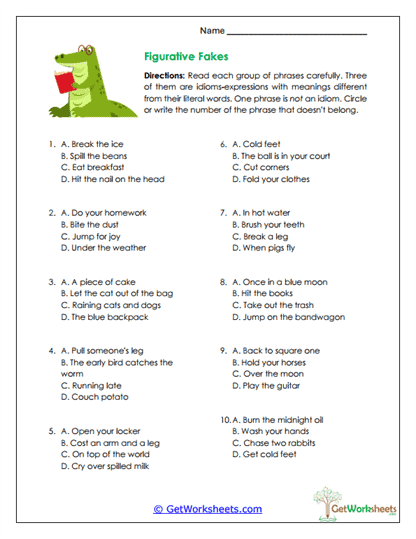
Figurative Fakes
Each set presents three true idioms and one literal outlier. To spot the "fake," students must articulate what makes an idiom idiomatic-conventional figurative meaning plus community recognition-not just "sounds colorful." Have learners rewrite the literal imposter into a real idiom that would fit the group; this quick extension reinforces the definitional line between figurative language and mere phrasing.
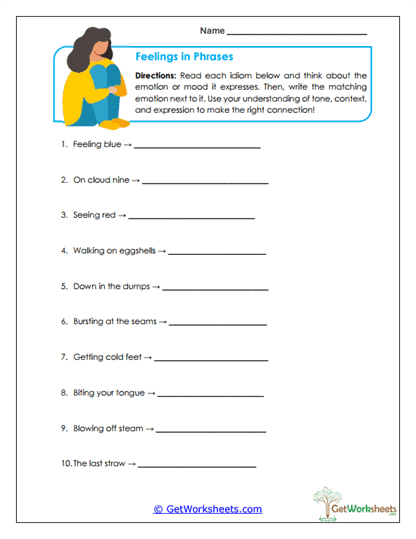
Feelings in Phrases
Students map idioms to emotions and states of mind (feeling blue, seeing red, walking on eggshells, on cloud nine). Beyond matching, they explain how each idiom cues the feeling (imagery, color symbolism, bodily tension). This activity dovetails with SEL goals: learners gather expressive tools for describing emotions more precisely in journals, discussions, and narratives.
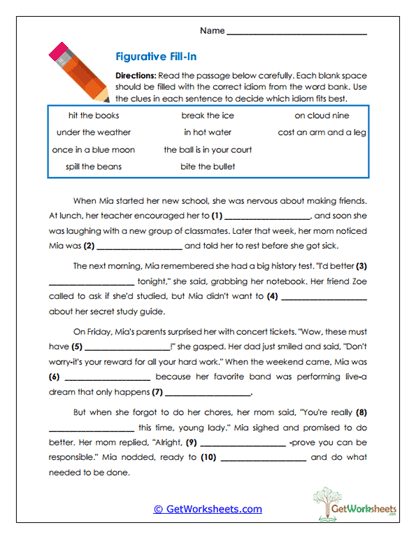
Figurative Fill-In
A short story with blanks invites students to insert idioms from a bank (hit the books, bite the bullet, once in a blue moon, etc.). Because several idioms could almost work, students must weigh nuance and cadence-does the phrase fit the speaker's voice, the stakes, the tone? After completion, a "literal rewrite" challenge has them replace each idiom with a plain paraphrase to feel the loss of color and rhythm, highlighting why authors choose figurative language.
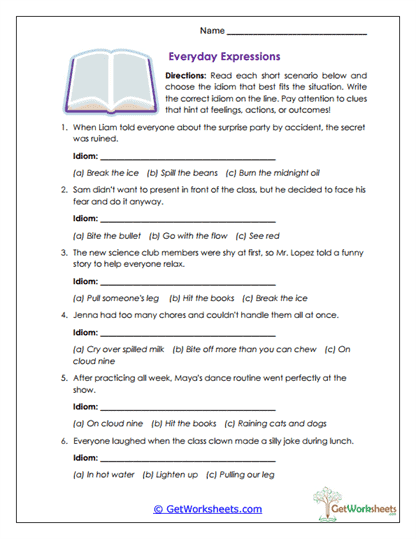
Everyday Expressions
Real-life scenarios (tests, teamwork, celebrations, setbacks) ask students to pick the best-fit idiom from several candidates. This applied reasoning emphasizes appropriateness-spill the beans suits secrets, not stress; bite the bullet fits necessary action, not joy. Students justify their choices in one sentence, practicing evidence-based explanation aligned to standards for speaking and writing.
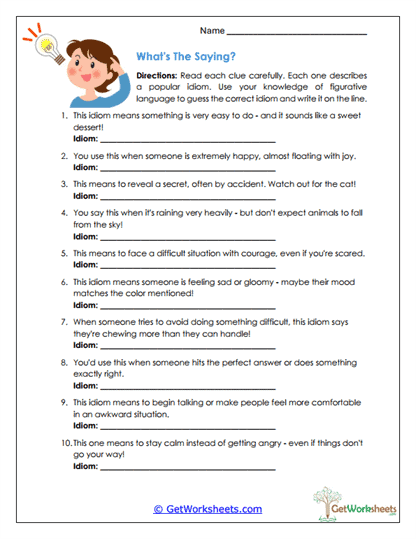
What's the Saying?
Concise clues or mini-definitions require students to retrieve the exact idiom (piece of cake, break the ice, raining cats and dogs). It's retrieval practice with a purpose: rapid recall plus confirmatory usage. For enrichment, ask students to add a brief cultural note or origin guess (where possible) and then verify in a class discussion-an easy doorway into etymology and language history without derailing the main skill focus.
Bookmark Us Now!
New, high-quality worksheets are added every week! Do not miss out!