Hurricanes Worksheets
About This Worksheet Collection
This hurricane-themed worksheet collection offers teachers a comprehensive set of resources for helping students understand one of Earth's most powerful natural hazards. The materials span vocabulary practice, sequencing tasks, reading passages, safety scenarios, and analytical challenges-giving learners multiple entry points into the science behind hurricanes. Whether used in a full weather unit or as stand-alone lessons, these worksheets support meaningful engagement with meteorology and disaster readiness.
As students move through the collection, they build essential academic skills such as interpreting scientific texts, comparing storm types, analyzing data, and applying cause-and-effect reasoning. They also develop practical knowledge related to storm safety, preparedness, and emergency decision-making. By blending scientific understanding with real-world application, these worksheets help learners connect atmospheric science to the experiences and challenges faced by coastal communities.
Detailed Descriptions Of These Worksheets
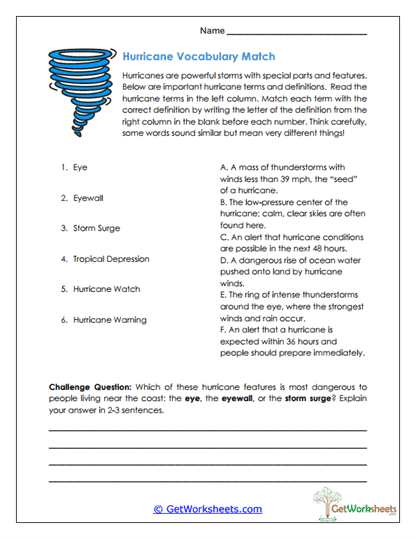
Vocabulary Match
Students match key hurricane terms to their correct definitions, reinforcing understanding of storm structure and safety terminology. By comparing each vocabulary word with a lettered description, learners sharpen their ability to distinguish closely related concepts. The challenge question pushes them to apply their knowledge to real-world hurricane risks. This activity supports strong scientific vocabulary development and practical weather awareness.
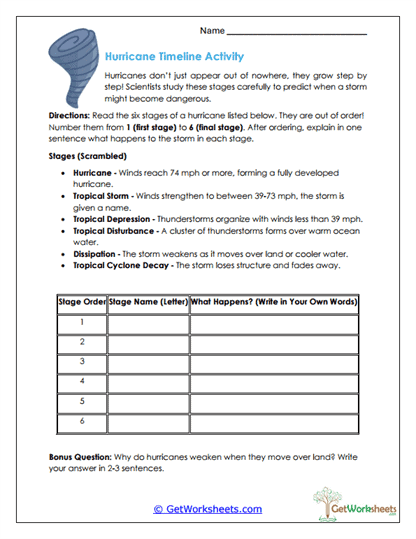
Hurricane Timeline
Learners arrange the six stages of hurricane development into the correct sequence, gaining a clearer picture of how storms evolve from small disturbances to powerful hurricanes. After ordering the stages, students explain each one in their own words to deepen comprehension. A bonus question encourages them to think critically about why hurricanes weaken when they move over land. This worksheet strengthens sequencing skills and scientific explanation.
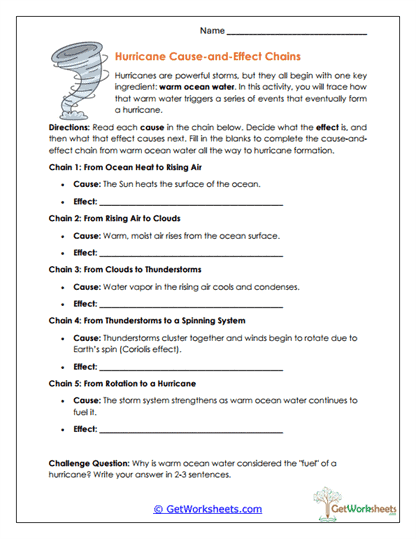
Cause and Effect
Students complete connected cause-and-effect chains that illustrate how atmospheric conditions build toward hurricane formation. Each chain asks learners to identify a missing cause or effect by analyzing clues about heat, air movement, and storm structure. The activity strengthens logical reasoning while helping students understand energy transfer in weather systems. A reflection question invites deeper thought about the role of warm ocean water.
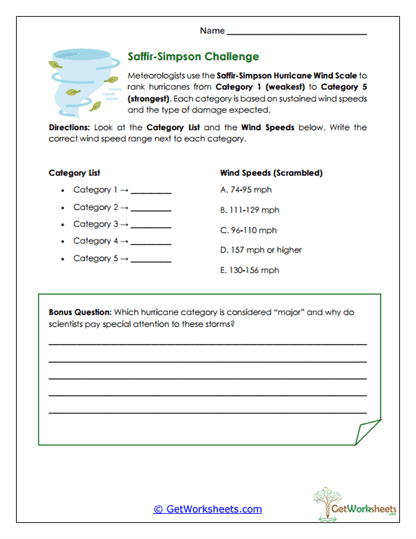
Saffir-Simpson Scale
This worksheet challenges students to match hurricane categories with the correct wind-speed ranges based on the Saffir-Simpson Scale. By interpreting scrambled data, learners build understanding of storm intensity and potential damage. A bonus question prompts them to consider which categories are labeled "major" hurricanes. The activity supports numerical reasoning and reinforces essential meteorology concepts.
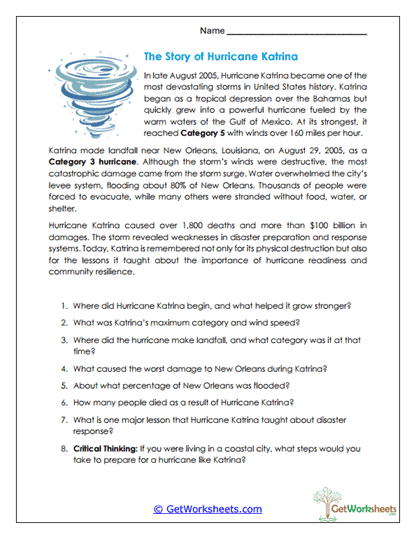
Story of Hurricane Katrina
Students read an informational passage about Hurricane Katrina and answer comprehension questions that ask them to recall details and analyze impacts. They explore the storm's development, its devastating flooding, and the long-term consequences for communities. The activity encourages thoughtful reflection on emergency preparedness and historical natural disasters. It also strengthens reading comprehension within a science and social studies context.
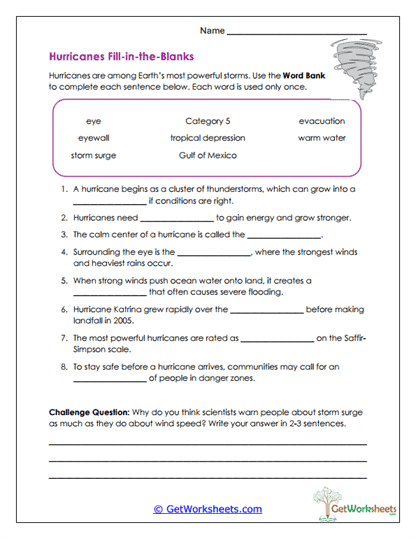
Fill-in-the-Blanks
Using a word bank, students complete sentences describing hurricane formation, structure, and dangers. The activity reinforces key vocabulary such as eyewall, storm surge, tropical depression, and evacuation. Learners practice applying scientific terminology in context to build deeper understanding. The challenge question emphasizes the importance of recognizing storm surge risks.
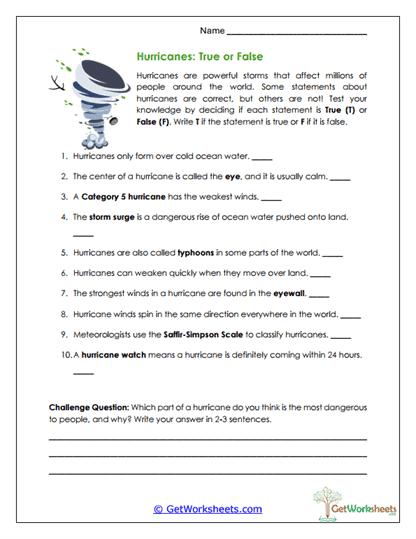
True or False
Students determine whether statements about hurricanes are accurate, correcting misconceptions about storm behavior, storm surge, and global storm names. The activity encourages learners to think critically as they analyze scientific claims. A challenge question asks them to identify the most dangerous part of a hurricane and justify their choice. This worksheet reinforces accurate understanding of severe weather.
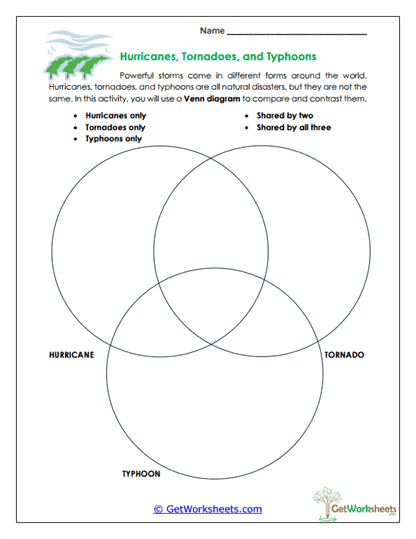
Comparison Venn Diagram
Students compare hurricanes, tornadoes, and typhoons using a three-circle Venn diagram. They examine similarities and differences in how each storm forms, moves, and causes damage. This visual organization helps students synthesize complex information about global weather systems. The activity builds comparison skills and reinforces understanding of major storm types.
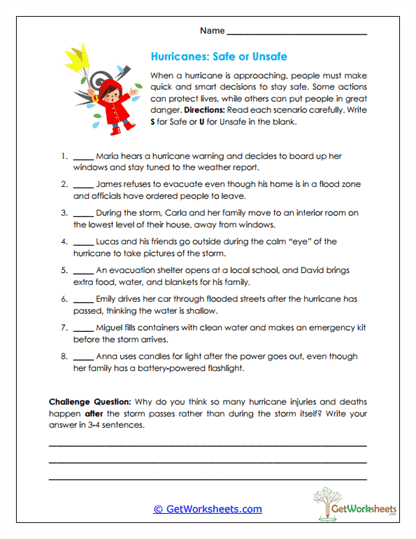
Safe or Unsafe?
Learners read scenarios about people's actions before, during, and after a hurricane and decide whether each behavior is safe. This helps students build real-world safety knowledge and recognize responsible decision-making. The challenge question encourages reflection on why injuries commonly occur after storms. The worksheet promotes safety literacy and thoughtful evaluation.
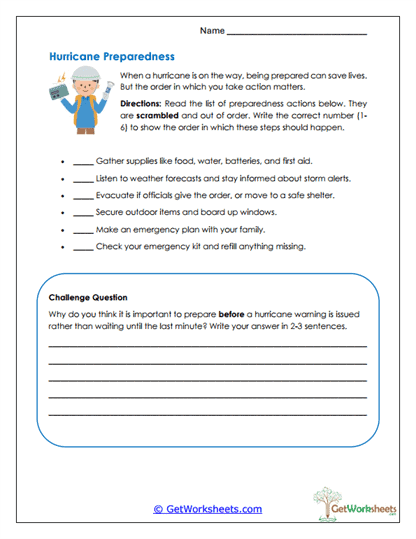
Preparedness Steps
Students number six hurricane preparation actions in the correct order, learning how to prioritize steps such as gathering supplies and monitoring alerts. The activity reinforces the importance of acting early during storm season. A reflection prompts students to think about why timing matters for safety. This worksheet strengthens sequencing and practical problem-solving skills.
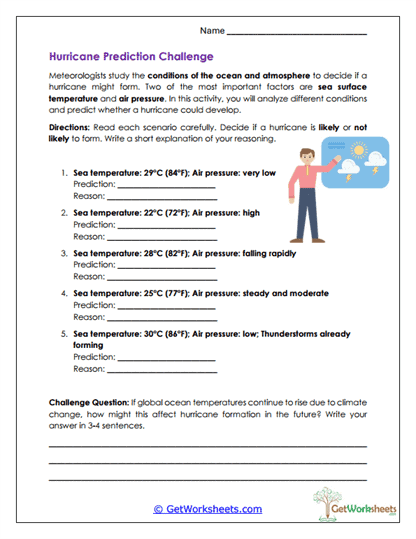
Prediction Challenge
Students analyze sea surface temperature and air pressure data to determine whether a hurricane is likely to form. Each scenario requires them to justify their predictions using meteorological reasoning. The challenge question explores how climate change influences long-term storm behavior. This worksheet supports data interpretation and scientific prediction.
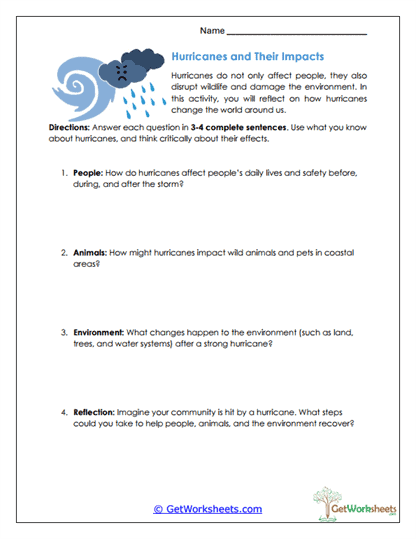
Impact Reflection
Learners answer open-ended questions about how hurricanes affect people, ecosystems, and communities. They explain both immediate and long-term consequences, such as flooding, habitat loss, and recovery efforts. The activity encourages empathy, scientific reflection, and awareness of community resilience. Students also propose actions that support recovery after major storms.
Bookmark Us Now!
New, high-quality worksheets are added every week! Do not miss out!