How to Cite AI as a Source Worksheets
About This Worksheet Collection
This collection helps students navigate the increasingly important skill of citing AI-generated content in academic work. Each worksheet breaks down a different aspect of using AI responsibly-from recognizing when AI should be cited, to distinguishing user ideas from generated ideas, to correcting flawed citations. The activities offer clear, practical scenarios that mirror real classroom writing tasks so learners can apply citation rules with confidence.
As students work through the set, they build competency in APA and MLA formats, source evaluation, paraphrase recognition, and academic integrity. They practice tracking where information originates, deciding when AI counts as a personal communication, and understanding how citation responsibilities change with context. Altogether, this collection develops strong research habits and teaches students to use AI transparently and ethically.
Detailed Descriptions Of These Worksheets
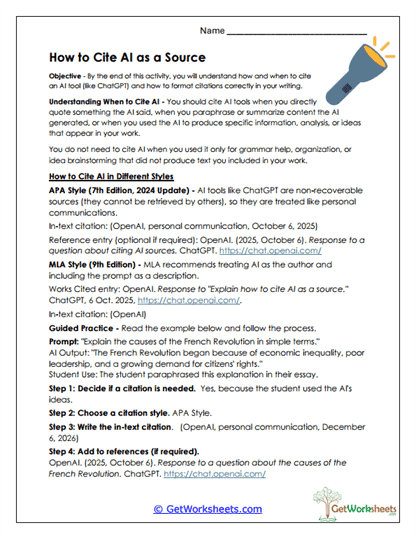
Cite AI Basics
This worksheet introduces students to the essential rules for citing AI tools in APA and MLA. Learners study when AI should be treated as a source, how personal communication formatting applies, and how to craft both in-text citations and reference entries. They then complete a guided citation practice activity based on sample prompts and responses. The task builds foundational understanding of academic integrity.
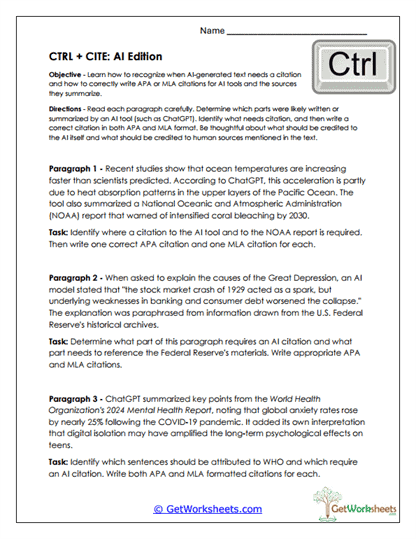
Ctrl + Cite
Students read short academic-style paragraphs and determine which portions originate from AI and which come from human sources. For each example, they decide when an AI citation is required and then create APA and MLA entries. The activity strengthens students' ability to track information origins and apply citation rules precisely. It encourages careful reading to distinguish between generated content and external research.
Who Wrote That?
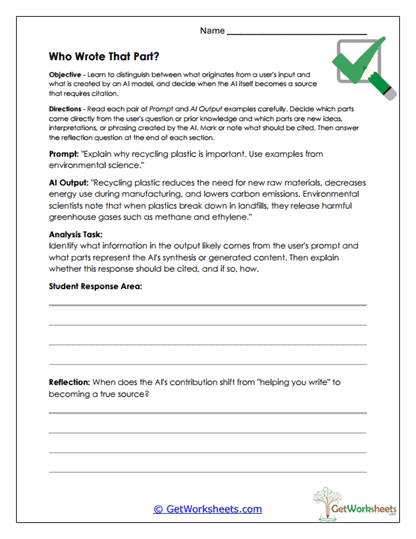
In this worksheet, students review a prompt and an AI-generated response, identifying the boundary between user-supplied ideas and AI-created additions. They determine whether citation is necessary and explain their reasoning. The activity encourages thoughtful reflection on when AI shifts from being a writing tool to functioning as a true source.
Truth or Chat?
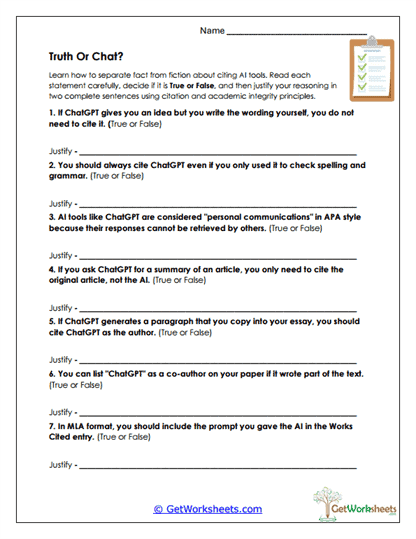
Students evaluate seven statements about citing AI and determine whether each is true or false. They justify their decisions using complete sentences, helping to reinforce correct understandings of personal communication rules and AI citation expectations. This worksheet dispels common misconceptions and strengthens confidence in applying citation standards.
Fix That Bot!
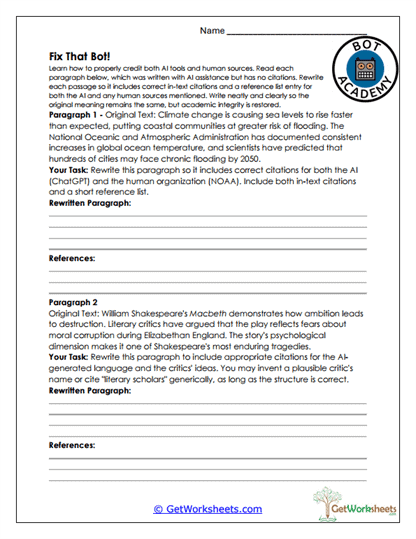
Learners revise paragraphs that improperly use AI-generated content without correct citations. They rewrite each example to include accurate in-text citations and formatted reference entries for both AI tools and human organizations. This activity teaches students how to identify incomplete attribution and correct errors through clear, accurate revisions.
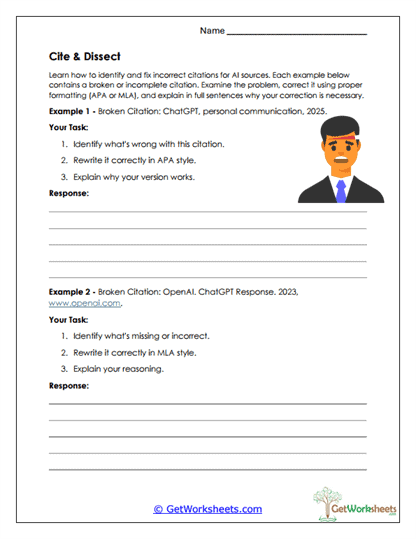
Cite & Dissect
Students receive broken or incomplete AI citations and must diagnose the issues before rewriting them in both APA and MLA style. They explain what was incorrect and how their corrected version solves the problem. The worksheet reinforces mastery through active correction and encourages attention to detail.
Prompt Smarter
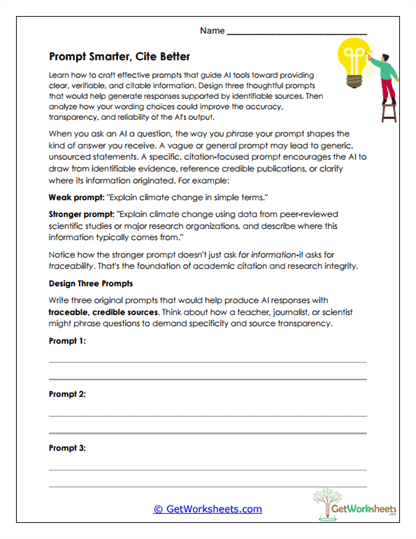
Learners explore how the quality of a prompt affects whether AI produces verifiable, citable information. They compare weak and strong prompts, then craft their own improved versions. This worksheet builds students' understanding of how prompt design influences accuracy, credibility, and transparency in AI output.
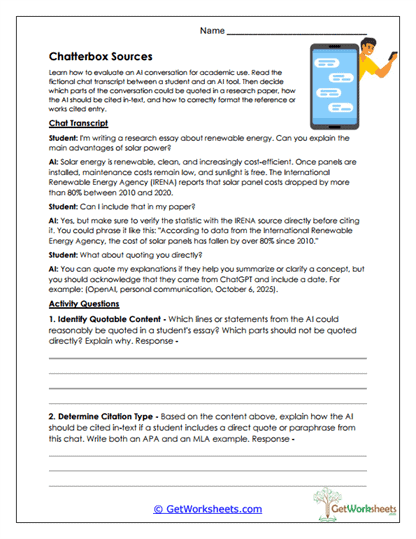
Chatterbox Sources
Students analyze a short dialogue about renewable energy between a student and an AI tool. They determine which lines can be quoted in a research project and which require citation of human sources. The activity also asks learners to write both APA and MLA citations for AI-generated material, deepening understanding of source use in mixed conversations.
Prompt and Circumstance
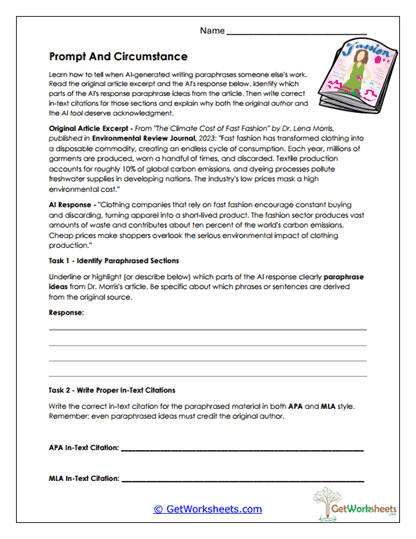
Students compare an article excerpt with an AI paraphrase to see which parts restate the original author's ideas. They then write correct APA and MLA in-text citations for the paraphrased portions. This task builds strong paraphrase recognition skills and clarifies when attribution is mandatory.
Tech Transparency
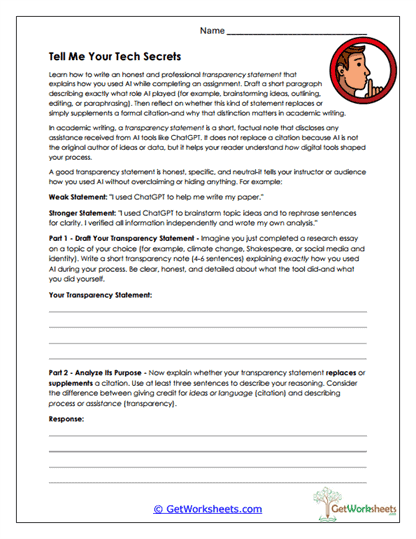
In this worksheet, students write a transparency statement describing how they used AI during an assignment. They evaluate whether their statement replaces a citation or supplements one. The task emphasizes honesty and teaches learners when AI assistance affects the intellectual content of a piece.
Who Said It First?
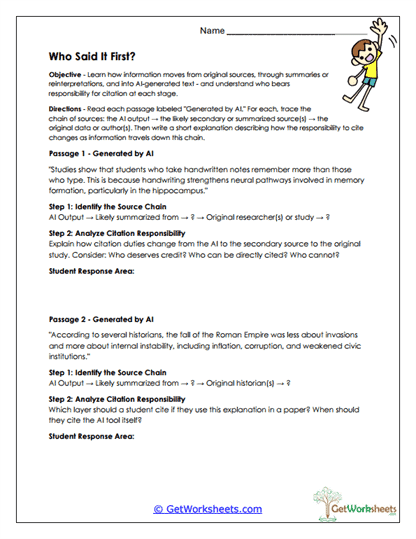
Students trace information through its full source chain-from original studies to secondary summaries to AI-generated restatements. By examining passages, they identify which ideas belong to which source and assign proper credit. This activity deepens understanding of layered attribution and the complexities of tracing information flow.
Style Wars: Cite Club
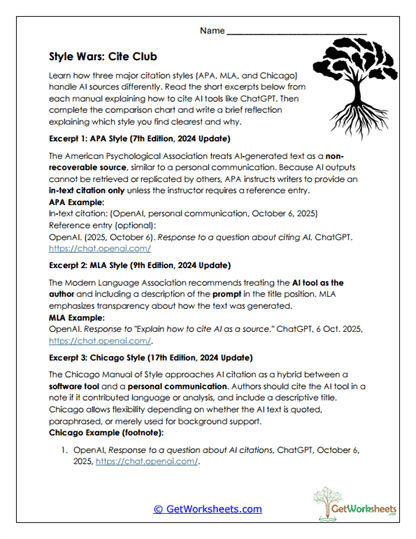
This worksheet compares how APA, MLA, and Chicago styles each cite AI-generated material. Students complete a chart outlining the differences in formatting, labels, and reference structures. They finish with a written reflection on which style feels most intuitive. The activity helps students navigate style-specific guidelines with confidence.
Bookmark Us Now!
New, high-quality worksheets are added every week! Do not miss out!