Homonyms Worksheets
About This Worksheet Collection
The Homonyms worksheet collection guides students through the fascinating world of words that sound alike or look alike but carry different meanings. From playful riddles to analytical reading passages, these activities help learners master contextual interpretation, spelling precision, and vocabulary flexibility. Students explore how homonyms enrich communication, create humor, and sometimes cause confusion-all while sharpening reading comprehension and writing clarity.
Each worksheet moves learners from basic recognition to creative and analytical application. Through sentence-building, story-based tasks, and problem-solving with multiple-meaning words, students build confidence in using context to uncover meaning and ensure accuracy in their writing and speech.
Detailed Descriptions Of These Worksheets
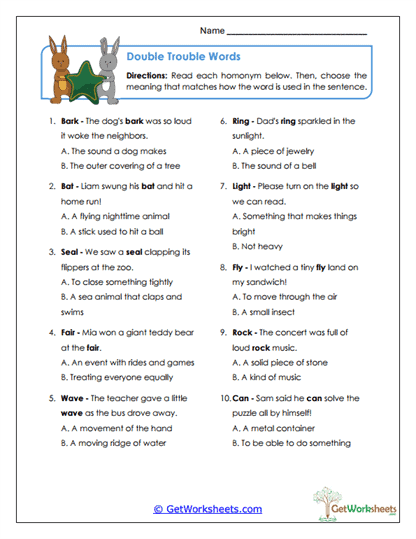
Double Trouble Words
Students identify homonyms in context by selecting the correct definition from two options. Examples like bark, ring, and seal teach how surrounding words shape meaning. The exercise builds comprehension and context-clue reasoning.
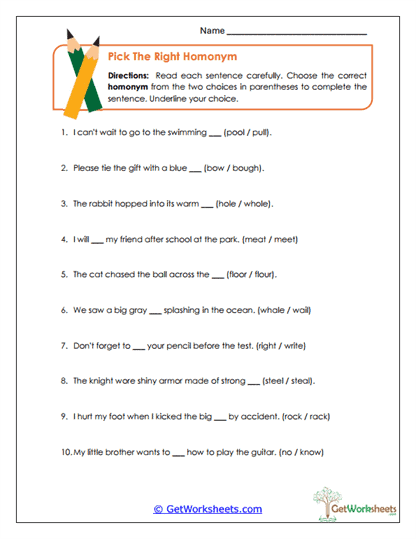
Pick the Right Homonym
Learners read sentences containing pairs such as hole/whole and knight/night, choosing the correct spelling and meaning for each. This task combines vocabulary understanding with spelling accuracy and attention to detail.
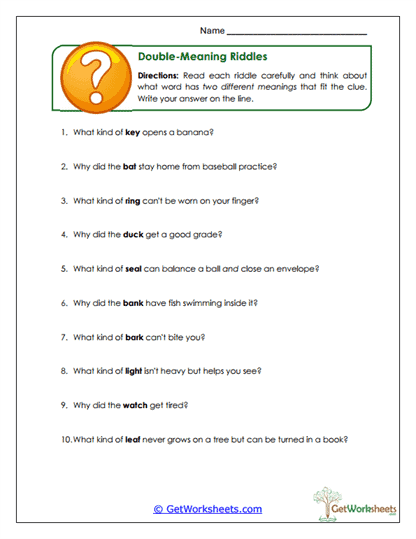
Double-Meaning Riddles
Through fun riddles, students solve clues that point to a single homonym with two meanings-like key or bank. The game-style format strengthens inference, reasoning, and appreciation for language play.
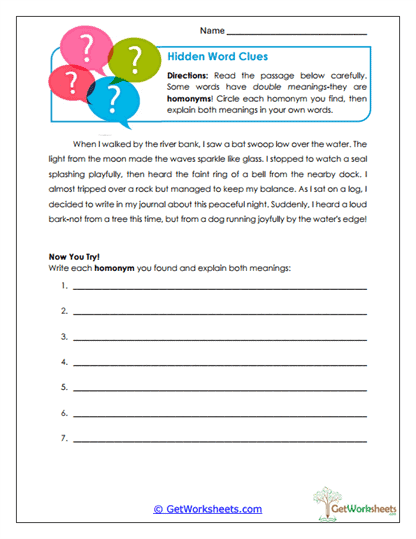
Hidden Word Clues
Students read a short story and underline homonyms embedded within it, explaining both meanings in their own words. This contextual approach deepens reading comprehension and analytical vocabulary skills.
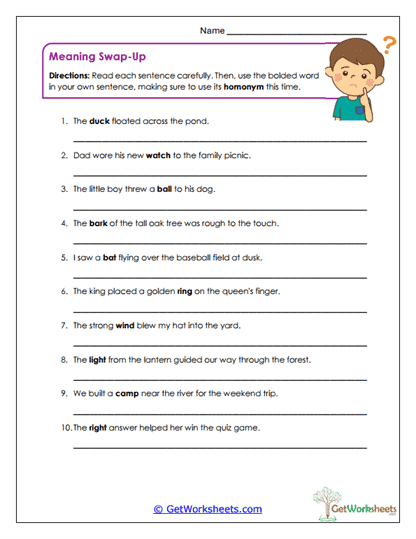
Meaning Swap-Up
Learners rewrite given words in new sentences that display different meanings. Using examples such as duck or watch, students practice creative expression and strengthen understanding of how context drives meaning.
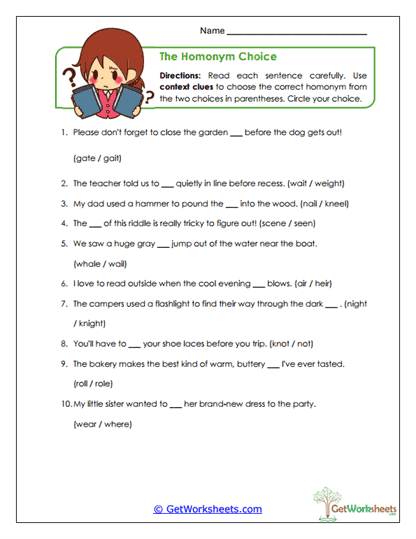
The Homonym Choice
In each sentence, learners choose between similar-sounding homonyms (gate/gait, knight/night). This reinforces spelling, grammar, and meaning through contextual decision-making.
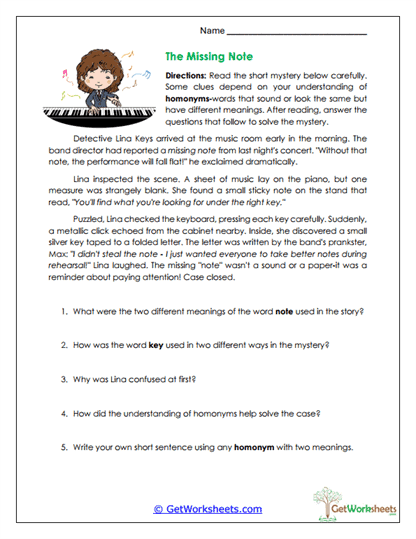
The Missing Note
A mystery story uses double-meaning words like note and key as clues. Students interpret each homonym and explain how meaning affects the plot, combining vocabulary study with reading comprehension.
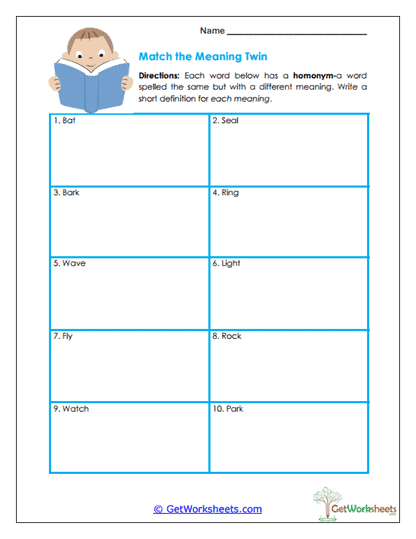
Match the Meaning Twin
Students define two distinct meanings for each homonym (e.g., bat, seal, rock). The structured approach supports clarity, dictionary use, and a deeper grasp of word versatility.
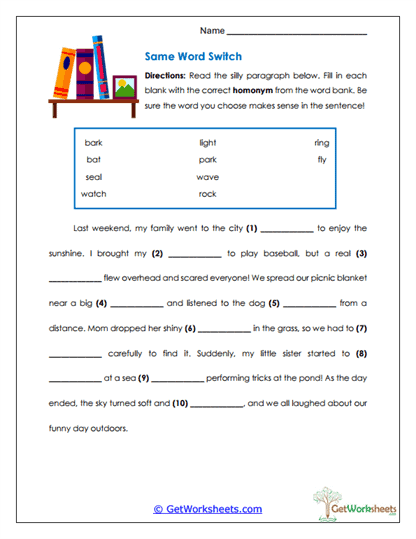
Same Word Switch
Learners complete a humorous passage by inserting correct homonyms from a word bank. This fill-in-the-blank activity merges reading fluency with contextual vocabulary application.
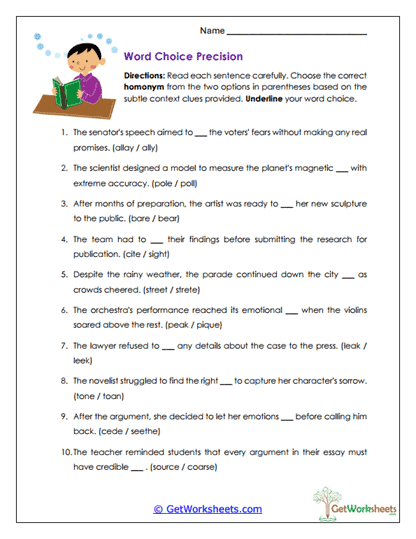
Word Choice Precision
Advanced learners differentiate between closely related homonym pairs such as bare/bear and peek/peak. The focus on subtle distinctions strengthens spelling accuracy, word choice, and contextual understanding.
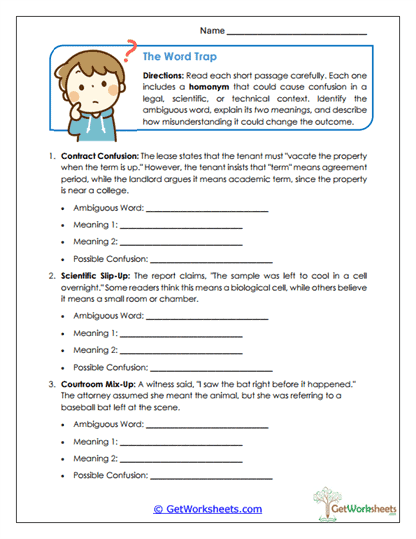
The Word Trap
Students read scenarios showing how homonyms like term or cell could cause confusion in academic or professional contexts. They explain both meanings and analyze how misinterpretation alters communication. This fosters precision and critical thinking.
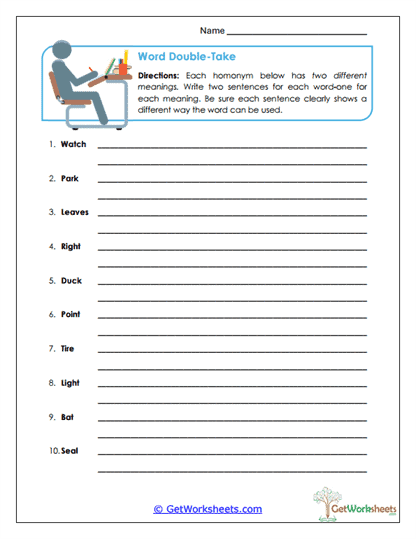
Word Double-Take
Learners write two original sentences for each provided homonym, showcasing both meanings clearly. This culminating exercise promotes mastery through creative application, syntax control, and expressive vocabulary use.
Bookmark Us Now!
New, high-quality worksheets are added every week! Do not miss out!