Homographs Worksheets
About This Worksheet Collection
The Homographs worksheet collection helps students master words that share spelling but differ in meaning, pronunciation, or grammatical use. Through creative writing, context analysis, drawing, riddles, and real-world examples, learners explore how meaning shifts with usage. These engaging activities strengthen vocabulary comprehension, contextual reasoning, and flexible thinking-essential for interpreting complex language, humor, and nuance in reading and writing.
Students move from identifying homographs in passages to generating their own sentences and stories that play on double meanings. By encountering homographs in riddles, comics, and even newspaper headlines, they gain practical insight into how ambiguity and wordplay enrich English communication.
Detailed Descriptions Of These Worksheets
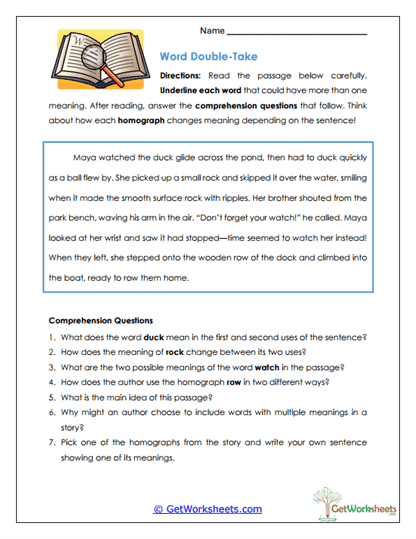
Word Double-Take
Students underline multiple-meaning words in a passage and explain how context changes each meaning. Examples like duck, watch, and row guide close reading and inference, reinforcing awareness of language complexity and author word choice.
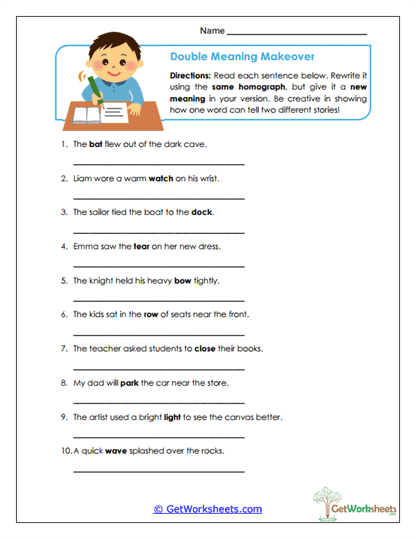
Double Meaning Makeover
Learners rewrite sentences to reuse a given homograph in a completely new context, demonstrating mastery of flexible word use. The exercise builds creativity, vocabulary depth, and syntax control through contrastive rewriting.
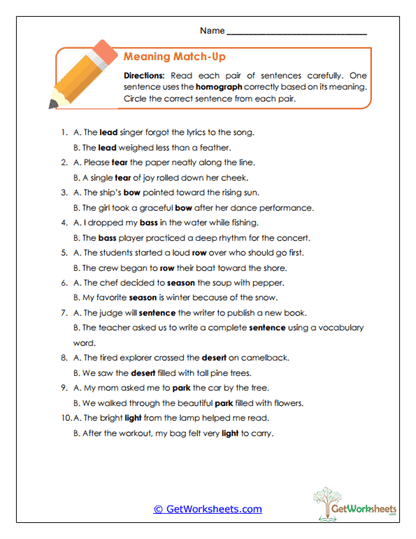
Meaning Match-Up
Students decide which of two sentences uses a homograph correctly, analyzing words like lead, tear, and season. The side-by-side comparison trains careful reading, vocabulary discernment, and context-based reasoning.
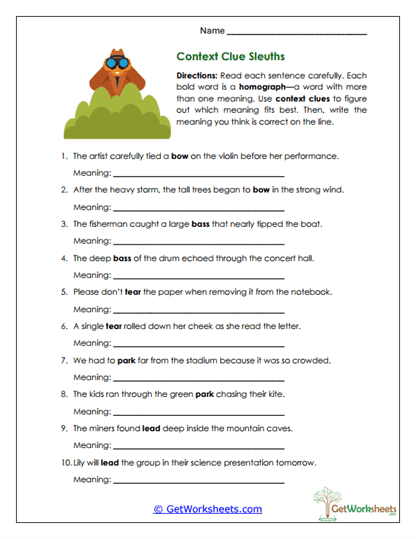
Context Clue Sleuths
Using sentence clues, learners deduce meanings of bolded homographs such as bow and bass, then write definitions that match the context. This detective-style task hones inference, comprehension, and analytical vocabulary skills.
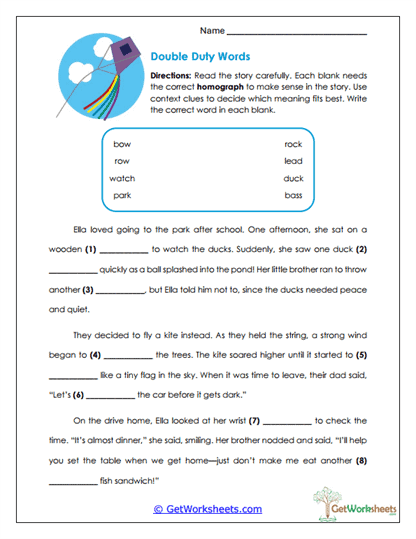
Double Duty Words
In a fill-in-the-blank story, students select homographs from a word bank to complete sentences meaningfully. The narrative format reinforces contextual understanding while making vocabulary practice fun and fluent.
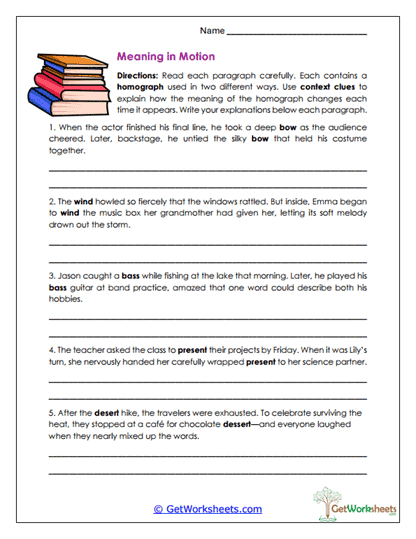
Meaning in Motion
Each paragraph uses the same homograph twice with different meanings. Students explain the shift, examining how part of speech and context shape interpretation. The open-ended format supports higher-level reading and precision in written responses.
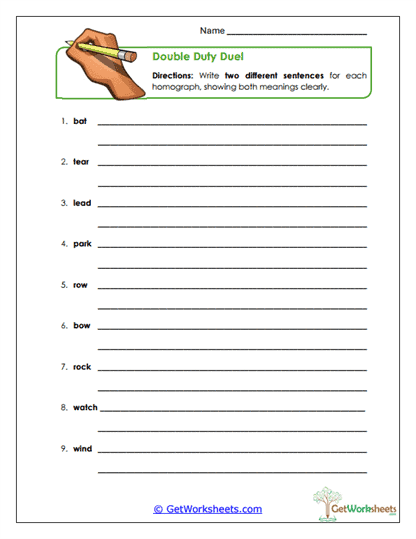
Double Duty Duel
Learners write two unique sentences for each homograph, such as bat or wind, to illustrate distinct meanings. This productive task strengthens grammar, semantics, and creativity by turning recognition into active language generation.
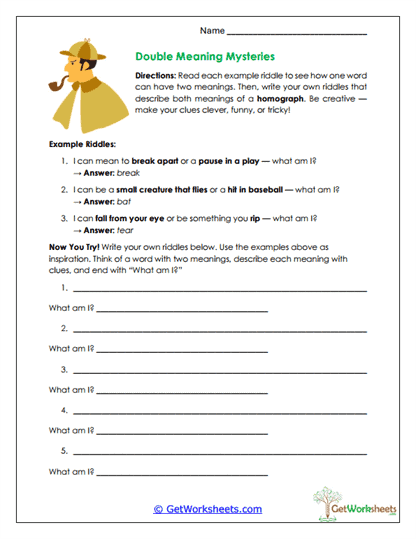
Double Meaning Mysteries
Students read playful riddles that describe two meanings of one word, then craft original riddles for words like tear or rock. The game-like approach boosts engagement, figurative thinking, and precise expression.
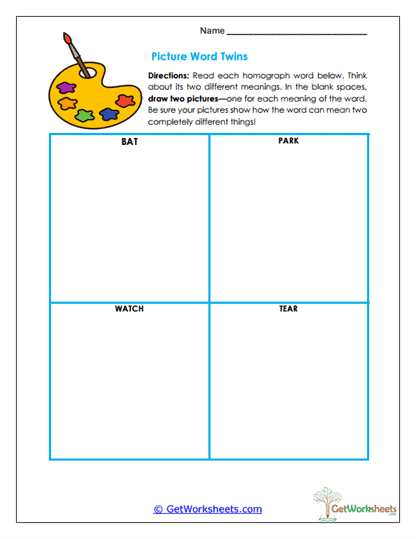
Picture Word Twins
Visual learners draw two illustrations for each homograph, linking meaning to imagery. By pairing language and art, students deepen comprehension and connect words to real-world representations.
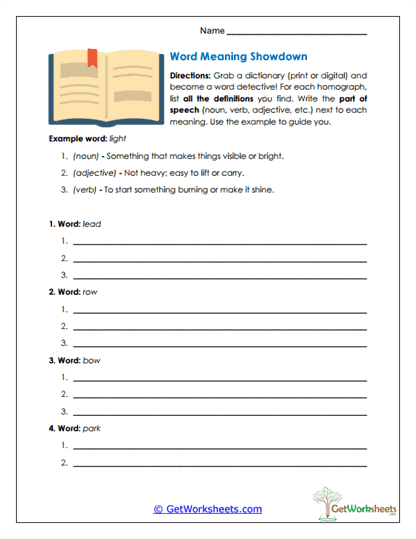
Word Meaning Showdown
Through dictionary research, students find and record all definitions and parts of speech for assigned homographs. This structured reference activity reinforces vocabulary accuracy, grammar awareness, and resource skills.
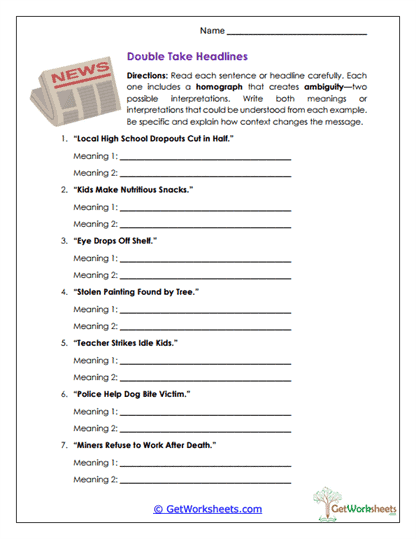
Double Take Headlines
Students interpret humorous or ambiguous newspaper headlines containing homographs (e.g., Teacher Strikes Idle Kids). They explain both meanings, exploring how context and phrasing alter understanding. The exercise builds critical reading and language humor appreciation.
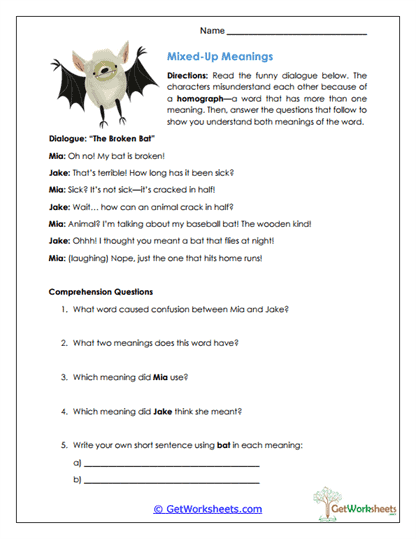
Mixed-Up Meanings
In a short dialogue, characters misinterpret a homograph (like bat). Students identify the confusion, explain both meanings, and write example sentences. The conversational setup develops vocabulary, comprehension, and real-world communication insight.
Bookmark Us Now!
New, high-quality worksheets are added every week! Do not miss out!