History of AI Worksheets
About This Worksheet Collection
The History of AI collection traces the remarkable evolution of Artificial Intelligence from its theoretical roots to today's innovations. Through timelines, readings, and analytical activities, students explore how key figures, inventions, and discoveries have shaped the modern digital world. These worksheets connect historical context with technological progress, helping learners understand how ideas developed over decades to influence science, society, and communication. Each lesson invites students to think critically about milestones and the human creativity that drives technological change.
By engaging with biographies, cause-and-effect analysis, and primary concepts such as the Turing Test and AI winters, learners build both literacy and historical reasoning. They practice sequencing, comparing, evaluating, and synthesizing information across time periods. The collection nurtures curiosity about innovation while reinforcing essential skills in reading comprehension, research, and evidence-based reflection. Students finish with a richer perspective on how Artificial Intelligence continues to evolve-and why understanding its past helps shape its responsible future.
Detailed Descriptions Of These Worksheets
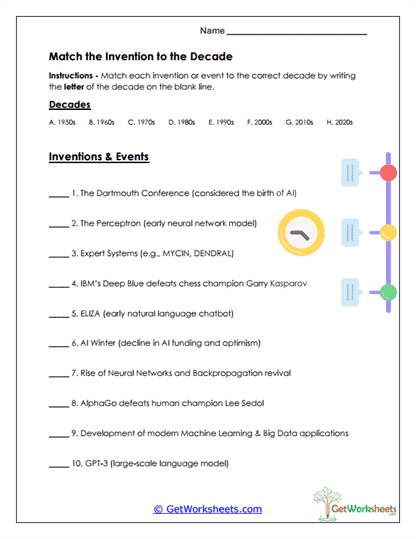
AI Decade Match
Students match major AI inventions and milestones to the correct decades, connecting breakthroughs such as the Perceptron and GPT-3 to their time periods. This activity builds chronological understanding and historical reasoning. Learners explore how innovation in computing has accelerated and shifted over time, recognizing patterns in technological growth.
Dartmouth Conference
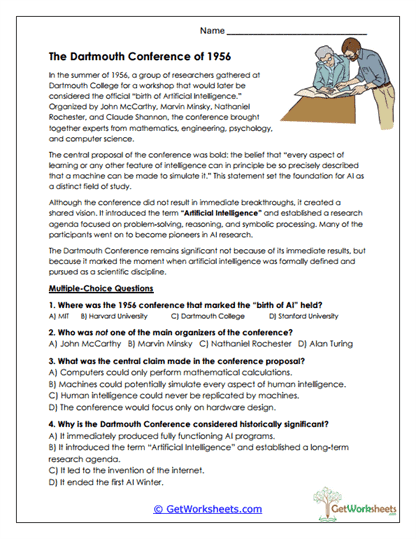
In this reading comprehension activity, students learn about the 1956 Dartmouth Conference-the event that formally introduced Artificial Intelligence as a field. They analyze the conference's goals, participants, and long-term influence through guided questions. The worksheet enhances content-specific vocabulary and comprehension while linking historical context to scientific development.
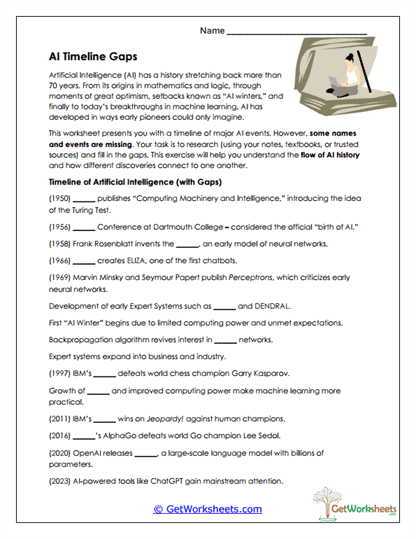
AI Timeline Gaps
Learners complete a partially filled timeline of AI history by researching missing names, dates, and inventions. The task fosters information synthesis, research skills, and awareness of major AI milestones such as ELIZA and Deep Blue. Students strengthen chronological reasoning while gaining insight into the evolution of computing.
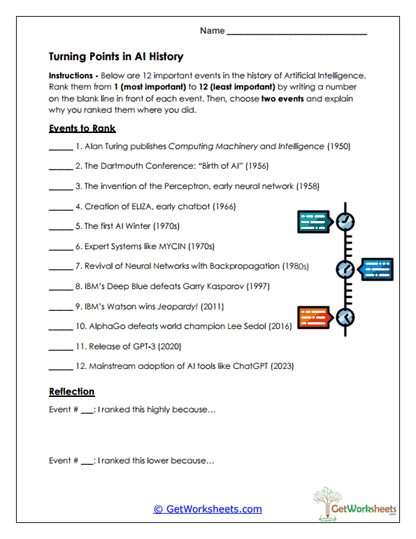
Turning Points in AI
Students evaluate and rank key moments in AI history according to their importance and impact. By justifying their reasoning, learners engage in higher-order thinking and analytical comparison. The reflection component deepens understanding of how breakthroughs connect across time and encourages critical writing.
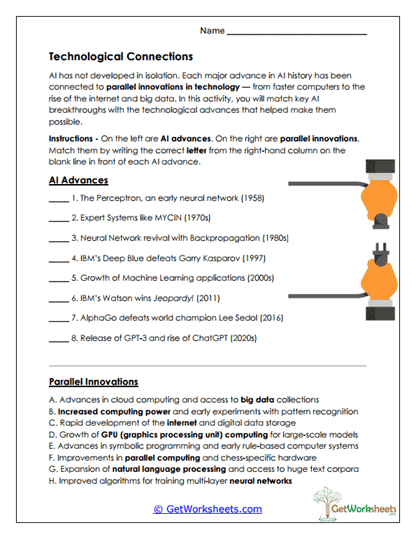
Technological Connections
In this matching exercise, learners link AI advancements to parallel developments like cloud computing or data storage. The worksheet highlights how progress in one field drives innovation in another. It builds contextual analysis skills and encourages students to see AI as part of a broader technological ecosystem.
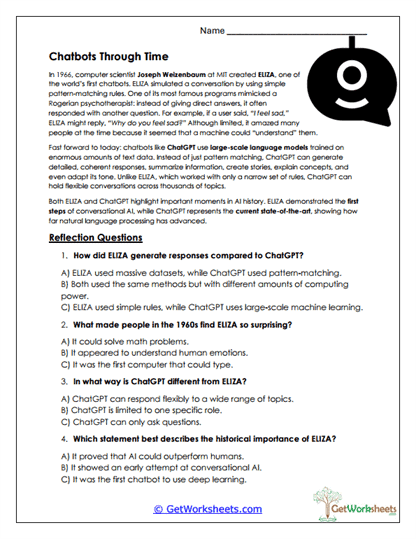
Chatbots Through Time
Students compare early chatbots like ELIZA to modern systems such as ChatGPT, examining differences in accuracy, language, and complexity. The worksheet promotes critical reading and comparative analysis. Learners reflect on how early experiments laid the groundwork for today's conversational AI.
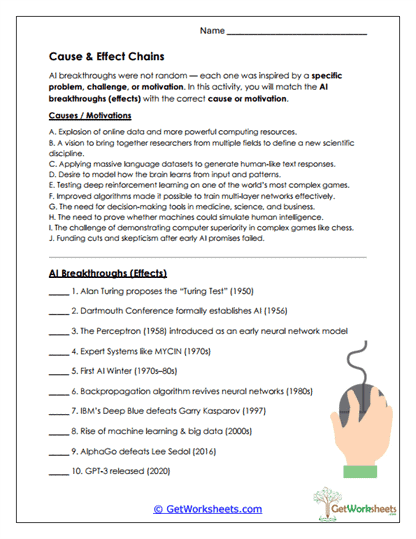
Cause and Effect Chains
This analytical activity helps students understand how real-world challenges inspired key advances in AI. Learners match causes, such as data growth, to effects like the rise of machine learning. The exercise reinforces comprehension of innovation cycles and deepens understanding of motivation in scientific progress.
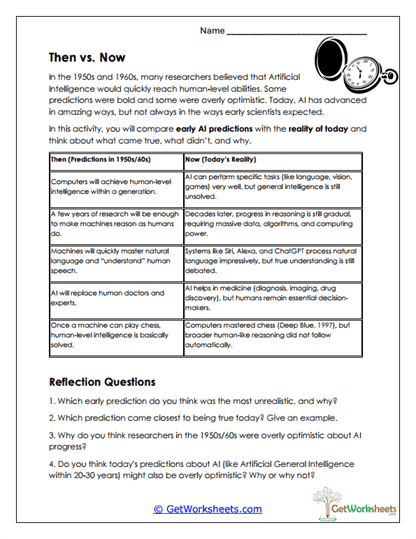
Then vs. Now
Students compare early AI predictions with modern realities, identifying which expectations came true and why. They analyze historical optimism, scientific limitations, and evolving perspectives. The reflection writing builds reasoning, evaluation, and awareness of how ideas transform over time.
Funding Cuts
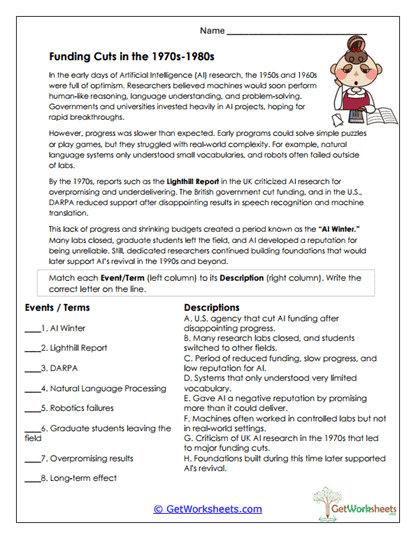
This worksheet explores the economic downturns known as AI winters, when reduced funding slowed research progress. Students read about key setbacks and analyze how financial and institutional pressures shape innovation. It builds vocabulary, comprehension, and awareness of cause and consequence in technology history.
Pioneers of AI
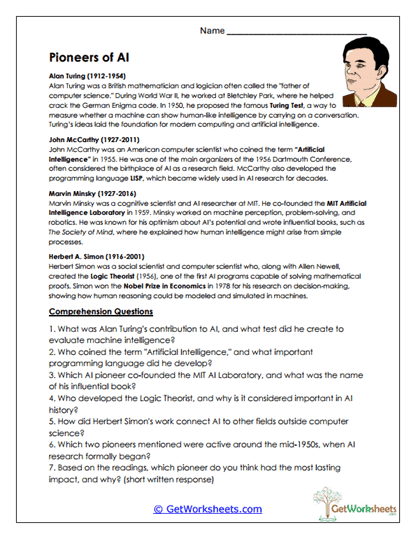
Learners read short biographies of foundational AI figures including Turing, McCarthy, Minsky, and Simon. Comprehension questions help students identify each person's unique contribution to the field. The worksheet reinforces literacy, critical thinking, and appreciation for collaboration in early AI research.
Modern Pioneers of AI
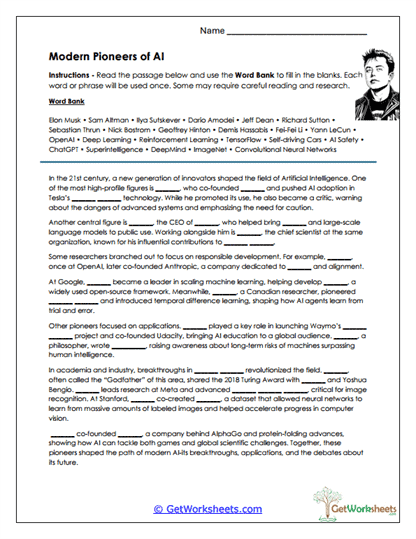
Students fill in missing information in a reading passage about current AI leaders like Elon Musk, Geoffrey Hinton, and Sam Altman. They use context clues and research to complete the exercise accurately. This worksheet connects historical understanding with present-day innovation, emphasizing ethical and creative leadership in technology.
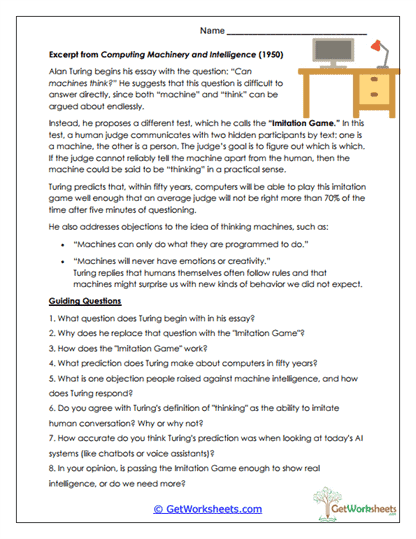
Turing's Imitation Game
In this philosophical reading, students examine excerpts from Alan Turing's 1950 essay and the concept of the Turing Test. Guided questions lead them to reflect on whether machines can truly think and what intelligence means. The activity promotes interpretation, argumentation, and thoughtful discussion of ethics and prediction in early AI theory.
Bookmark Us Now!
New, high-quality worksheets are added every week! Do not miss out!