Helping (Auxiliary) Verbs Worksheets
About This Worksheet Collection
This Helping (Auxiliary) Verbs worksheet collection gives teachers a full toolkit for introducing, practicing, and mastering the role of helper verbs in English sentences. Through a mix of fill-in-the-blank items, underlining activities, charts, sorting tasks, editing practice, and connected passages, students encounter helping verbs in both isolated sentences and rich, narrative contexts. The themes-school life, home routines, sports, adventures, and everyday situations-keep practice relatable while still targeting essential grammar skills.
Across the collection, learners build a strong foundation in how helping verbs combine with main verbs to show tense, aspect, mood, questions, and negatives. They learn to distinguish auxiliaries from main verbs, select accurate forms of be, have, and do, and use modals with confidence. At the same time, students strengthen key literacy skills such as close reading, sentence expansion, error correction, and tense shifting, making these worksheets valuable for grammar instruction and general writing development.
Detailed Descriptions Of These Worksheets
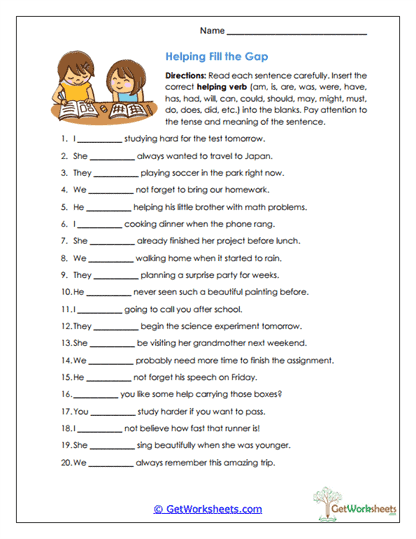
Helping Verb Fill-In
Students complete sentences by choosing the correct helping verb from a list that includes forms of be, have, do, and several modals. Each sentence offers context clues about time, number, and meaning, pushing learners to think carefully before they decide. As they work, students see how auxiliaries support main verbs in progressive, perfect, and future structures. This worksheet develops precise verb-phrase control and reinforces vocabulary connected to everyday school and home activities.
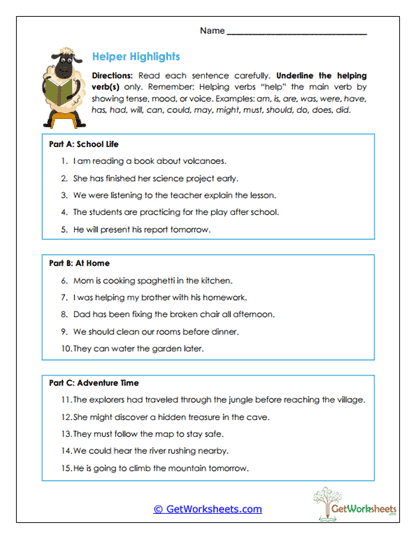
Helping Verb Underline
In this activity, students read short sentences and underline the helping verbs that work alongside the main verbs. The sentences are organized by theme, so learners can recognize verb phrases in familiar situations like school routines, home responsibilities, and imaginative adventures. By isolating the auxiliary elements, students learn to distinguish them from the main actions in the sentence. This focused identification work strengthens grammar analysis and boosts confidence reading multi-word verb phrases.
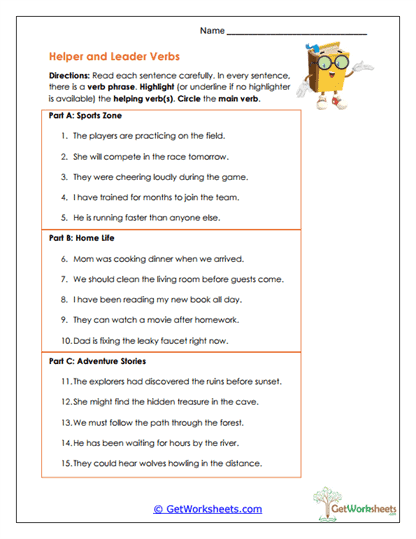
Helper and Main Verbs
Students highlight the helping verb and circle the main verb in each sentence, visually separating the two roles within the verb phrase. The themed sections-sports, home life, and adventure stories-keep practice engaging while still emphasizing careful grammatical analysis. Learners gain a clearer understanding of how auxiliaries and main verbs work together to express tense and aspect. This worksheet lays important groundwork for future lessons on voice, complex tenses, and more advanced sentence structures. It also encourages close reading as students must attend to every word.
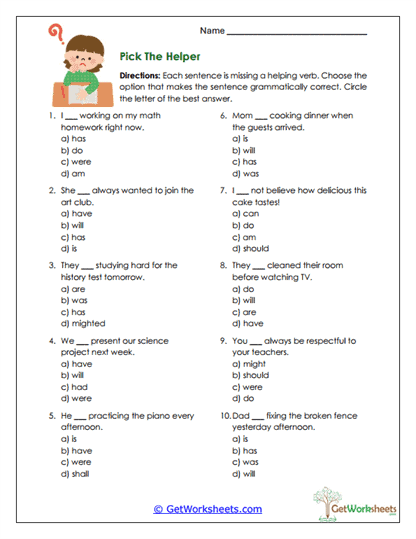
Helping Verb Multiple Choice
Learners choose the best helping verb from multiple options to complete each sentence correctly. The questions include present and past progressive forms as well as modal constructions, so students see a wide range of auxiliary uses. They must compare similar choices and rely on context to make the right selection. The format mirrors standardized-test style grammar questions, making it especially useful for assessment preparation. Over time, students develop quick, accurate decision-making about verb phrases.
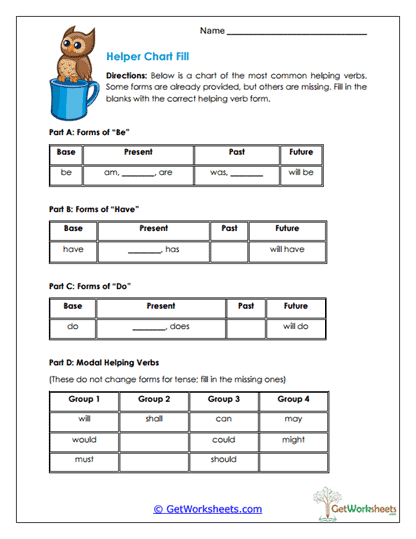
Helping Verb Chart
This worksheet presents a chart of common helping verbs and asks students to fill in the missing forms. Learners review forms of be, have, and do, along with a set of modal verbs organized into clear categories. By completing the chart, students strengthen recall of auxiliary forms and see how they shift across different tenses. The visual layout supports long-term retention and can serve as a handy reference for writing and editing. It's an excellent tool for solidifying foundational grammar knowledge.
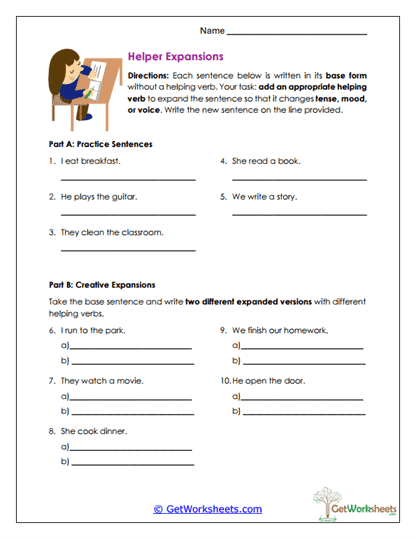
Helper Expansions
Students begin with simple base-form sentences and expand them by adding appropriate helping verbs to create more precise verb phrases. In the guided section, they receive support in choosing auxiliaries, while the challenge section asks them to produce two different expanded versions for each sentence. This flexibility helps students explore how helping verbs change tense, mood, and meaning. The activity deepens understanding of how auxiliaries shape nuance and time in writing. It also strengthens revision skills as learners experiment with multiple ways to express an idea.
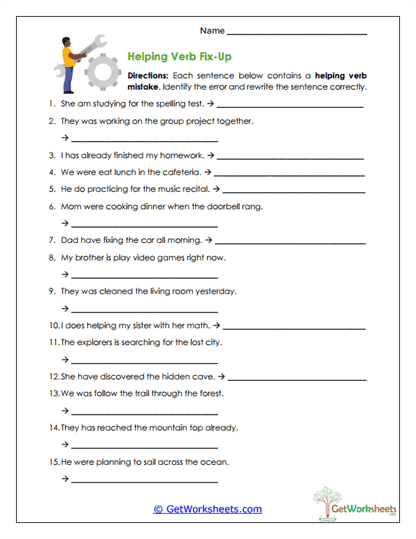
Helping Verb Fix-Up
This worksheet presents sentences that misuse helping verbs and asks students to correct them. Learners identify errors involving be, have, and do, as well as mistakes in progressive and perfect tenses, and then rewrite each sentence with accurate verb phrases. The editing focus encourages careful attention to tense consistency and subject-verb agreement. By repeatedly fixing flawed constructions, students build stronger proofreading habits and grammar confidence. The task is especially useful for preparing students to edit their own writing.
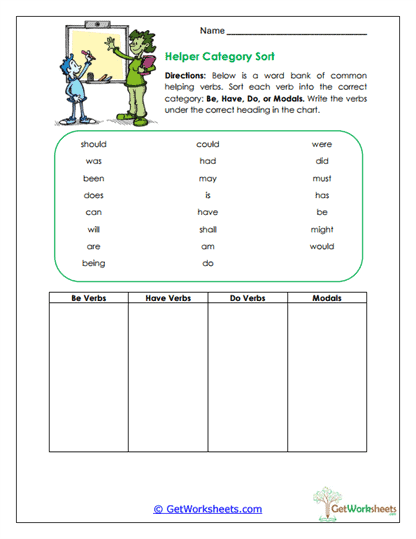
Helping Verb Sort
Students sort a list of auxiliary verbs into four groups: be verbs, have verbs, do verbs, and modals. This classification task helps learners recognize that not all helping verbs behave the same way and that each group plays a different role in building tense and meaning. As they organize the list, students practice analytical thinking and pattern recognition. The visual act of sorting supports deeper understanding of how verb families work across sentences. This worksheet creates a solid base for later work with more complex verb phrases.
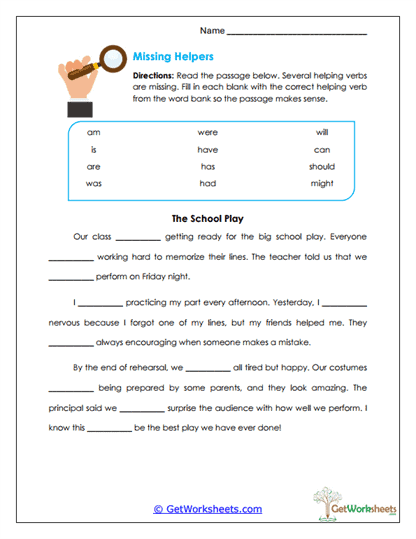
Missing Helpers Passage
Learners read a short passage in which several helping verbs have been removed and must choose appropriate auxiliaries from a word bank to complete it. The story format requires them to consider context, tense, and agreement for each blank. This integrated approach lets students practice grammar and reading comprehension at the same time. As they restore the missing helping verbs, they experience how auxiliaries keep narrative language smooth and precise. The activity gives valuable practice with grammar in authentic text rather than isolated examples.
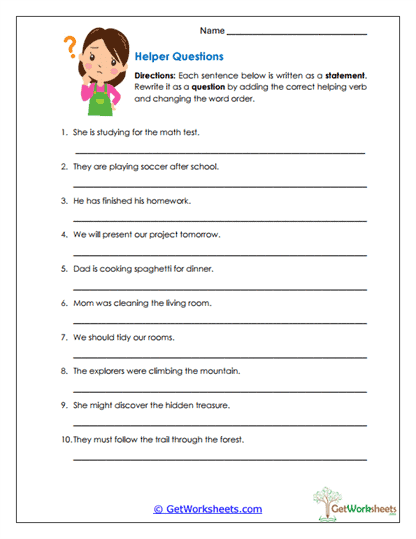
Helping Verb Questions
Students transform declarative sentences into questions by adding the correct helping verb and reversing word order. The worksheet includes present, past, and future contexts, giving learners broad exposure to interrogative structures. Through repeated practice, they internalize the role of auxiliaries in forming questions and master subject-verb inversion. This work directly supports speaking and listening skills as well, since accurate question formation is vital in real communication. It's a practical bridge between grammar knowledge and everyday language use.
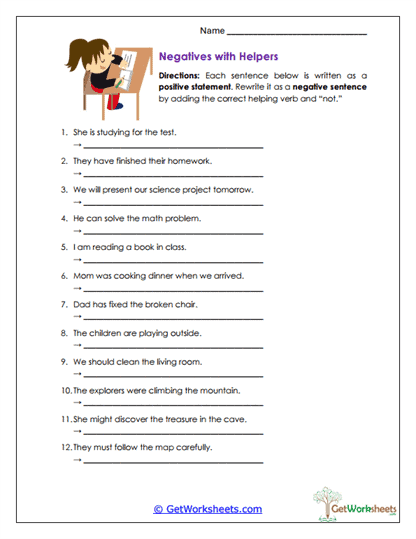
Negative Helper Sentences
Learners rewrite affirmative sentences as negative ones by inserting the appropriate helping verb and the word not. They must consider tense, subject-verb agreement, and meaning in order to choose do, does, did, a form of be, have, or a modal. This focused practice clarifies how auxiliary verbs behave in negative constructions. As students revise each sentence, they develop editing skills and gain confidence forming accurate negative statements. The worksheet also reinforces how small changes to the helper verb can significantly affect tone and clarity.
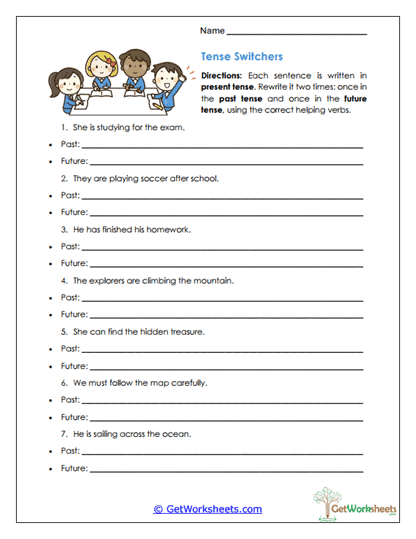
Tense Switching Practice
In this activity, students take present-tense sentences and rewrite each one twice-once in the past tense and once in the future-using correct helping verbs. They see clearly how auxiliaries signal shifts in time and aspect as they modify the verb phrase. The task introduces or reviews simple, progressive, and perfect forms depending on the context of the original sentence. This structured transformation work sharpens understanding of temporal relationships in writing. It also helps students maintain tense consistency while experimenting with more complex verb-phrase construction.
Bookmark Us Now!
New, high-quality worksheets are added every week! Do not miss out!