Fixing Bad AI Prompts Worksheets
-
Adapting Prompts for Audiences
-
Adding Missing Context
-
Adjusting Tone for Audience
-
-
Breaking Down Overloaded Prompts
-
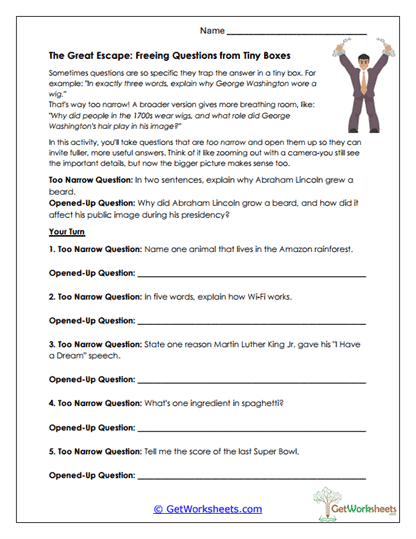
Broadening Narrow Questions
-
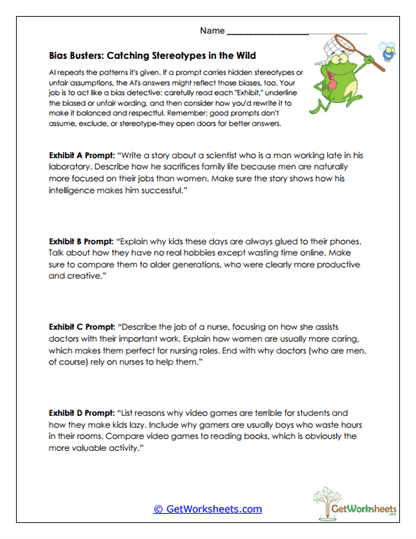
Identifying and Rewriting Bias
-
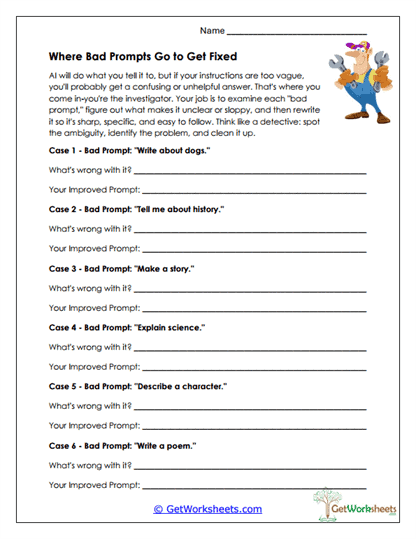
Improving Vague Prompts
-
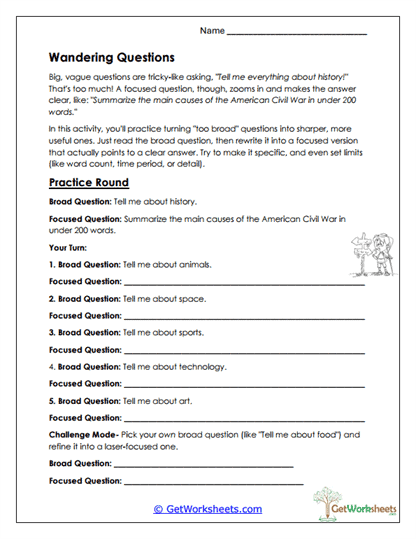
Narrowing Broad Questions
-
Polishing Placeholder Prompts
-
Ranking Prompt Clarity
-
Sequencing Clear Directions
-
Trimming Wordy Prompts
About This Worksheet Collection
The Fixing Bad AI Prompts collection empowers students to become thoughtful communicators by teaching them how to design clear, fair, and effective prompts. Each worksheet presents examples of weak or confusing directions and guides learners to analyze, correct, and refine them. Through hands-on rewriting tasks, students uncover what makes prompts vague, biased, overloaded, or incomplete-and learn strategies to fix those issues. The collection blends writing instruction with digital literacy, showing how clear communication improves both human expression and AI-generated responses.
As learners progress through these activities, they build a robust foundation in clarity, audience awareness, and precision. They strengthen their analytical and editing abilities by revising tone, structure, and specificity to improve purpose and readability. The exercises also promote ethical and responsible technology use, encouraging students to recognize bias and communicate with fairness and intent. Together, these lessons cultivate strong writers who understand that well-crafted language drives better outcomes-whether writing essays or prompting AI.
Detailed Descriptions Of These Worksheets
Improving Vague Prompts
Students identify weak, unclear prompts and rewrite them into specific, detailed directions. They analyze examples such as "Write about dogs" to determine what context or focus is missing. This task builds precision in communication and develops awareness of how detail shapes results. Learners practice editing for clarity and purpose while exploring how well-crafted prompts lead to stronger AI or written responses.
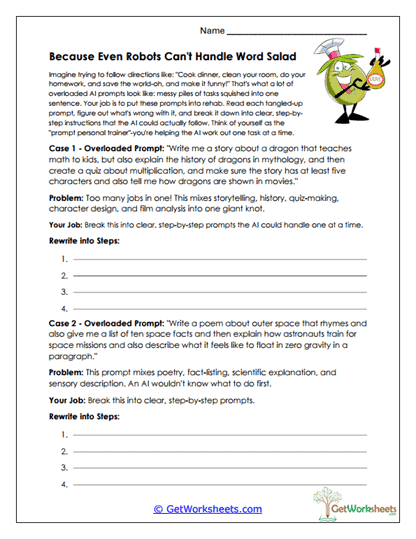
Breaking Down Overloaded Prompts
This activity teaches students how to simplify prompts that contain too many instructions at once. They learn to separate tangled requests into organized, step-by-step tasks. Through practice, learners build logical sequencing skills and understand how focused prompts produce more coherent outcomes. The worksheet reinforces critical thinking and clarity in both writing and technology communication.
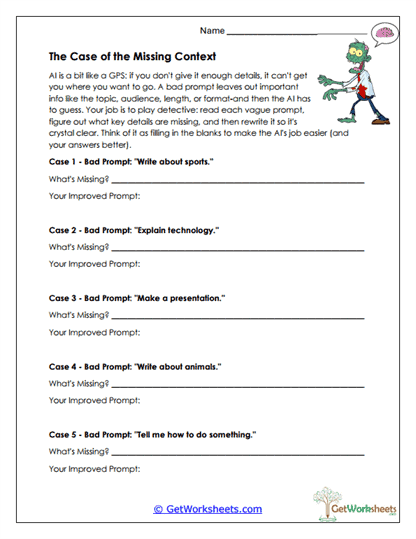
Adding Missing Context
Students analyze vague directions to determine which key details-like audience, purpose, or topic-are missing. They then rewrite each example to include the right context for understanding. This exercise promotes completeness and teaches how specificity improves communication accuracy. It enhances critical thinking, writing detail, and real-world awareness of how context shapes results.
Identifying and Rewriting Bias
In this thought-provoking worksheet, students uncover bias in prompts and rewrite them to be fair and inclusive. They explore how certain words or assumptions can lead to unbalanced results and practice replacing them with objective phrasing. The activity builds empathy, awareness, and ethical communication. Learners gain tools to create language that is equitable and respectful in both writing and AI inputs.
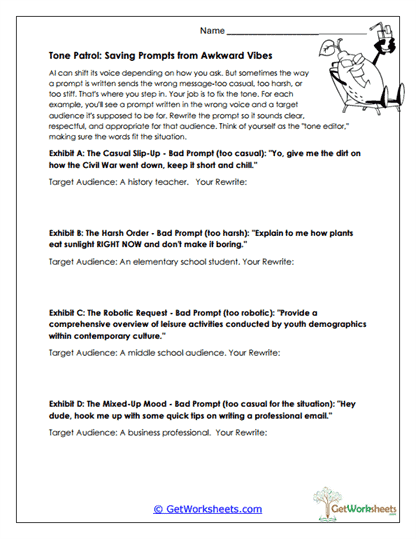
Adjusting Tone for Audience
Students examine prompts written in inappropriate tones and edit them to better suit their intended audience. By shifting between formal, casual, or professional language, they develop sensitivity to tone and voice. The exercise enhances audience awareness, stylistic control, and communication adaptability-skills that transfer seamlessly from classroom writing to real-world interaction.
Narrowing Broad Questions
Learners take overly general questions and refine them into clear, answerable versions. Each example guides students to add focus points, constraints, or key details to strengthen the question's purpose. This task cultivates precision in inquiry and teaches how narrowing scope improves both comprehension and responses. It's ideal for developing critical questioning and research skills.
Broadening Narrow Questions
This companion worksheet challenges students to expand overly limited prompts to invite deeper thought. They practice revising questions to encourage broader exploration and discussion. By comparing narrow and open-ended examples, learners strengthen their flexibility and critical analysis. The activity supports growth in writing development and communication depth.
Sequencing Clear Directions
Students reorganize jumbled instructions into logical, step-by-step order. The activity improves sequencing, comprehension, and procedural writing. Learners practice giving clear directions for everyday tasks, reinforcing the importance of structure in communication. It's a practical lesson in organizing ideas for both readers and AI systems.
Ranking Prompt Clarity
In this evaluative exercise, learners rank several prompts from weakest to strongest. They compare detail, clarity, and answerability to determine which is most effective. The process develops analytical reasoning and metacognitive reflection on writing quality. Students gain insight into what makes a prompt strong and actionable.
Polishing Placeholder Prompts
Students complete unfinished prompts containing blanks or placeholders, filling them with meaningful details to make them usable. This exercise encourages creativity and critical word choice. Learners refine general ideas into precise statements, strengthening editing skills and writing focus. The result is polished, specific prompts ready for real communication or AI input.
Trimming Wordy Prompts
In this editing-focused worksheet, students condense lengthy prompts into concise, clear versions. They must preserve meaning while reducing unnecessary words. The exercise develops summarization, clarity, and attention to essential ideas. Learners gain confidence in writing efficiently and expressing complex thoughts simply.
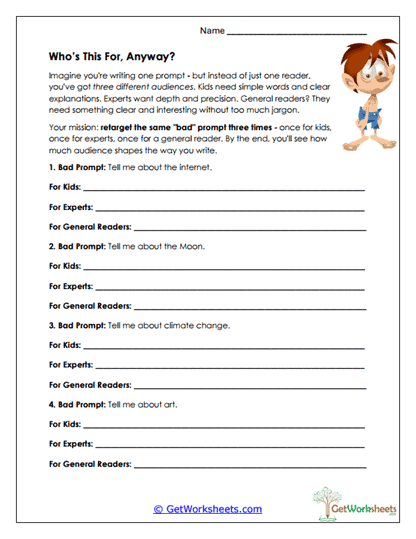
Adapting Prompts for Audiences
Students practice rewriting the same prompt for multiple audiences-children, experts, or general readers. This task deepens understanding of tone, vocabulary, and context. By adjusting purpose and style, learners enhance their control over communication and audience engagement. The worksheet encourages flexibility, empathy, and mastery of audience-based writing.
Bookmark Us Now!
New, high-quality worksheets are added every week! Do not miss out!