Earth's Rotation and Revolution Worksheets
About This Worksheet Collection
The Earth's Rotation and Revolution collection helps students understand the motions that shape time, light, and life on our planet. Through engaging readings, visual models, vocabulary challenges, and creative applications, learners explore how Earth's spinning and orbiting produce day, night, and the changing seasons. Each worksheet builds scientific literacy by connecting abstract astronomical ideas to observable natural patterns.
The collection promotes interdisciplinary learning that merges science, geography, math, and language skills. From calculating time zones to illustrating orbit paths, students develop inquiry-based reasoning, spatial awareness, and conceptual clarity. These activities make the study of planetary motion both accessible and exciting by linking real-world observations-like shifting shadows and seasonal changes-to Earth's cosmic movements.
Detailed Descriptions Of These Worksheets
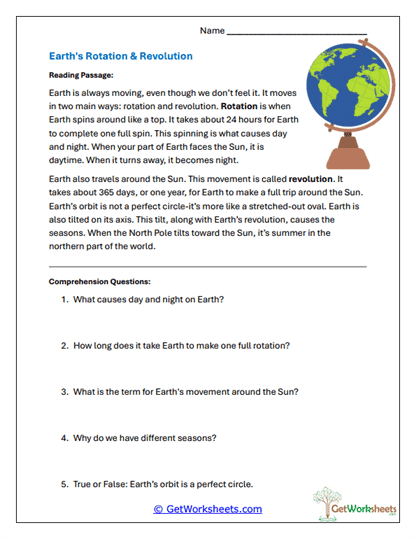
Days and Years
Students read a clear explanation of how Earth's rotation and revolution create the cycles of day, night, and seasons. The passage introduces concepts like axial tilt and orbital path, connecting them to observable effects such as sunlight variation. Learners answer comprehension questions to demonstrate understanding. The activity reinforces vocabulary and scientific reasoning about planetary motion.
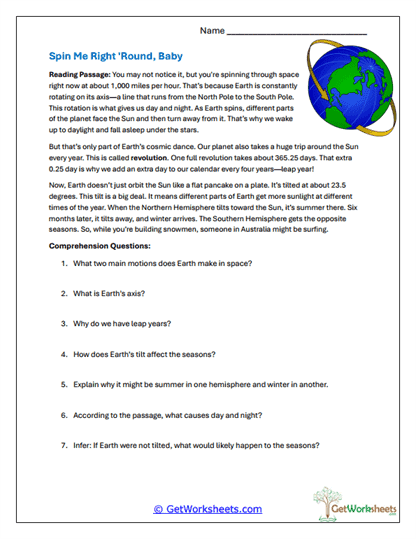
Spin Me Right 'Round
Learners explore how Earth's rotation speed and orbit shape day length, weather, and seasonal shifts. The passage connects measurable facts like Earth's tilt and revolution time to real-world examples such as leap years. Comprehension questions encourage inferencing and cause-and-effect analysis. The worksheet builds analytical reading and applied science understanding.
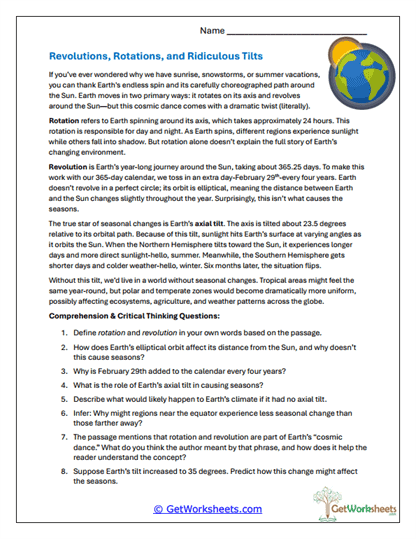
Revolutions, Rotations, and Tilts
Students deepen their understanding of how sunlight and Earth's tilt affect seasonal differences through an advanced informational passage. The questions require synthesis and explanation of axial tilt, day length, and temperature change. Learners apply precise scientific vocabulary in written responses. This higher-level task promotes critical thinking and conceptual mastery.
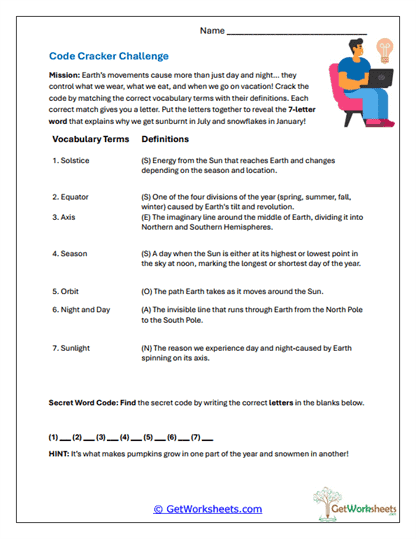
Code Cracker Challenge
In this puzzle-style activity, students decode science terms like orbit, solstice, and axis by matching definitions to clues that reveal a secret word. The challenge combines vocabulary practice with critical reasoning. Learners strengthen comprehension of Earth science terminology while enjoying an interactive problem-solving format. It supports both language development and conceptual recall.
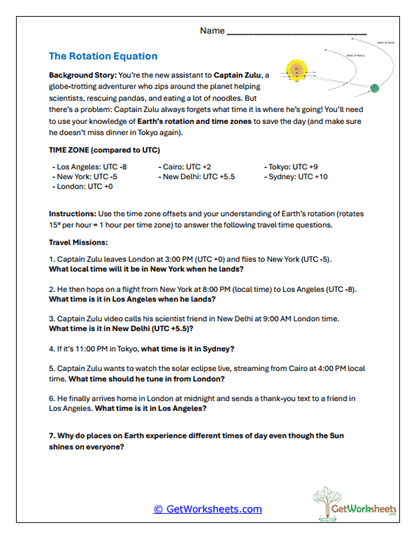
The Rotation Equation
Students apply their understanding of Earth's 24-hour rotation to solve global time-zone problems in a travel scenario. Using data and logic, they calculate time differences between cities as Earth rotates 15° per hour. The real-world context connects science to geography and math. This worksheet reinforces quantitative reasoning and spatial understanding of planetary motion.
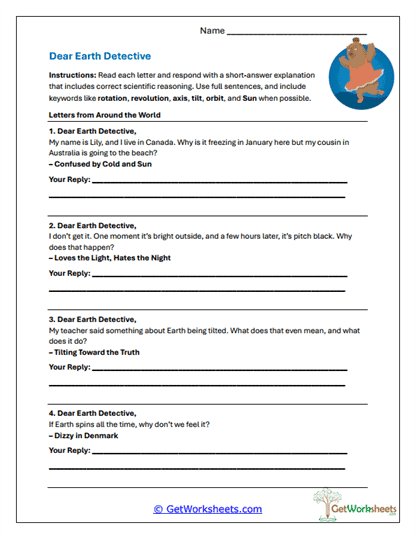
Dear Earth Detective
Learners respond to fictional letters from around the world asking about seasons and time differences. They write scientific explanations using terms like rotation and revolution to clarify misconceptions. The activity promotes evidence-based reasoning and clear written communication. It encourages curiosity and global awareness through science inquiry.
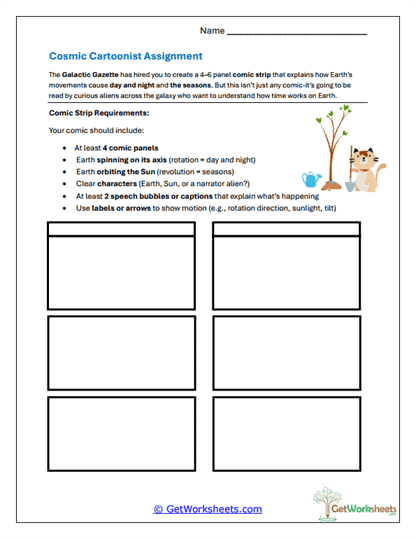
Cosmic Cartoonist Assignment
Students design a comic strip illustrating Earth's spinning and orbiting around the Sun. Each panel depicts key motions with labeled captions showing how they create day, night, and seasons. The creative format integrates art and science, strengthening retention through visual storytelling. Learners demonstrate understanding of astronomical cycles in an expressive way.
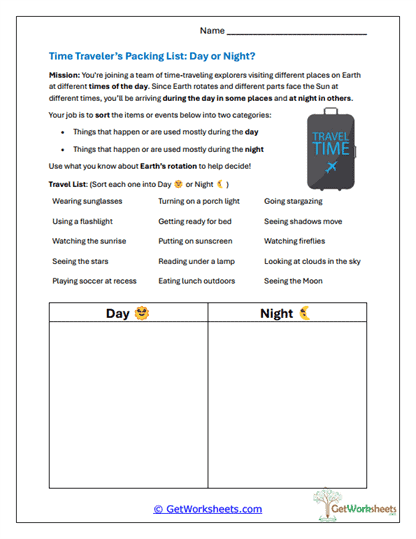
Time Traveler's Packing List
In this sorting game, students classify items and activities as belonging to "Day" or "Night" based on their knowledge of Earth's rotation. The task links science to daily experience, promoting practical comprehension. It also strengthens reasoning and classification skills. The relatable context makes the concept of day-night cycles engaging and memorable.
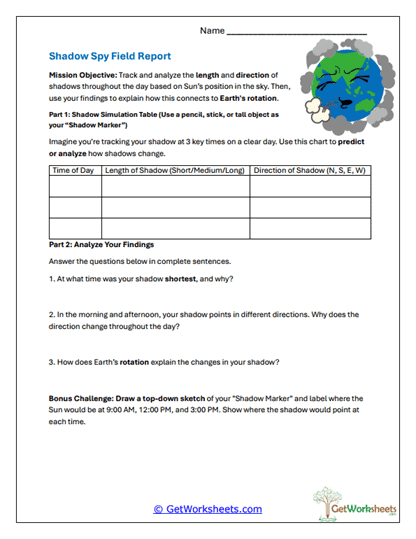
Shadow Spy Field Report
Students record and analyze how shadows change position and length throughout the day. They use observations to explain how Earth's rotation causes these shifts. The worksheet develops data collection, analysis, and scientific explanation skills. A drawing challenge reinforces visual reasoning and understanding of the Sun's movement across the sky.
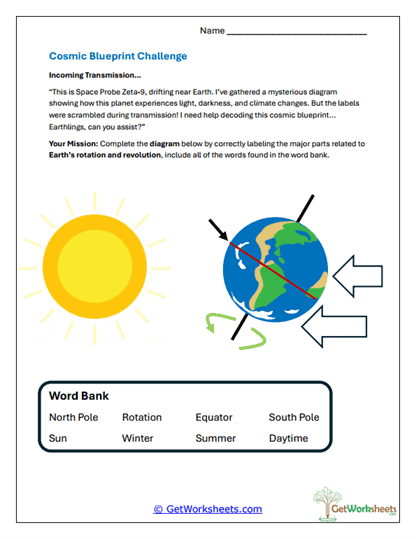
Cosmic Blueprint Challenge
Learners label a diagram showing Earth's rotation, revolution, and sunlight distribution using a provided word bank. The activity enhances vocabulary recall and diagram interpretation. Students visualize spatial relationships between the equator, poles, and orbit. This hands-on labeling task promotes understanding of how motion affects temperature and daylight.
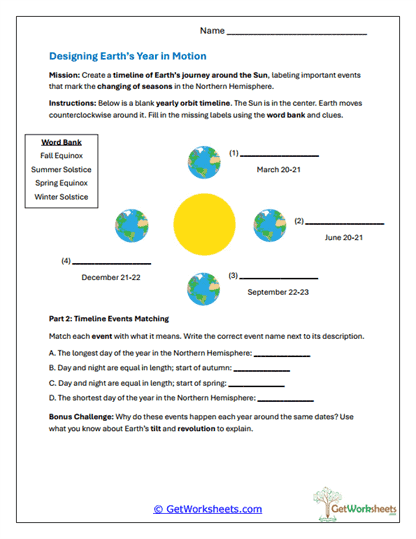
Designing Earth's Year in Motion
Students create a labeled timeline and orbital diagram marking solstices and equinoxes around Earth's revolution. They match each event to its seasonal meaning and daylight pattern. This exercise builds comprehension of cyclical astronomical patterns. Learners connect diagram analysis with reasoning about sunlight and the tilt of Earth's axis.
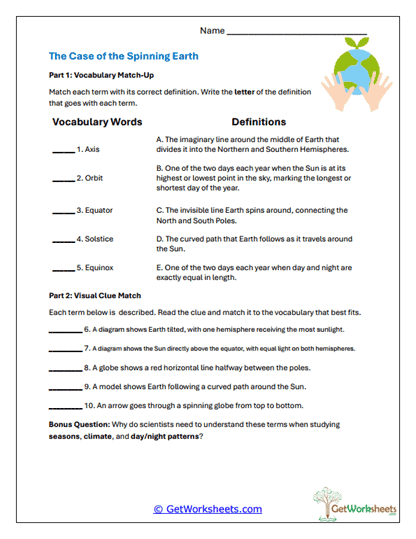
The Case of the Spinning Earth
This two-part worksheet combines vocabulary identification with diagram interpretation. Students match scientific terms like equinox, orbit, and axis to definitions, then apply them to visual cues describing Earth's movement. A reflection question ties these ideas to climate and seasonal change. The activity strengthens conceptual vocabulary and analytical thinking.
Bookmark Us Now!
New, high-quality worksheets are added every week! Do not miss out!