Dialogue Writing Worksheets
About This Worksheet Collection
This Dialogue Writing worksheet collection helps students master the skills needed to write clear, expressive, and meaningful conversations in narratives. Through activities focused on mechanics, character voice, action beats, mood, subtext, and thematic expression, students learn how dialogue functions as more than just spoken words-it builds character, advances plot, establishes mood, and reveals hidden meaning.
The worksheets guide learners from foundational skills, such as proper punctuation and identifying internal thoughts, to advanced narrative techniques like managing multi-character conversations and crafting subtext-driven exchanges. By practicing clear formatting, refining tone, adding movement, and exploring deeper emotional layers, students gain confidence in writing dialogue that feels natural, purposeful, and engaging.
Detailed Descriptions Of These Worksheets
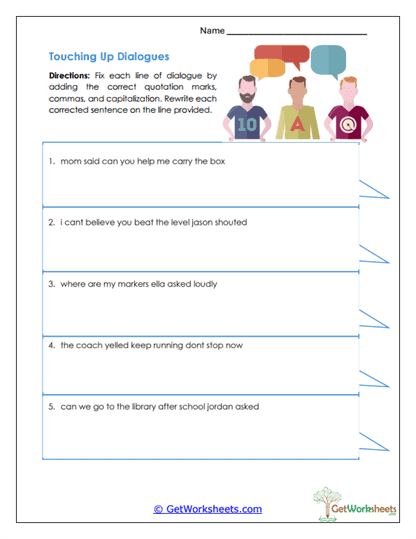
Dialogue Fix-Up
Students correct improperly formatted dialogue by fixing punctuation, capitalization, and quotation marks. This exercise teaches essential dialogue conventions and strengthens proofreading skills. Learners gain confidence in writing clear, correctly punctuated conversations that follow narrative standards.
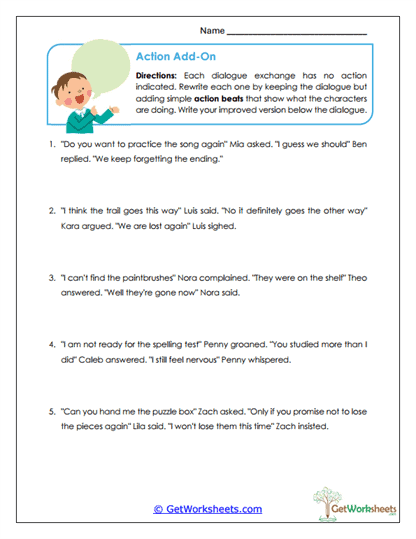
Action Add-On
Students enhance plain dialogue by adding action beats that show what characters are doing as they speak. This activity improves pacing and characterization while reducing overuse of "said." It teaches learners how subtle physical actions make dialogue more dynamic and expressive.
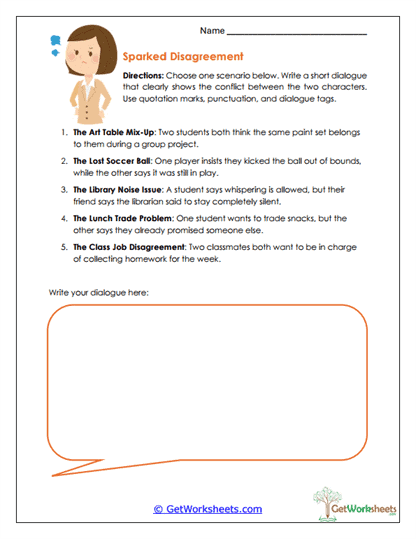
Sparked Disagreements
Learners choose a conflict scenario and write a short dialogue showing tension through tone, word choice, and interaction. The activity develops skills in writing conflict-driven conversations and helps students show emotion indirectly. It also reinforces correct dialogue formatting.
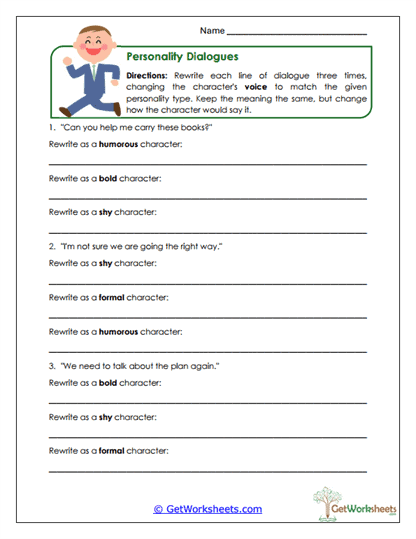
Personality Dialogue Rewrites
Students rewrite the same line in different character voices-humorous, bold, shy, or formal. This strengthens understanding of how tone and voice reflect personality. Learners practice crafting dialogue that feels authentic and unique to each character.
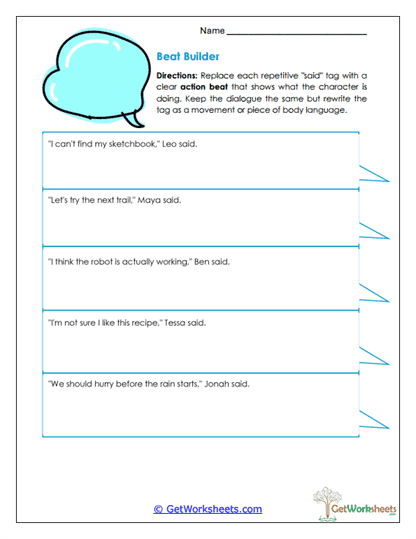
Beat Builder
Students replace basic "said" tags with meaningful action beats that reveal behavior or emotion. This task shows how action can communicate tone and intent more effectively than repeated dialogue tags. It enriches scene flow and improves descriptive variation.
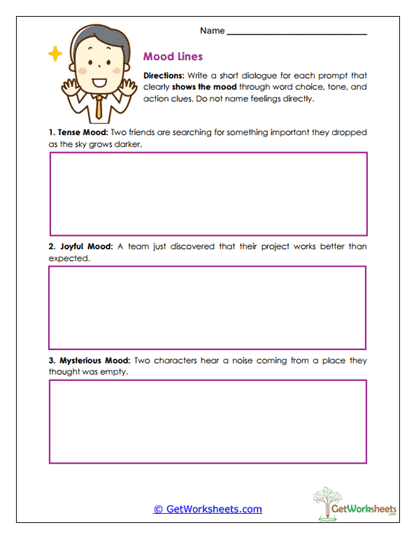
Mood Lines
Learners write dialogues that express moods-tense, joyful, mysterious-without explicitly naming emotions. They use tone, word choice, and action to imply atmosphere. This activity deepens skill in subtle emotional expression and mood creation through dialogue.
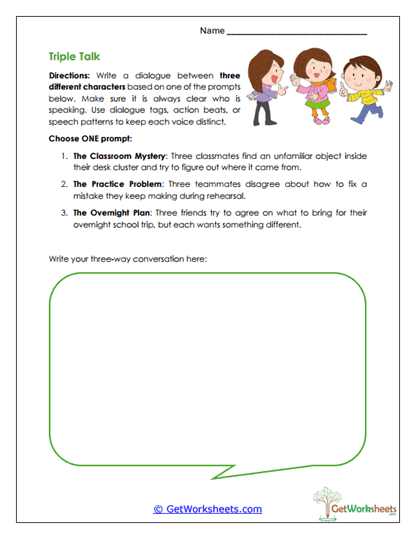
Triple Talk
Students create a conversation among three characters, keeping each voice distinct through speech patterns, tags, and actions. This worksheet teaches clarity in multi-character dialogue and strengthens pacing, interaction, and conversational structure.
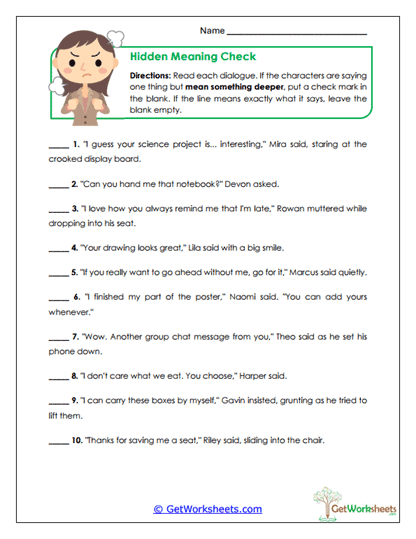
Hidden Meaning Check
Students analyze lines of dialogue to identify whether characters imply deeper meaning through sarcasm, understatement, or subtext. This strengthens inferential thinking and close reading. Learners develop awareness of how characters communicate beyond literal words.
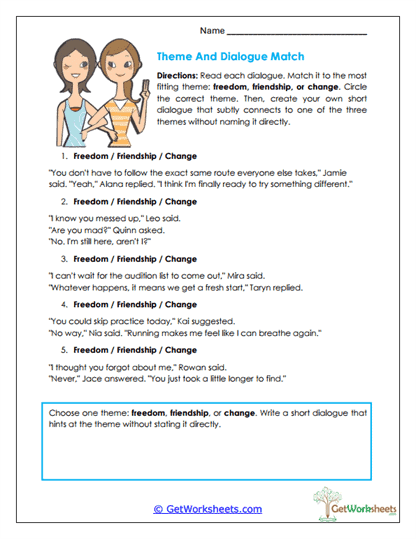
Theme Dialogue Match
Learners match sample dialogues to themes-freedom, friendship, or change-then write their own theme-driven conversation. This reinforces understanding of theme and teaches students to express deeper ideas through character interactions.
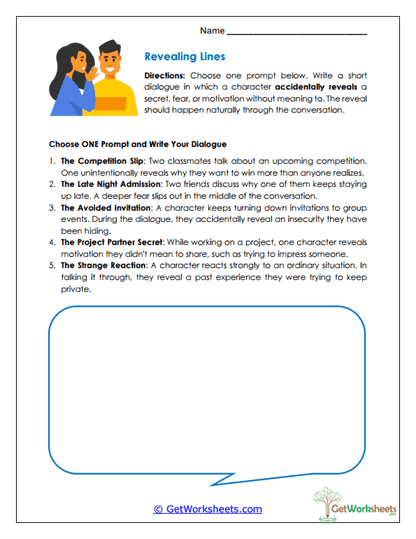
Revealing Lines
Students write a dialogue in which a character accidentally reveals an emotion or secret through natural conversation. This teaches subtext, character motivation, and meaningful scene development. It encourages narrative realism and nuanced communication.
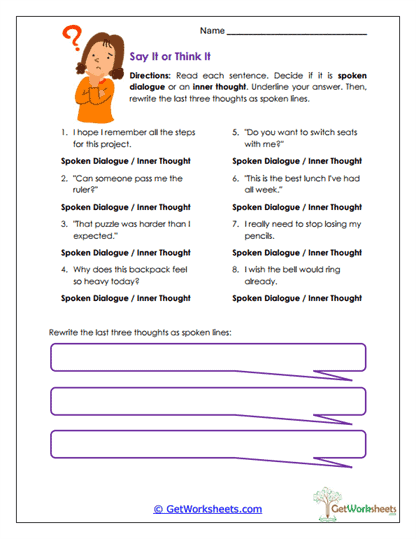
Say It or Think It
Learners distinguish between internal thoughts and spoken dialogue, then rewrite selected thoughts as spoken lines. This builds clarity in narrative communication and strengthens understanding of when characters think privately versus speak aloud.
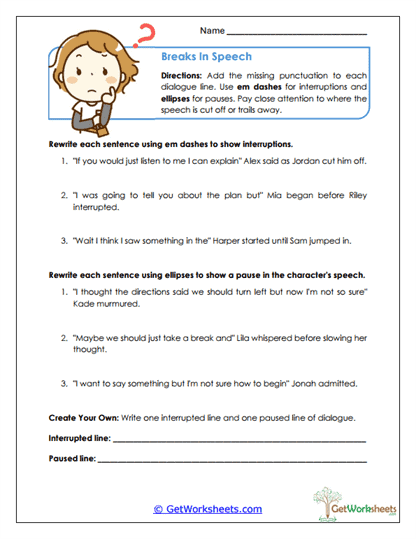
Breaks in Speech
Students practice punctuating interruptions and pauses using em dashes and ellipses. They rewrite sample lines and create original examples, learning how punctuation reflects natural speech patterns. This enhances dialogue realism, rhythm, and tone.
Bookmark Us Now!
New, high-quality worksheets are added every week! Do not miss out!