Density Worksheets
About This Worksheet Collection
The Density worksheet collection provides an in-depth exploration of one of the most important quantitative relationships in physical science-how mass, volume, and density interact to define the properties of matter. These resources guide students from foundational calculations to advanced applications involving mixtures, graphs, and real-world experimentation. Designed for both classroom and lab use, the collection blends mathematical rigor with conceptual inquiry, helping learners understand not just how to compute density, but what it reveals about materials, buoyancy, and physical behavior.
Through hands-on data work, problem-solving, and critical reasoning, students gain proficiency in applying formulas, interpreting graphs, and drawing conclusions from experimental results. Each worksheet reinforces precision, unit consistency, and the ability to connect mathematical models with observable science. By completing this series, learners develop both the technical fluency and the scientific mindset necessary for success in physics, chemistry, and engineering.
Detailed Descriptions Of These Worksheets
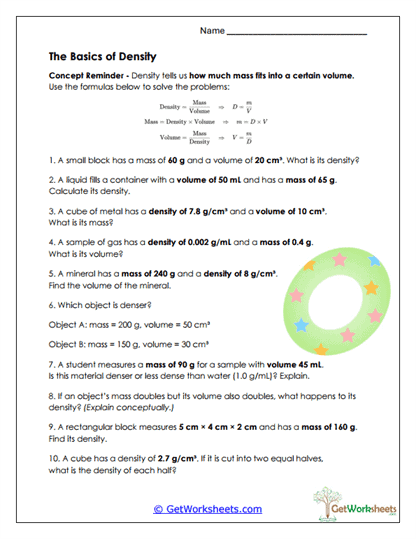
Basics of Density
Students calculate density using the standard formula and its rearrangements to solve for mass and volume. The activity strengthens computational accuracy and unit fluency while exploring how changes in mass or volume affect overall density. Learners build foundational reasoning about material properties and practice applying formulas across varied examples.
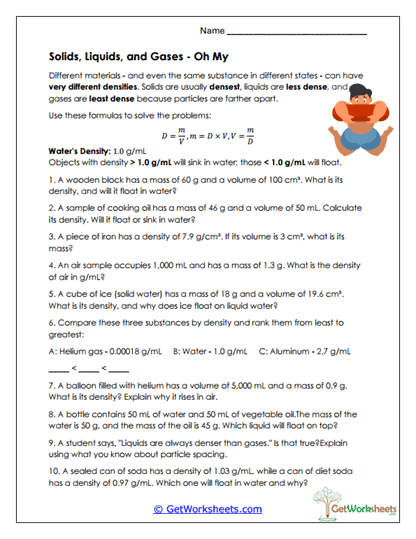
States and Density
This worksheet compares the densities of solids, liquids, and gases to show how particle spacing influences material behavior. Students compute densities, predict floating or sinking, and arrange materials by relative density. It develops both mathematical reasoning and conceptual understanding of buoyancy and matter's physical states.
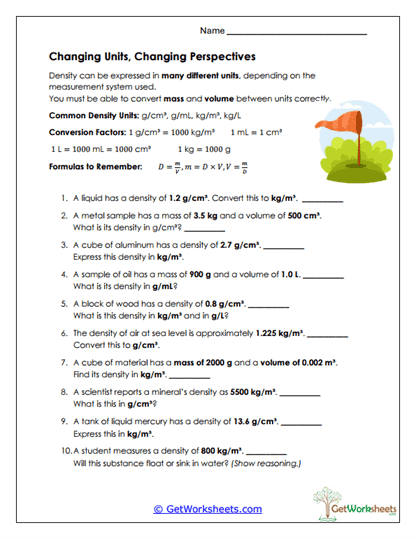
Unit Conversion Practice
Learners convert between different density units such as g/cm³, kg/m³, and kg/L. Through applied problems, they refine conversion skills, reinforce consistency in measurement systems, and integrate math with science. The task promotes analytical precision and a deeper appreciation for standardized units in data reporting.
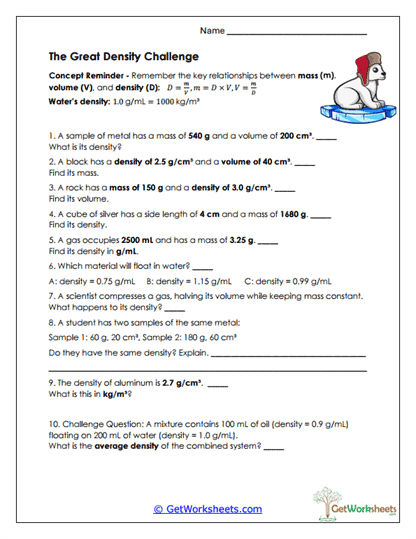
Density Challenge
In this higher-level problem set, students tackle multistep questions that combine density with mass, volume, and proportional relationships. They analyze mixed materials, compound systems, and conceptual patterns. The challenge enhances algebraic reasoning, logical thinking, and mastery of quantitative problem-solving in scientific contexts.
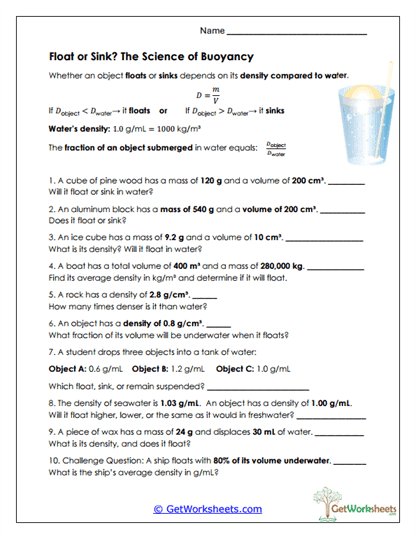
Float or Sink
Students predict floating behavior by comparing densities to that of water, determining which objects rise, sink, or stay suspended. The exercise introduces fractional submersion and density ratios as predictors of buoyancy. Learners connect numerical calculation with physical observation, bridging math and fluid mechanics.
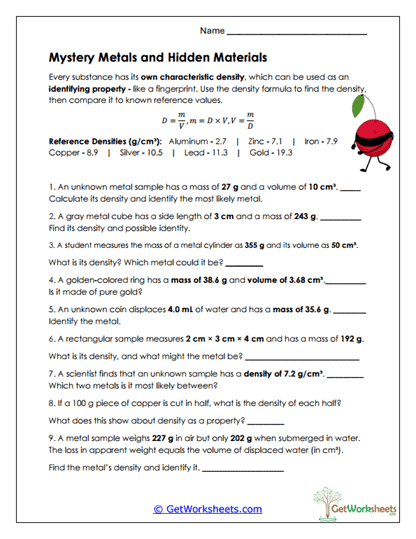
Identifying Metals
This worksheet transforms density into a diagnostic tool for classifying unknown substances. Students compute sample densities, compare them to reference tables, and draw evidence-based conclusions. It promotes scientific inquiry and reinforces the concept that density is a characteristic property of matter.
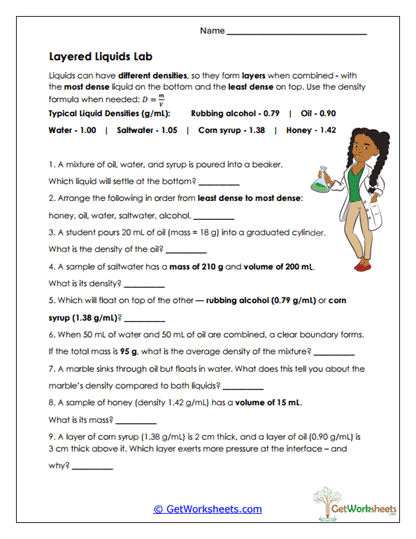
Layered Liquids
Learners analyze how liquids with different densities arrange themselves into visible layers. They calculate values, predict stacking order, and justify conclusions using scientific reasoning. The activity visualizes density in a tangible way, strengthening data interpretation and cause-and-effect understanding in fluid systems.
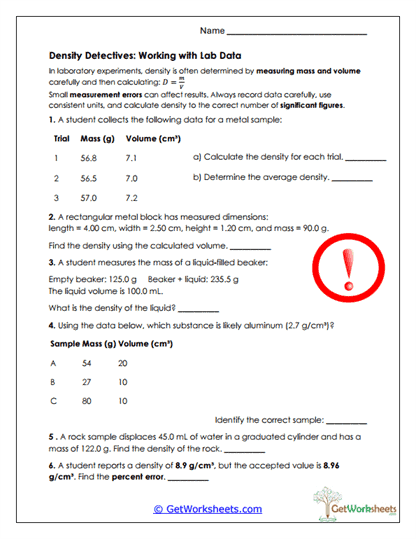
Density Lab Data
Students interpret experimental data to calculate densities, find averages, and discuss precision and error sources. This lab-style worksheet reinforces scientific accuracy and critical thinking. Learners connect quantitative results with concepts of data reliability and material identification in real investigations.
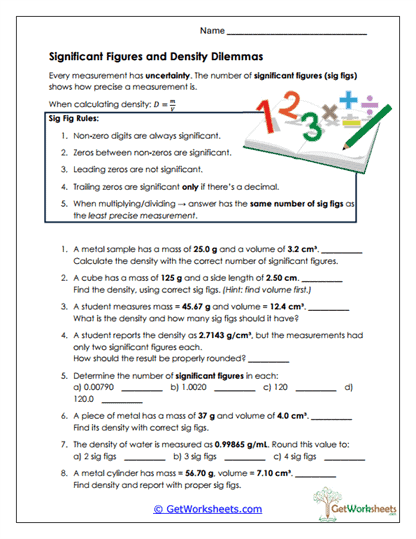
Significant Figures
This exercise focuses on numerical precision by teaching students to identify, count, and apply significant figures in density calculations. Learners practice rounding rules and consistent data reporting. It cultivates attention to detail and highlights the importance of measurement accuracy in laboratory science.
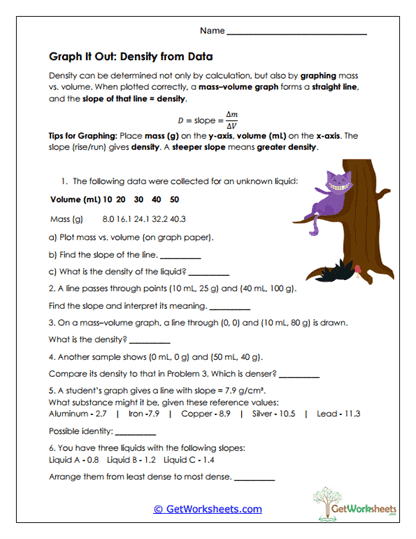
Graphing Density
Students graph mass and volume data to calculate density from the slope of a best-fit line. The activity integrates math and science by linking graphical interpretation with the density formula. Learners enhance data visualization, recognize patterns, and understand how linear relationships reveal material properties.
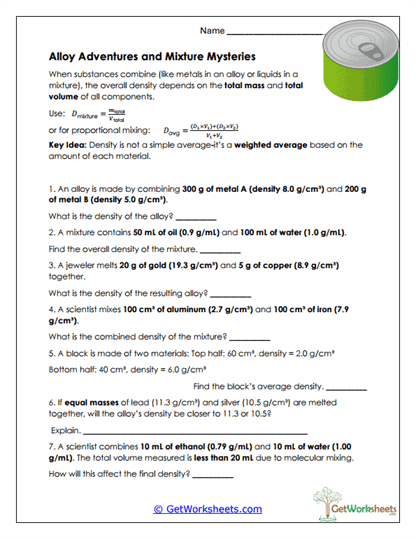
Alloy Mixtures
Learners compute the combined density of mixed materials such as alloys or liquid blends. They use weighted averages and proportional reasoning to analyze how mass and volume determine final density. The worksheet builds advanced problem-solving skills while demonstrating how composition affects physical properties.
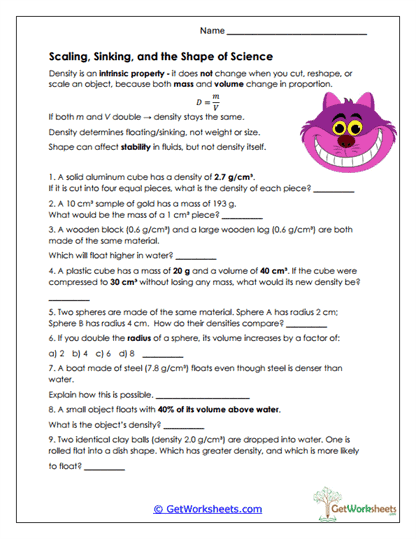
Shape and Density
This conceptual worksheet clarifies that density remains constant regardless of object shape or size. Students solve problems involving scaling, submerged volume, and buoyancy to distinguish between density and shape effects. The activity connects geometry and physics, deepening understanding of intrinsic properties and real-world buoyancy phenomena.
Bookmark Us Now!
New, high-quality worksheets are added every week! Do not miss out!